Wire Harness Acceptance Criteria: What IPC/WHMA-A-620 Means for OEM Buyers
Selecting a wire harness supplier is about more than price, lead time, or production capacity. OEM buyers also need confidence that every harness is manufactured to consistent quality standards.
This is where IPC/WHMA-A-620, the world’s most widely recognized standard for cable and wire harness assemblies, becomes an important reference. Rather than defining product design requirements, it establishes acceptance criteria for workmanship, inspection, testing, and manufacturing quality.
Understanding what IPC/WHMA-A-620 covers helps OEM buyers evaluate suppliers more effectively, reduce quality risks, and ensure long-term product reliability.
What Is IPC/WHMA-A-620?
IPC/WHMA-A-620 is the industry standard that defines the requirements and acceptance criteria for cable and wire harness assemblies.
Developed jointly by IPC and the Wire Harness Manufacturer’s Association (WHMA), the standard provides a common language for manufacturers, OEMs, inspectors, and quality engineers.
It covers a wide range of manufacturing requirements, including:
- Wire preparation
- Crimp termination
- Soldered connections
- Connector assembly
- Insulation quality
- Harness routing
- Identification and labeling
- Inspection requirements
- Electrical testing
Instead of relying on subjective judgments, manufacturers and customers can evaluate harness quality against consistent, internationally recognized criteria.
Why OEM Buyers Should Care About Acceptance Criteria
A harness may pass an electrical continuity test but still contain workmanship defects that shorten its service life.
Examples include:
- Damaged insulation
- Incorrect crimp dimensions
- Incomplete terminal insertion
- Excessive exposed conductor
- Improper strain relief
- Poor cable routing
These defects may not cause immediate failure but can reduce long-term reliability, especially in industrial automation, medical devices, transportation, and energy storage systems.
IPC/WHMA-A-620 helps prevent these issues by defining acceptable workmanship before products leave the factory.
Acceptance Criteria Go Beyond Visual Inspection
Many buyers assume acceptance criteria simply refer to appearance.
In reality, the standard evaluates multiple aspects of assembly quality.
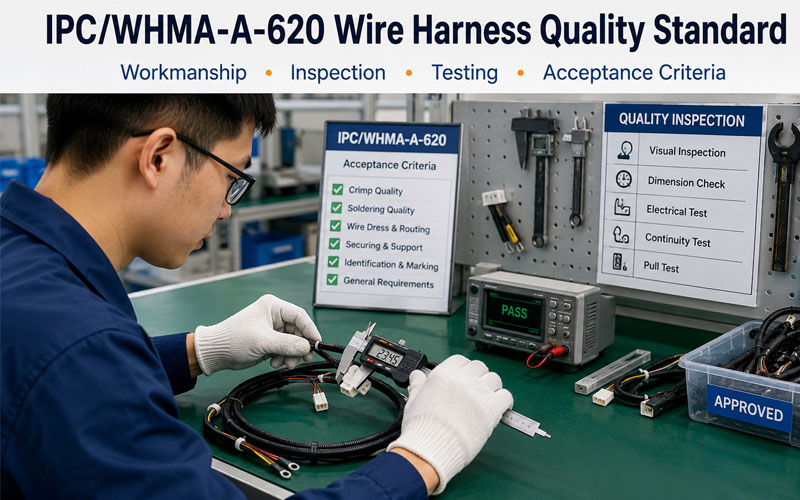
Typical inspection items include:
- Crimp quality
- Wire strip length
- Terminal positioning
- Connector locking
- Insulation support
- Cable protection
- Label accuracy
- Harness dimensions
Inspection verifies not only whether the harness works today, but whether it has been manufactured correctly for reliable long-term operation.
Understanding Product Classes
IPC/WHMA-A-620 classifies products according to their required reliability level.
Class 1
General consumer products where occasional performance degradation is acceptable.
Examples:
- Household appliances
- Consumer electronics
Class 2
Products requiring reliable performance throughout their expected service life.
Examples:
- Industrial automation
- Commercial equipment
- Communication systems
Class 3
High-performance products where continuous operation is critical and failure is unacceptable.
Examples:
- Medical devices
- Aerospace equipment
- Military systems
- Safety-critical industrial controls
OEM buyers should ensure suppliers understand which product class applies to their project.
Crimp Quality Is One of the Most Important Requirements
Poor crimping remains one of the leading causes of wire harness failures.
IPC/WHMA-A-620 evaluates:
- Proper conductor insertion
- Correct insulation support
- Crimp height
- Wire strand integrity
- Terminal deformation
- Mechanical strength
Manufacturers often combine these requirements with pull-force testing and crimp cross-section analysis to verify process stability.
Inspection Alone Is Not Enough
Final inspection cannot compensate for inconsistent manufacturing processes.
Leading wire harness manufacturers build quality into production through:
- Standardized work instructions
- Calibrated crimping equipment
- Operator training
- Process validation
- Automated inspection
- Statistical process control (SPC)
- 100% electrical testing
A controlled manufacturing process produces consistent quality long before the final inspection stage.
Questions OEM Buyers Should Ask Their Harness Supplier
When evaluating a cable assembly manufacturer, buyers should ask questions such as:
- Do you manufacture according to IPC/WHMA-A-620?
- Which product classes do you support?
- How do you verify crimp quality?
- Do you perform 100% electrical testing?
- What inspection equipment is used?
- Is production traceable?
- How are operators trained and certified?
- How are nonconforming products controlled?
These questions provide valuable insight into a supplier’s quality management system.
How FPIC Supports High-Quality Wire Harness Manufacturing
FPIC manufactures customized wire harnesses and cable assemblies for industrial automation, energy storage systems, robotics, medical equipment, and other demanding applications.
Our manufacturing process emphasizes standardized workmanship, calibrated production equipment, automated inspection, comprehensive quality control, and 100% electrical testing. By following internationally recognized manufacturing practices, we help customers achieve consistent product quality and reliable field performance across high-volume production.
Final Thoughts
For OEM buyers, IPC/WHMA-A-620 is more than a manufacturing standard—it is a practical tool for evaluating supplier capability and product quality.
A supplier that understands and applies recognized acceptance criteria is more likely to deliver consistent workmanship, fewer field failures, and lower lifecycle costs.
When selecting a wire harness manufacturer, evaluating quality systems is just as important as comparing pricing or production capacity.
FAQ
What is IPC/WHMA-A-620?
IPC/WHMA-A-620 is the internationally recognized standard that defines acceptance criteria and workmanship requirements for cable and wire harness assemblies.
Does IPC/WHMA-A-620 specify wire harness design?
No. The standard focuses on manufacturing quality, workmanship, inspection, and acceptance criteria rather than electrical or mechanical product design.
Why is IPC/WHMA-A-620 important for OEM buyers?
It provides objective quality standards that help buyers evaluate suppliers, improve manufacturing consistency, and reduce product quality risks.
What types of defects does the standard address?
It covers issues such as improper crimping, damaged insulation, incorrect wire stripping, poor connector assembly, labeling errors, and workmanship defects.
Does compliance guarantee a reliable wire harness?
Compliance significantly improves manufacturing consistency, but long-term reliability also depends on proper design, material selection, environmental protection, and application-specific testing.
Looking for a Reliable Wire Harness Manufacturing Partner?
FPIC provides custom wire harnesses and cable assemblies for industrial automation, energy storage, robotics, medical devices, and other demanding industries. Our standardized manufacturing processes, automated inspection, and comprehensive electrical testing help ensure consistent quality from prototype to mass production.
Contact FPIC today to discuss your wire harness manufacturing requirements.
Resources
- IPC/WHMA-A-620 – Requirements and Acceptance for Cable and Wire Harness Assemblies
https://www.ipc.org/
The industry’s primary standard defining workmanship and acceptance criteria for cable and wire harness assemblies. - WHMA – Wire Harness Manufacturer’s Association
https://www.whma.org/
Provides technical resources, industry guidance, and best practices for wire harness manufacturing and quality management. - IPC – Training and Certification Programs
https://www.ipc.org/
Information on IPC standards, certification programs, and quality requirements for electronics manufacturing. - UL Solutions – Wire Harness Safety and Certification
https://www.ul.com/
Technical resources covering wire harness safety, certification, and electrical reliability requirements. - IEC 60364 – Low-Voltage Electrical Installations
https://webstore.iec.ch/
International standard for safe electrical installation practices relevant to cable assemblies and electrical connections.