How to Prevent Seal Failure in Waterproof Wire Harness Assemblies
Waterproof wire harness assemblies are widely used in automotive, agricultural, marine, construction, and energy storage applications. Their primary purpose is to keep moisture, dust, and contaminants away from electrical contacts.
However, many field failures are not caused by the connector itself, but by seal-related issues that allow water to enter the system over time.
Even a connector with an IP67 or IP69K rating can fail if seals are damaged, improperly installed, or exposed to conditions beyond their design limits.
This article explains the most common causes of seal failure and practical strategies to improve long-term sealing reliability.
Why Seal Integrity Matters
Seals are the first line of defense against environmental exposure.
When sealing performance degrades, the consequences may include:
- corrosion of terminals
- increased contact resistance
- insulation degradation
- leakage current
- intermittent failures
- complete system shutdown
Because water ingress often develops gradually, the root cause may remain hidden until failures become severe.
Common Types of Seals in Wire Harness Assemblies
Typical sealing elements include:
- wire seals
- interface seals
- grommets
- overmolded seals
- backshell seals
Each component protects a different path where contaminants could enter.
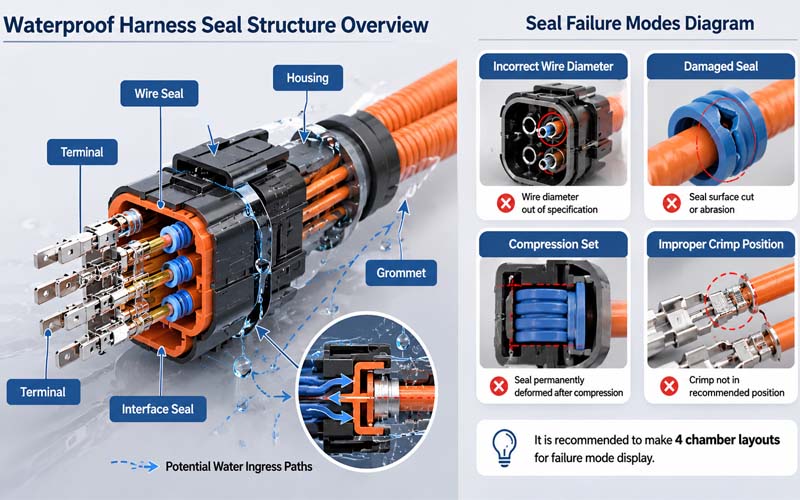
The Most Common Causes of Seal Failure
1.Incorrect Wire-to-Seal Match
Wire seals are designed for specific insulation diameter ranges.
If the wire diameter is too small:
- insufficient compression occurs
- sealing performance is reduced
If too large:
- seal damage may occur during assembly
Correct wire and seal matching is essential.
2.Seal Damage During Assembly
Seals can be damaged by:
- sharp wire edges
- improper insertion tools
- excessive insertion force
- lack of lubrication (when permitted)
Small cuts or tears may not be visible but can significantly reduce sealing effectiveness.
3.Improper Crimp Position
If the terminal crimp is positioned incorrectly, the seal may not sit properly inside the connector cavity.
This can create leakage paths.
4.Material Incompatibility
Seal materials must withstand:
- temperature extremes
- chemicals and oils
- UV exposure
- long-term compression
Common materials include silicone, EPDM, and fluorocarbon elastomers.
Improper material selection may lead to swelling, hardening, or cracking.
5.Compression Set
Over time, elastomer seals may lose their ability to recover after compression.
This permanent deformation is known as compression set.
Excessive compression set reduces sealing force and increases leakage risk.
6.Improper Connector Orientation
If connectors are installed where water accumulates, prolonged exposure can exceed seal capability.
Good system design should allow drainage and avoid water traps.
7.Thermal Cycling and Mechanical Stress
Repeated temperature changes and harness movement can degrade seal performance over time.
These effects may cause:
- material fatigue
- micro-gaps
- reduced sealing pressure
Design Strategies to Improve Seal Reliability
Match Seal Geometry to Wire Diameter
Always verify the actual insulation outer diameter rather than nominal wire size.
Select Materials Based on Real Environment
Consider:
- temperature range
- fluid exposure
- UV resistance
- compression set characteristics
Optimize Connector Orientation
Design installations to promote drainage and minimize standing water.
Protect Seals During Assembly
Use validated tooling and assembly processes to prevent damage.
Validate Under Combined Stress
Test sealing performance after:
- thermal cycling
- vibration
- humidity exposure
- chemical exposure
Manufacturing Best Practices
To reduce seal-related failures:
- inspect seal placement
- verify insertion depth
- control crimp dimensions
- maintain assembly cleanliness
- perform leak or electrical testing where appropriate
Process discipline is often as important as design.
Typical Validation Tests
Common tests include:
- IP67/IP69K ingress protection tests
- thermal shock
- humidity cycling
- pressure wash simulation
- salt spray exposure
Post-test electrical measurements help confirm seal effectiveness.
Warning Signs of Seal Problems
During production or field use, common indicators include:
- visible seal damage
- abnormal insertion force
- moisture inside connectors
- corrosion on terminals
- intermittent electrical behavior
Early detection can prevent costly failures.
How FPIC Supports Waterproof Harness Reliability
FPIC supports customers with:
- waterproof connector and harness design
- wire-to-seal compatibility review
- controlled assembly processes
- IP-rated validation testing
- custom overmolding solutions
By combining design expertise with manufacturing control, we help customers build reliable waterproof assemblies for demanding environments.
Final Thoughts
Waterproof connector performance depends on more than an IP rating.
- Long-term sealing reliability requires:
- proper seal selection
- compatible wire dimensions
- careful assembly
- realistic validation testing
- installation-aware system design
Preventing seal failure is one of the most effective ways to improve wire harness durability in harsh environments.
FAQ
What is the most common cause of seal failure?
Incorrect wire-to-seal fit and seal damage during assembly are among the most common causes.
Can an IP67 connector still leak?
Yes. IP ratings assume correct assembly and proper seal integrity.
What is compression set?
Permanent deformation of elastomer material after long-term compression.
Which seal materials are commonly used?
Silicone, EPDM, and fluorocarbon elastomers.
How can seal reliability be validated?
Through ingress protection testing combined with thermal, vibration, and environmental aging tests.
Improve Waterproof Wire Harness Reliability
Seal integrity is critical to long-term electrical performance in harsh environments.
FPIC provides custom waterproof wire harness assemblies with validated sealing solutions for automotive, industrial, and energy storage applications.
Contact us to discuss your sealing and wire harness requirements.
Resources
- IEC 60529 – IP Code Standard
Defines ingress protection ratings such as IP67 and IP69K. - USCAR-2 – Automotive Connector Performance Specification
Includes sealing and environmental validation requirements. - TE Connectivity – Connector Sealing Design Guidelines
Practical guidance on seal design and assembly considerations. - Molex – Waterproof Connector Systems
Discusses sealing technologies and validation methods. - Parker O-Ring Handbook
Reference for elastomer sealing design and compression set behavior.