Wire Harness Routing in Compact Equipment: How to Balance Space, Heat and Maintenance
As equipment becomes smaller and more integrated, wire harness routing has become a critical engineering challenge.
In applications such as battery systems, industrial controllers, medical devices, robotics, and compact machinery, harnesses must fit into tight spaces while remaining safe, reliable, and serviceable.
A routing solution that minimizes package size may create heat exposure, assembly difficulty, or maintenance problems later in the product lifecycle.
This article explains how engineers can balance space constraints, thermal management, and serviceability when designing wire harness routing for compact equipment.

Why Routing Matters More Than Many Teams Expect
A wire harness is often treated as a secondary packaging element. In reality, routing directly affects:
- electrical reliability
- thermal performance
- assembly efficiency
- maintenance accessibility
- EMI behavior
- long-term durability
Poor routing decisions can lead to:
- insulation damage
- excessive bending stress
- connector strain
- overheating
- difficult repairs
The best harness design considers the full product lifecycle.
The Three Main Design Objectives
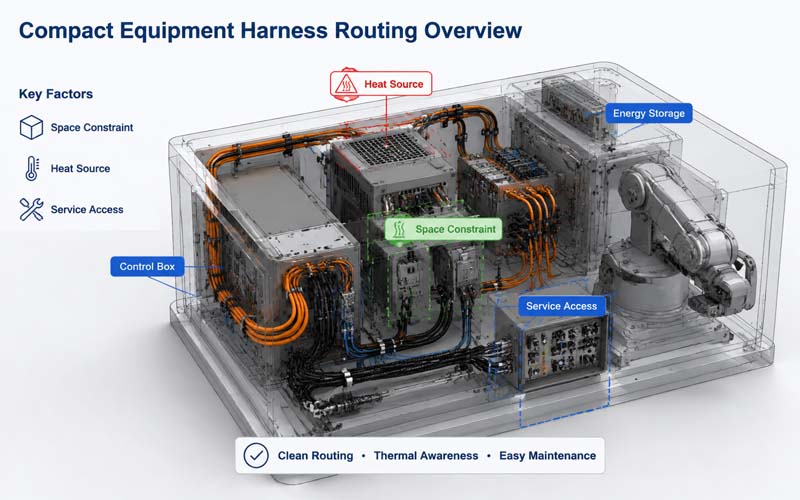
In compact equipment, routing decisions usually involve balancing three competing priorities:
Minimize occupied space
Avoid heat and mechanical hazards
Maintain serviceability
Optimizing one objective often affects the others.
1.Space Utilization
Use Three-Dimensional Routing Early
Harness design should be integrated into 3D mechanical design rather than treated as an afterthought.
Important considerations include:
- connector keep-out zones
- bend radius
- fastening locations
- motion envelopes
Minimize Bundle Diameter
Reduce harness size by:
- optimizing conductor selection
- grouping circuits logically
- using compact connectors
- eliminating unnecessary slack
Avoid Over-Constraining the Harness
Bundles should fit securely but not be compressed to the point of damaging insulation or restricting flexibility.
2.Thermal Management
Keep Distance from Heat Sources
Common heat sources include:
- power electronics
- motors
- transformers
- heaters
- batteries
Elevated temperatures accelerate insulation aging and reduce component life.
Use Appropriate Materials
When high temperatures cannot be avoided, select:
- high-temperature wire insulation
- heat-resistant sleeving
- protective conduit
Consider Airflow
Routing should avoid blocking cooling airflow and should not trap heat around sensitive components.
3.Serviceability and Maintenance
Allow Connector Access
Technicians should be able to disconnect connectors without removing unrelated components whenever possible.
Provide Service Loops Where Necessary
Small service loops can improve accessibility and reduce stress during maintenance.
Use Clear Identification
Labels and circuit markers help reduce maintenance time and errors.
Mechanical Protection Strategies
Routing should protect harnesses from:
- abrasion
- sharp edges
- vibration
- pinch points
- repeated motion
Common protective measures include:
- grommets
- edge clips
- braided sleeves
- corrugated conduit
- strain reliefs
Bend Radius Considerations
Excessive bending can damage conductors and insulation.
Minimum bend radius depends on:
- wire type
- shielding
- conductor construction
Routing should avoid tight bends directly behind connectors.
Managing Dynamic Movement
In robotics and moving assemblies, routing must account for:
- repeated flexing
- torsion
- acceleration loads
Use high-flex cable constructions and validated motion paths.
Routing and EMI Considerations
Physical layout also influences electromagnetic performance.
Best practices include:
- separating power and signal circuits
- maintaining shield continuity
- minimizing loop area
- controlling grounding paths
Design Review Checklist
Before finalizing routing, confirm:
- adequate bend radius
- connector accessibility
- thermal clearance
- abrasion protection
- fastening points
- assembly feasibility
- serviceability
- EMI considerations
Common Routing Mistakes
Prioritizing Shortest Path Only
The shortest route is not always the most reliable.
Routing Too Close to Heat Sources
Can significantly shorten harness life.
Insufficient Strain Relief
Increases connector stress.
No Maintenance Access
Makes field service difficult.
Ignoring Tolerance Stack-Up
May cause installation interference.
Application Examples
Compact routing is especially important in:
- battery energy storage systems
- electric vehicles
- industrial control cabinets
- medical devices
- robotics
- telecom equipment
Each application requires a tailored balance of packaging and service considerations.
How FPIC Supports Routing Optimization
FPIC supports customers with:
- custom harness layout review
- connector and material recommendations
- thermal and mechanical design guidance
- prototype builds
- manufacturability optimization
By considering routing early, we help reduce reliability risk and simplify production.
Final Thoughts
Wire harness routing in compact equipment is a multidisciplinary design challenge.
The most successful designs balance:
- space efficiency
- thermal protection
- mechanical durability
- serviceability
- manufacturability
When routing is addressed early in product development, the result is a more reliable and easier-to-maintain system.
FAQ
Why is wire harness routing important?
Routing affects reliability, thermal exposure, assembly efficiency, and maintenance access.
How close can a harness be to heat sources?
This depends on wire insulation ratings and thermal shielding strategies.
What is a service loop?
Extra length intentionally added to improve maintenance access and reduce stress.
Why is bend radius important?
Excessive bending can damage conductors and insulation.
Should routing be considered in early design?
Yes. Early integration prevents packaging conflicts and redesign.
Optimize Harness Routing for Compact Equipment
FPIC provides custom wire harness solutions designed for tight spaces, harsh environments, and efficient maintenance.
Contact us to discuss your routing and packaging challenges.
Resources
- IPC/WHMA-A-620
Requirements and acceptance criteria for cable and wire harness assemblies. - NASA Workmanship Standards for Cable Harnesses
Practical guidance on routing, bend radius, and mechanical protection. - UL Solutions – Wiring Harness Design Resources
Safety and design considerations for cable assemblies. - TE Connectivity – Cable Routing Best Practices
Connector and routing design recommendations. - Molex – Cable Management and Routing Solutions
Practical design guidance for compact equipment.