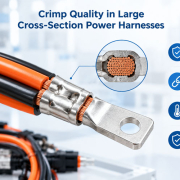
How to Control Crimp Quality in Large Cross-Section Power Harnesses
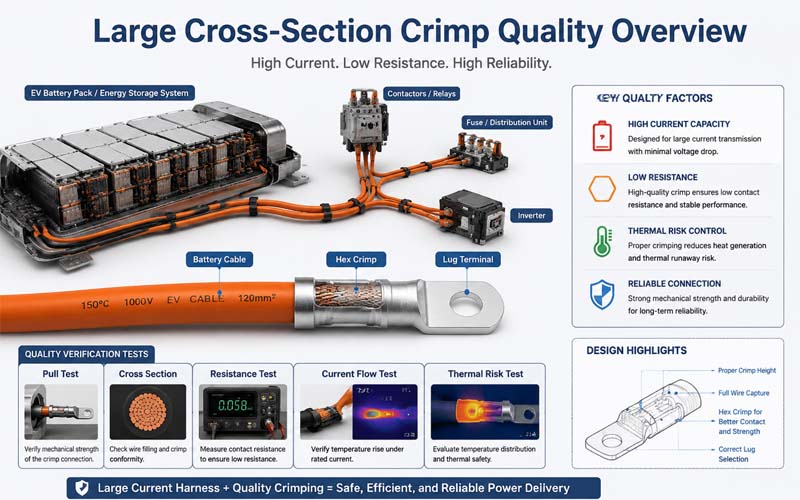
Large cross-section power harnesses are widely used in electric vehicles, battery energy storage systems (ESS), industrial equipment, and heavy machinery.
These assemblies often carry hundreds of amps through conductors ranging from 16 mm² to 120 mm² or larger.
In such applications, crimp quality is one of the most critical factors affecting electrical performance, thermal behavior, and long-term reliability.
A poorly controlled crimp can lead to:
- excessive contact resistance
- localized heating
- voltage drop
- conductor pull-out
- insulation damage
- catastrophic field failures
This article explains how manufacturers can control crimp quality in large cross-section power harnesses.
Why Large Cross-Section Crimping Is More Challenging
Compared with small-signal terminals, large power crimps involve:
- much higher crimping forces
- greater conductor stiffness
- tighter dimensional tolerances
- more significant thermal consequences
Small process deviations can create substantial differences in electrical and mechanical performance.
Key Quality Objectives of a Power Crimp
A properly formed crimp should provide:
- low and stable contact resistance
- high pull-out strength
- minimal voids
- uniform compression
- no strand damage
- long-term thermal stability
The crimp must function as a gas-tight metal-to-metal connection.
Critical Process Variables
Conductor Preparation
Quality starts before crimping.
Control:
- strip length
- nicked strands
- strand spread
- oxidation
- contamination
Damaged strands reduce both conductivity and mechanical strength.
Terminal and Cable Compatibility
The terminal barrel must match:
- conductor cross-section
- strand class
- conductor material
- insulation diameter (where relevant)
Using an oversized or undersized barrel significantly increases failure risk.
Tooling and Dies
Large crimps typically require:
- hex crimp dies
- indent crimp dies
- hydraulic or servo presses
Die geometry must be validated for the specific terminal and cable combination.
Crimp Height or Across-Flats Dimension
For large hex crimps, the most common dimensional characteristic is across-flats dimension.
This dimension strongly correlates with compression quality.
Crimp Force Monitoring
Modern equipment can monitor crimp force signatures to detect process anomalies such as:
- missing strands
- incorrect cable size
- improper insertion
- worn tooling
Mechanical Verification
Pull Force Testing
Pull testing verifies mechanical retention.
Acceptance criteria depend on conductor size and application requirements.
Visual Inspection
Inspect for:
- complete wire insertion
- symmetrical compression
- barrel cracks
- exposed strands
- insulation damage
Cross-Section Analysis
Microsections reveal:
- voids
- strand deformation
- barrel fill
- cracks
Cross-section analysis is one of the most effective validation tools.
Electrical Verification
Contact Resistance Measurement
Measure millivolt drop or resistance under controlled conditions.
Large power connections are highly sensitive to small resistance changes.
Thermal Rise Testing
Current cycling and temperature monitoring help verify real-world performance.
Common Crimp Defects
Under-Crimping
Insufficient compression leads to high resistance and strand movement.
Over-Crimping
Excessive compression can damage strands or crack the barrel.
Incomplete Insertion
Reduces effective conductor engagement.
Strand Damage
Caused by poor stripping or insertion.
Tool Wear
Changes crimp geometry over time.
Process Validation Strategy
A robust validation plan typically includes:
- dimensional checks
- pull force testing
- cross-section analysis
- contact resistance measurement
- current cycling
- environmental testing
Validation should be repeated after tooling changes or material substitutions.
Production Control Methods
Effective production control includes:
- first article approval
- periodic destructive testing
- crimp force monitoring
- preventive maintenance
- operator certification
- lot traceability
Large power crimps should be treated as special characteristics.
Standards and Specifications
Common references include:
- IPC/WHMA-A-620
- USCAR-21
- OEM-specific crimp standards
- IEC and UL requirements
Customer-specific requirements always take precedence.
Application Examples
Large cross-section crimp control is critical in:
- EV battery cables
- ESS battery interconnects
- inverter cables
- DC fast chargers
- industrial power distribution
- off-highway vehicles
How FPIC Controls Power Crimp Quality
FPIC manufactures high-current cable assemblies with:
- validated crimp tooling
- crimp force monitoring
- pull force and microsection testing
- contact resistance verification
- HiPot and continuity testing
- full traceability
Our engineering team supports conductor sizes from standard battery cables to custom high-current assemblies.
Final Thoughts
In large cross-section power harnesses, crimp quality directly affects safety, efficiency, and product life.
Reliable control requires:
- correct terminal and cable matching
- validated tooling
- dimensional monitoring
- mechanical and electrical verification
- disciplined process control
A high-current connection is only as reliable as the crimp that forms it.
FAQ
Why is crimp quality especially important in large power cables?
Small resistance increases can generate significant heat at high current.
What is the most common inspection dimension for hex crimps?
Across-flats dimension is widely used.
Is pull testing sufficient?
No. Pull testing should be combined with cross-section and electrical verification.
What causes high resistance in a crimp?
Under-compression, contamination, strand damage, or incomplete insertion.
How often should destructive tests be performed?
Frequency depends on customer requirements and process risk.
Need Reliable High-Current Cable Assemblies?
FPIC provides custom power harnesses for EV, ESS, and industrial applications with validated crimp processes and comprehensive quality control.