Designing Industrial Wire Harness for EMI, Grounding and Signal Integrity
Industrial wire harness are increasingly used in electrically noisy environments such as factory automation, robotics, servo systems, energy storage equipment, and industrial control cabinets.
In these applications, a wire harness is more than a bundle of conductors. It becomes part of the system’s electromagnetic design.
Poor harness design can lead to:
- unstable sensor readings
- communication errors
- servo faults
- unexpected controller resets
- electromagnetic compliance failures
This article explains how to design industrial wire harnesses for effective EMI control, robust grounding, and reliable signal integrity.
Why EMI and Signal Integrity Matter in Industrial Systems
Modern industrial equipment often combines:
- high-current motor drives
- switching power supplies
- high-speed digital communication
- precision analog sensors
- safety circuits
These systems generate significant electromagnetic noise.
Sensitive signals may include:
- encoder feedback
- thermocouples
- RS-485 / CAN communication
- Ethernet
- low-level analog signals
If cable design is not optimized, noise coupling can compromise system reliability.
Understanding EMI in Wire Harnesses
Electromagnetic interference (EMI) can be coupled through:
- conduction
- radiation
- capacitive coupling
- inductive coupling
Common noise sources include:
- variable frequency drives (VFDs)
- servo motors
- relays and contactors
- switching power converters
The harness design must minimize both noise emission and susceptibility.
Cable Routing Principles
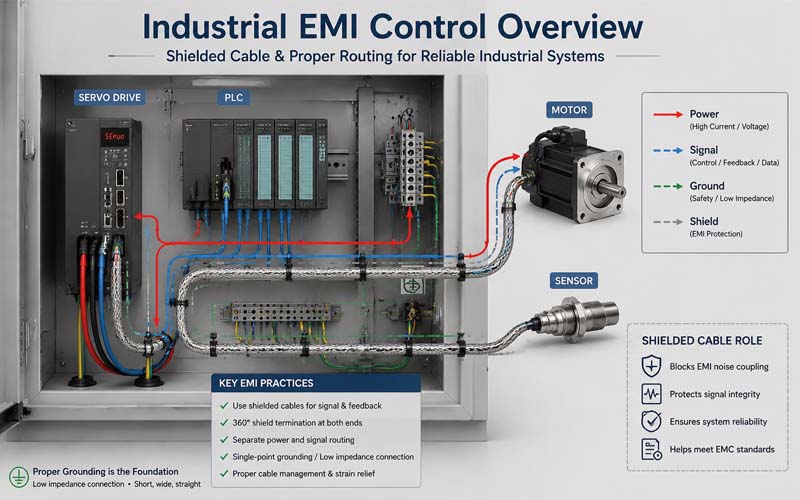
Proper routing is one of the most effective EMI mitigation strategies.
Separate Power and Signal Cables
Avoid running noisy power cables alongside sensitive signal lines.
Cross at 90 Degrees
If cables must intersect, crossing at right angles minimizes coupling.
Minimize Loop Area
Keep forward and return conductors close together.
Maintain Ground Continuity
Ground interruptions can create noise problems.
Shielding Strategies
Shielding helps block external interference and contain internally generated noise.
Types of Shielding
- foil shield
- braided shield
- combination foil + braid
Shield Termination Best Practices
Effective shielding depends heavily on termination quality.
Recommendations:
- use 360° shield termination whenever possible
- keep pigtails as short as possible
- maintain low-impedance grounding paths
A well-designed shield with poor termination may provide limited benefit.
Grounding Design Principles
Grounding affects both safety and EMI performance.
Single-Point Grounding
Often used for low-frequency analog systems to reduce ground loops.
Multi-Point Grounding
Common for high-frequency shielding applications where low impedance is critical.
Protective Earth (PE)
Safety grounding must remain separate from signal reference where required by system design.
Signal Integrity Considerations
Signal integrity becomes critical for high-speed or low-level circuits.
Differential Signaling
Protocols such as CAN, RS-485, and Ethernet use differential pairs for improved noise immunity.
Maintain:
- controlled pair twist
- consistent spacing
- matched conductor lengths
Impedance Control
For high-speed communication, cable geometry affects impedance and reflections.
Crosstalk Reduction
Separate sensitive pairs from noisy circuits and maintain shielding as needed.
Wire and Cable Selection
Select cable construction based on signal type and environment.
Consider:
- conductor size
- insulation dielectric properties
- shield coverage
- pair twisting
- flex life
- temperature rating
Cable selection is fundamental to achieving signal performance.
Connector Design and Shield Continuity
Connectors must preserve shielding and grounding integrity.
Important features include:
- metal shells
- EMI backshells
- shield clamps
- low-resistance ground contacts
Poor connector design can become the weakest point in the EMI path.
Common Design Mistakes
Mixing Power and Sensor Wiring
Increases noise coupling.
Long Shield Pigtails
Reduces shield effectiveness.
Floating Shields Without Intentional Design
Can create unpredictable behavior.
Inadequate Ground Planning
Leads to ground loops and noise issues.
Ignoring Installation Routing
System layout can negate good cable design.
Validation and Testing
Recommended validation methods include:
- continuity and grounding checks
- shield resistance measurement
- EMC testing
- signal integrity measurement
- noise injection testing
Testing should reflect actual installation conditions.
Application Examples
Industrial harness EMI design is critical in:
- robotic arms
- CNC equipment
- servo systems
- battery energy storage systems
- industrial sensors
- machine vision systems
Each application requires a tailored approach to shielding and grounding.
Beyond electrical design, the mechanical integrity of these systems is equally vital; for instance, high-performance robotic arms and controllers often rely on a professional cnc machining service to produce precision aluminum housings and structural components that provide both EMI shielding and heat dissipation.
How FPIC Supports Industrial Harness Design
FPIC provides custom industrial wire harness solutions with:
- shielded cable assembly design
- grounding and EMI optimization
- connector and backshell selection
- prototype and production manufacturing
- continuity, HiPot, and shielding verification
Our engineering team works with customers to improve both electrical performance and manufacturability.
Final Thoughts
In industrial systems, wire harnesses play a direct role in electromagnetic compatibility and signal quality.
A successful design must consider:
- cable routing
- shielding strategy
- grounding architecture
- connector design
- real-world validation
When EMI, grounding, and signal integrity are addressed early, the result is a more robust and reliable system.
FAQ
What is the most effective way to reduce EMI in wire harnesses?
Proper routing and effective shield termination are among the most effective methods.
Should shield be grounded at one end or both ends?
It depends on frequency and system grounding strategy.
Why are long shield pigtails a problem?
They increase impedance and reduce shielding effectiveness at high frequencies.
What signals are most sensitive to EMI?
Low-level analog signals and high-speed communication lines.
How can signal integrity be validated?
Using impedance measurements, noise testing, and real-system functional validation.
Improve EMI Performance in Your Industrial Wire Harness
If your system includes servo drives, sensors, or high-speed communication, harness design is critical to reliable operation.
FPIC provides custom industrial wire harness assemblies optimized for EMI control, grounding, and signal integrity.
Contact us to discuss your application requirements.
Resources
- IEC 61000 – Electromagnetic Compatibility Standards
International EMC standards for industrial equipment. - IPC/WHMA-A-620 – Cable and Wire Harness Requirements
Industry standard for harness workmanship and assembly quality. - Belden – Industrial Cable and EMI Design Guide
Practical guidance on shielding and signal integrity. - TE Connectivity – Shield Termination Best Practices
Technical recommendations for 360° shield grounding. - Molex – Industrial Connectivity Solutions
Connector and cable design considerations for industrial environments.