Custom Wire Harness Quotation Guide: What Data Buyers Must Provide First
Requesting a quote for a custom wire harness may seem straightforward, but the accuracy and speed of the quotation depend heavily on the information provided upfront.
Incomplete RFQs often lead to multiple rounds of clarification, engineering delays, and inaccurate pricing. In contrast, a well-prepared quotation package allows suppliers to evaluate technical feasibility, material selection, and manufacturing costs more efficiently.
This article explains what buyers should provide when requesting a custom wire harness quotation and why each piece of information matters.
Why RFQ Quality Directly Affects Quote Accuracy
Custom wire harness pricing is influenced by many factors, including:
- wire type and length
- connector selection
- terminal specifications
- shielding requirements
- testing requirements
- annual volume
- regulatory certifications
Without complete technical data, suppliers may make assumptions that result in inaccurate pricing or extended lead times.
A detailed RFQ helps reduce risk for both buyer and manufacturer.
1.Drawings or Technical Documentation
The most valuable information in any RFQ is a technical drawing.
Useful documents include:
- 2D drawings
- 3D CAD models
- wiring schematics
- BOMs
- sample photos
- existing physical samples
A drawing should ideally include:
- overall dimensions
- branch lengths
- wire gauges
- connector part numbers
- labels and markings
Even a hand sketch can be helpful if formal drawings are not available.
2.Wire Specifications
Provide detailed wire requirements, including:
- conductor size (AWG or mm²)
- insulation material
- voltage rating
- temperature rating
- color requirements
- shielding needs
If no specific part number is required, describe the application environment so the supplier can recommend suitable wire types.
3.Connector and Terminal Information
Whenever possible, provide:
- manufacturer and part numbers
- terminal part numbers
- mating connector references
- sealing requirements
If part numbers are unknown, share:
- photos
- dimensions
- mating details
- environmental conditions
This helps suppliers identify compatible alternatives.
4.Harness Layout and Lengths
Accurate dimensions are essential for quoting material and labor.
Include:
- total cable lengths
- branch lengths
- breakout points
- tolerances
- bend or routing constraints
For complex assemblies, a harness board drawing is highly recommended.
5.Electrical Requirements
Specify:
- operating voltage
- current per circuit
- signal or power classification
- impedance or shielding requirements
- grounding strategy
These parameters influence wire size, terminal selection, and insulation design.
6.Environmental Conditions
The operating environment determines material and sealing requirements.
Important conditions include:
- temperature range
- vibration level
- exposure to water, dust, oil, or chemicals
- UV exposure
- indoor or outdoor installation
A harness used in an engine compartment requires different materials than one used in indoor equipment.
7.Testing Requirements
Define the required validation and production tests, such as:
- continuity testing
- insulation resistance
- HiPot testing
- pull force testing
- functional testing
Testing requirements directly affect equipment, labor, and documentation costs.
8.Regulatory and Certification Requirements
Some projects require compliance with specific standards.
Examples include:
- UL
- IPC/WHMA-A-620
- ISO 9001
- IATF 16949
- RoHS
- REACH
Be sure to state any documentation or certification needs.
9.Quantity and Forecast
Pricing depends heavily on volume.
Provide:
- prototype quantity
- pilot quantity
- annual demand
- expected order schedule
This allows suppliers to evaluate tooling, purchasing strategy, and production planning.
10.Packaging and Labeling Requirements
If special packaging is needed, specify:
- individual bagging
- reel or tray packaging
- custom labels
- barcodes
- traceability requirements
These details may affect both cost and lead time.
11.Target Price and Timeline
Sharing commercial expectations can speed the quoting process.
Helpful information includes:
- target cost
- prototype deadline
- production SOP date
- approval milestones
This helps suppliers recommend cost-optimized solutions.
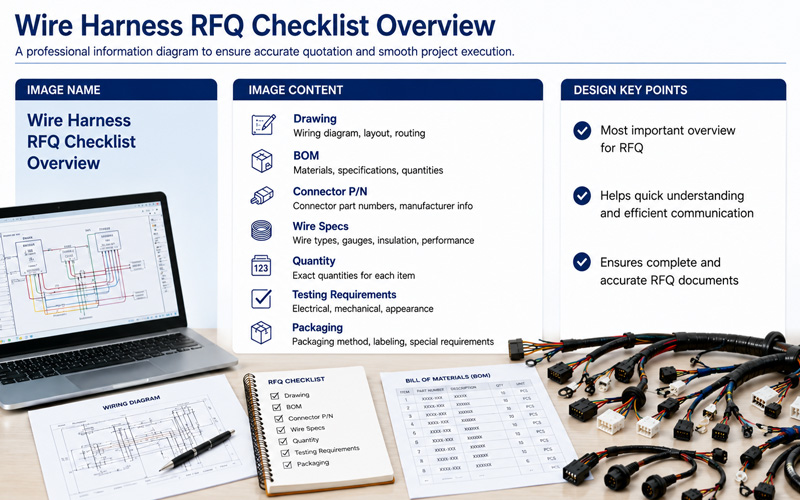
Recommended RFQ Checklist
Before requesting a quote, prepare the following:
- drawings or samples
- wire specifications
- connector part numbers
- harness dimensions
- electrical requirements
- environmental conditions
- testing requirements
- certifications
- quantity forecast
- packaging requirements
- target timeline
Providing these items significantly improves quote accuracy and response speed.
Common RFQ Mistakes
Only Sending Photos
Photos are helpful but rarely sufficient by themselves.
Missing Quantity Information
Volume has a major impact on pricing.
No Environmental Description
Suppliers cannot recommend appropriate materials without application context.
Undefined Testing Requirements
Testing can significantly affect manufacturing cost.
Incomplete Connector Information
Missing part numbers may delay engineering review.
How FPIC Supports Fast and Accurate Quotations
FPIC helps customers streamline custom wire harness sourcing by offering:
- engineering review of RFQ data
- connector and material recommendations
- DFM and cost optimization suggestions
- prototype and production support
- complete testing and documentation services
Even if your information is incomplete, our engineering team can help identify missing details and propose practical solutions.
Final Thoughts
The quality of your RFQ directly determines the quality of your quotation.
Providing complete technical and commercial information enables suppliers to:
- quote more accurately
- respond faster
- reduce engineering revisions
- recommend optimized solutions
A well-prepared RFQ saves time, improves communication, and helps ensure project success.
FAQ
What is the most important document for a wire harness RFQ?
A detailed drawing or sample is the most valuable starting point.
Can I request a quote without part numbers?
Yes. Photos, dimensions, and application details can often be enough for preliminary evaluation.
Why is annual volume important?
Volume affects material pricing, tooling decisions, and labor efficiency.
Do testing requirements affect cost?
Yes. Additional testing and documentation increase production cost and lead time.
What if my RFQ is incomplete?
An experienced supplier can help identify missing information and guide the design process.
Need a Fast and Accurate Custom Wire Harness Quote?
Send us your drawings, samples, or application requirements, and FPIC will help you develop a cost-effective and reliable wire harness solution.