How Digital Manufacturing Improves Wire Harness Traceability
Wire harnesses often contain multiple wires, terminals, connectors, seals, labels, protective materials, and processing steps.
As product complexity increases, simply recording the final inspection result is no longer enough to provide complete manufacturing visibility.
Manufacturers need to know:
- Which materials were used?
- Which production process handled the assembly?
- When was each process completed?
- Which inspection results were recorded?
- Which operator or equipment performed the operation?
- Which finished harnesses were affected if a problem is discovered?
This is where digital manufacturing and traceability systems become increasingly valuable.
By connecting material identification, production processes, inspection results, and finished-product records, manufacturers can create a more complete history for each wire harness.
Why Traceability Matters in Wire Harness Manufacturing
Wire harness production typically involves multiple manufacturing stages, such as:
1.Material receiving
2.Wire cutting
3.Stripping
4.Terminal crimping
5.Connector assembly
6.Branching and routing
7.Taping or protective covering
8.Electrical testing
9.Visual inspection
10.Final assembly
11.Packaging and shipment
A defect discovered at the final stage may originate from an earlier operation.
For example, an intermittent electrical problem could be associated with:
- Incorrect wire material
- Incorrect terminal
- Improper crimping
- Incomplete terminal insertion
- Damaged insulation
- Incorrect routing
- Poor connector assembly
- Testing or inspection error
Without production history, investigating the root cause can become a manual and time-consuming process.
Digital traceability provides the information needed to connect the final product with its manufacturing history.
1.From Paper Records to Digital Traceability
Traditional production records may rely heavily on:
- Paper travelers
- Manual checklists
- Handwritten inspection records
- Spreadsheet tracking
- Operator signatures
These methods can work for simple production environments, but they become increasingly difficult to manage as product variants and production volume increase.
Digital manufacturing can replace fragmented records with connected production data.
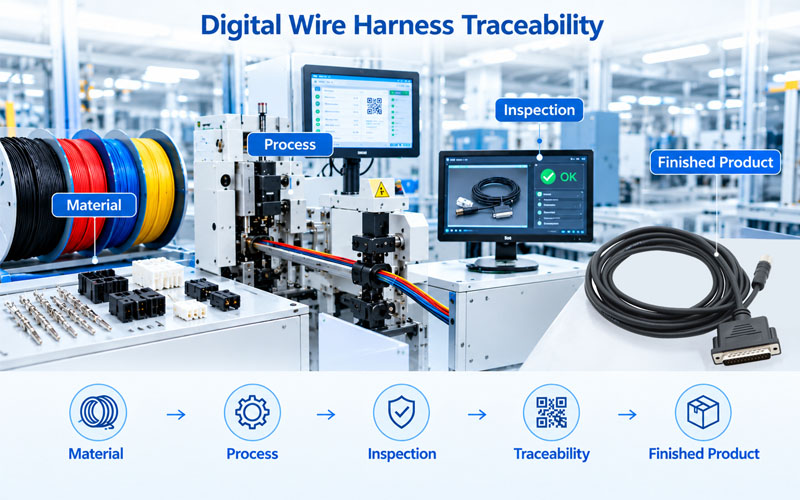
A simplified digital traceability structure can be viewed as:
Material → Process → Inspection → Assembly → Finished Product
Each stage contributes information to the product’s manufacturing history.
This makes it easier to retrieve production information when quality issues occur.
2.Barcode and QR Code Identification
Barcode and QR code systems can provide a practical foundation for wire harness traceability.
A unique identification code can be associated with:
- Work orders
- Material batches
- Wire reels
- Terminals
- Connectors
- Semi-finished assemblies
- Finished harnesses
Operators can scan the relevant code at defined production points.
Instead of manually entering the same information repeatedly, the manufacturing system can associate process data with the corresponding product or work order.
This helps reduce manual data-entry errors while improving production visibility.
3.Material Traceability Comes First
A finished wire harness can only be fully traceable if its critical materials are traceable.
Material records may include:
- Wire part number
- Wire specification
- Terminal part number
- Connector part number
- Seal or gasket
- Protective sleeve
- Label
- Material lot or batch
- Supplier information
For critical applications, batch-level traceability can become particularly valuable.
If a material issue is discovered later, the manufacturer can potentially identify which production orders or finished assemblies used the affected batch.
This supports more targeted investigation instead of treating an entire production period as potentially affected.
4.Process Traceability
Material identification is only one part of the picture.
The manufacturing system should also record critical production processes.
Depending on the harness, relevant information may include:
- Cutting parameters
- Strip length
- Crimping process
- Terminal insertion
- Connector assembly
- Sealing operation
- Label application
- Electrical testing
- Final inspection
Not every parameter needs to be digitally recorded for every product.
The better approach is to identify critical-to-quality processes and determine which data should be captured.
5.Digital Crimping Traceability
Crimping is one of the most important processes in wire harness manufacturing.
A reliable crimp depends on factors such as:
- Correct terminal
- Correct wire size
- Crimp height
- Crimp width
- Conductor positioning
- Insulation support
- Tool condition
- Applicator setup
Digital manufacturing systems can associate crimping information with a work order or product record.
Where equipment supports data output, selected process parameters can potentially be captured automatically.
This creates a stronger connection between the physical crimp and its manufacturing record.
6.Digital Electrical Testing Records
Electrical testing is another important traceability point.
Depending on the product, final testing may include:
- Continuity
- Resistance
- Short-circuit detection
- Insulation resistance
- HiPot
- Functional testing
Instead of recording only PASS / FAIL, a digital system can retain the test result together with product identification.
For example:
Harness ID → Test Program → Test Result → Test Time → Production Order
This provides a much stronger record than a simple paper inspection sheet.
It can also make historical data easier to retrieve during customer audits or quality investigations.
7.Connecting WMS and Production Traceability
Digital traceability becomes more powerful when manufacturing data is connected with warehouse management.
For wire harness manufacturers, a WMS-managed finished goods warehouse can provide additional visibility after production is completed.
For example:
Production → Inspection → Finished Goods → Warehouse Location → Shipment
QR-code scanning can be used to record inbound and outbound movements.
This can help control:
- Product location
- Quantity
- Batch information
- FIFO management
- Shipment status
When warehouse data and production data are connected, the manufacturer gains visibility beyond the production line.
8.Real-Time Production Visibility
Digital manufacturing can provide a more current view of production status.
Management and production teams can monitor information such as:
- Work order progress
- Production quantity
- Inspection status
- Rework quantity
- Scrap quantity
- Equipment status
- Production bottlenecks
This can help identify problems earlier.
For example, if a particular process suddenly shows an increase in failures, the production team can investigate the issue before a larger quantity of assemblies is completed.
Traceability therefore supports not only after-the-fact investigation, but also proactive production control.
9.Traceability Helps With Root-Cause Analysis
One of the biggest benefits of digital manufacturing is faster root-cause analysis.
Consider a customer reporting an intermittent connection problem.
With complete traceability, the manufacturer may be able to investigate:
Finished Harness ID
↓
Production Order
↓
Material Batch
↓
Crimping Process
↓
Connector Assembly
↓
Electrical Test Result
↓
Final Inspection
This structured information can significantly reduce the time required to identify possible causes.
More importantly, it can help distinguish between an isolated product issue and a broader production problem.
10.Traceability Supports Targeted Containment
When a material or process issue is discovered, manufacturers need to determine the affected scope.
Without detailed traceability, the response may be overly broad.
With batch and process records, the manufacturer can potentially identify:
- Which work orders were involved
- Which production period was affected
- Which material batches were used
- Which products passed through a specific process
- Which finished goods remain in inventory
- Which products were already shipped
This supports more targeted containment and reduces unnecessary disruption.
11.Digital Traceability Improves Customer Confidence
Traceability is increasingly important for customers purchasing customized wire harnesses.
Customers may require evidence of:
- Material control
- Process control
- Inspection records
- Test results
- Production consistency
- Batch identification
Digital records can make this information easier to retrieve and organize.
For industries such as automotive, industrial automation, medical equipment, energy storage, and other demanding applications, traceability can become part of the overall supplier quality system.
12.Traceability Is Not the Same as Data Collection
A common misconception is that collecting more data automatically creates better traceability.
It does not.
A useful traceability system should answer practical questions.
For example:
What happened?
Which process was completed?
When did it happen?
When was the operation performed?
Where did it happen?
Which production line or equipment was involved?
Who or what performed it?
Operator, machine, or test station.
Which product was affected?
Harness ID, work order, or batch.
What was the result?
Pass, fail, measurement, or process status.
The goal is not to collect unlimited information.
The goal is to collect the right information at the right production points.
13.Digital Manufacturing and Error Prevention
Traceability becomes even more valuable when digital systems are used for process verification.
For example, a scanning system can verify whether the operator has selected the correct:
- Work order
- Wire
- Terminal
- Connector
- Production instruction
- Test program
This creates an additional layer of error prevention.
Instead of discovering every mistake during final inspection, some incorrect operations can be blocked or identified earlier in the production process.
This is an important difference between traceability and process control.
A mature digital manufacturing system should ideally support both.
14.Data Integrity and System Security
As more production information becomes digital, data integrity becomes important.
A traceability system should consider:
- User permissions
- Data modification controls
- Backup
- Time synchronization
- Equipment communication
- Record retention
- Audit trails
Production records should be reliable enough to support quality analysis and customer requirements.
The system should also distinguish between automatically generated process data and manually entered information where appropriate.
15.Digital Traceability for Mass Production
Mass production creates a particularly strong need for consistent traceability.
When hundreds or thousands of similar harnesses are manufactured, manual identification becomes increasingly difficult.
Digital systems can associate each production unit with a unique or controlled production identity.
This helps manufacturers monitor:
- Production volume
- First-pass yield
- Defect rates
- Rework
- Material consumption
- Test results
- Batch performance
Over time, this data can also reveal recurring process trends.
16.A Practical Digital Traceability Workflow
A wire harness manufacturer can gradually build digital traceability rather than attempting to digitize every process simultaneously.
Step 1 — Define Critical Traceability Points
Identify which materials and processes have the greatest impact on product quality.
Step 2 — Establish Product Identification
Create a consistent system for work orders, product IDs, batches, and finished assemblies.
Step 3 — Digitize Material Movement
Connect incoming materials and warehouse movements with production orders.
Step 4 — Capture Critical Process Data
Record key information from crimping, assembly, inspection, and testing.
Step 5 — Connect Testing Systems
Associate electrical test results with the relevant product or production order.
Step 6 — Connect Finished Goods
Record finished product status, warehouse location, and shipment information.
Step 7 — Build Traceability Reports
Make production history searchable by product, batch, order, process, or date.
This step-by-step approach allows digital manufacturing to grow according to actual production requirements.
How FPIC Uses Digital Manufacturing for Traceability
For customized wire harness production, traceability is most useful when it connects actual production processes rather than existing only as a final quality report.
FPIC uses digital production and warehouse management practices to improve visibility across manufacturing and finished-goods operations.
For example, WMS-based QR-code scanning can support finished-goods inbound and outbound records, location control, and FIFO management.
Combined with process inspection and electrical testing, digital records can provide a clearer connection between production activities and finished harnesses.
The objective is straightforward:
Make the manufacturing history easier to identify, verify, and analyze.
Final Thoughts
Digital manufacturing is changing how wire harness manufacturers manage traceability.
The most valuable systems do more than store production data. They connect:
Materials → Processes → Inspections → Testing → Finished Products → Warehouse → Shipment
This connected structure can improve production visibility, support faster root-cause analysis, strengthen quality control, and provide customers with greater confidence in manufacturing consistency.
For wire harness manufacturers serving demanding industrial markets, traceability should be treated as part of the manufacturing architecture—not simply as paperwork completed after production.
FAQ
What is wire harness traceability?
Wire harness traceability is the ability to connect a finished harness with relevant material, production, inspection, testing, and shipment information.
How do QR codes improve wire harness traceability?
QR codes provide a practical way to identify work orders, materials, semi-finished products, and finished harnesses. Scanning can connect physical products with digital production records.
What information should be tracked?
Depending on the application, important information may include material batches, production orders, crimping processes, connector assembly, inspection results, electrical tests, warehouse movements, and shipment records.
Can traceability help with quality problems?
Yes. Detailed production records can help identify potential relationships between a customer complaint and specific materials, processes, production periods, or test results.
Does every wire harness need individual traceability?
Not necessarily. The appropriate level depends on product criticality, customer requirements, production volume, regulatory requirements, and quality risks.
What is the difference between traceability and process control?
Traceability records what happened and connects it to a product or batch. Process control focuses on preventing errors and keeping manufacturing processes within defined requirements. A strong digital manufacturing system can support both.
Looking for a Wire Harness Manufacturer with Strong Production Traceability?
FPIC provides customized wire harness and cable assembly solutions supported by structured production control, inspection, testing, and digital warehouse management practices.
Contact FPIC to discuss your wire harness design, production, testing, and traceability requirements.
Resources
- IPC/WHMA-A-620 – Requirements and Acceptance for Cable and Wire Harness Assemblies: Industry reference covering requirements and acceptance criteria for cable and wire harness assemblies.
- IPC – Industry Standards: Provides standards and resources supporting electronics and cable assembly manufacturing quality.
- GS1 – Traceability: Provides information on identification and traceability concepts used across supply chains and manufacturing environments.
- NIST – Smart Manufacturing: Provides background on digital and smart manufacturing systems, connected production data, and manufacturing intelligence.