M12 to RJ45 Harness Design for Industrial Ethernet: Shielding, Coding and IP Rating
As industrial automation systems become increasingly connected, reliable Ethernet communication has become a critical requirement.
Modern factories rely on Industrial Ethernet networks for:
- PLC communication
- motion control
- machine vision
- IIoT devices
- industrial robotics
- process automation
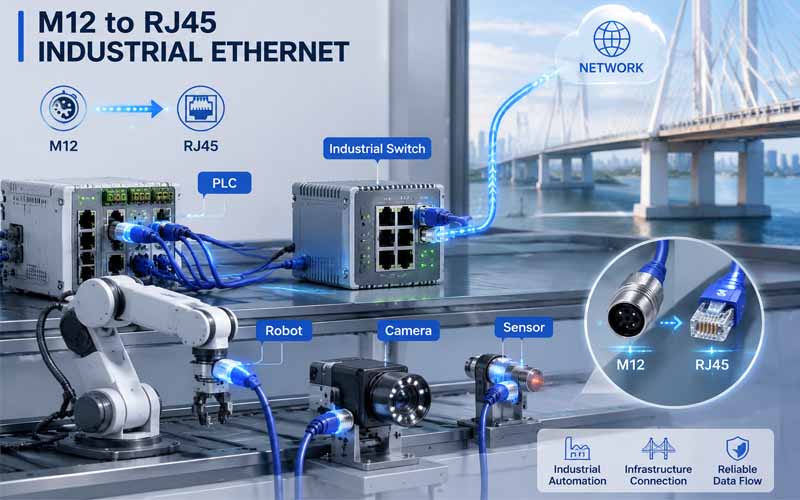
One of the most common connectivity solutions is the M12 to RJ45 harness assembly, which bridges industrial field devices and Ethernet network infrastructure.
Although these assemblies appear simple, their performance depends heavily on shielding design, connector coding, and environmental protection.
This article explains the key engineering considerations industrial buyers and automation designers should understand when specifying M12 to RJ45 cable assemblies.
Why M12 to RJ45 Harnesses Are Widely Used
Industrial environments differ significantly from office networks.
Typical factory conditions include:
- vibration
- oil exposure
- moisture
- dust
- electromagnetic interference (EMI)
- temperature fluctuations
While RJ45 connectors remain common inside control cabinets, field-level equipment often requires more robust interfaces.
M12 connectors provide:
- improved mechanical locking
- vibration resistance
- environmental sealing
- industrial durability
As a result, M12-to-RJ45 assemblies are widely used to connect field devices to Ethernet switches and controllers.
Understanding the Function of Each Connector
RJ45 Side
RJ45 connectors are commonly used for:
- Ethernet switches
- PLCs
- industrial PCs
- control cabinets
Advantages include:
- standardized interface
- easy integration
- widespread compatibility
However, standard RJ45 connectors are generally not designed for harsh environments.
M12 Side
M12 connectors are designed for industrial applications.
Benefits include:
- threaded locking mechanism
- vibration resistance
- IP67/IP68 sealing capability
- compact size
They are commonly found on:
- sensors
- vision systems
- servo drives
- industrial cameras
- network switches
- robotic equipment
M12 Coding Types and Their Applications
Selecting the correct coding is one of the most important design decisions.
Different coding types support different communication standards.
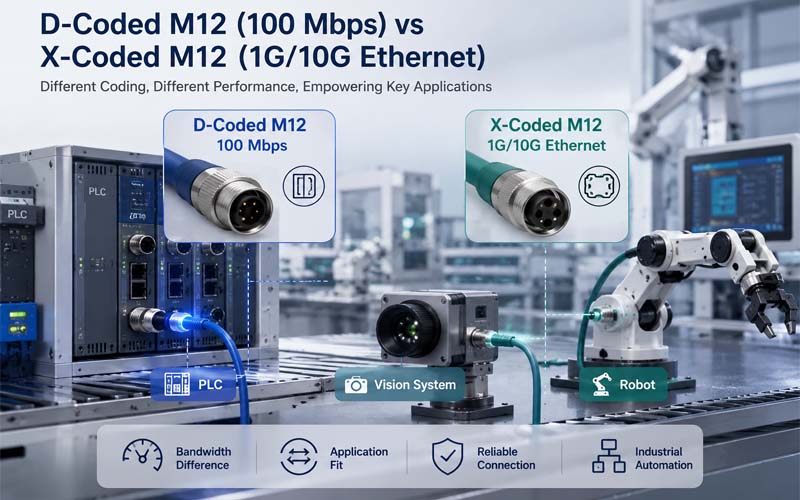
D-Coded M12
Typically used for:
- Fast Ethernet
- 100 Mbps networks
Common applications:
- PROFINET
- EtherNet/IP
- industrial controllers
D-coded connectors usually support:
- 4-wire Ethernet communication
X-Coded M12
Designed for:
- Gigabit Ethernet
- high-speed industrial communication
Typical applications:
- machine vision
- industrial cameras
- data-intensive automation systems
X-coded connectors provide:
- superior EMC performance
- 10 Gbps capability in some applications
Today, X-coding is becoming increasingly popular in Industry 4.0 installations.
Shielding: The Most Critical Design Element
Industrial Ethernet reliability depends heavily on shielding effectiveness.
Unlike office environments, industrial networks are exposed to noise generated by:
- servo drives
- VFDs
- motors
- switching power supplies
- welding equipment
Poor shielding can result in:
- packet loss
- communication interruptions
- network instability
- machine downtime
Cable Shield Construction Options
Typical shielding structures include:
Foil Shield
Provides:
- excellent high-frequency protection
- lightweight construction
Braided Shield
Provides:
- superior low-frequency protection
- improved mechanical durability
Dual Shield Design
Combines:
- foil shield
- braided shield
This is often preferred for industrial Ethernet applications.
Importance of 360° Shield Termination
Shield quality alone is not sufficient.
Proper shield termination is equally important.
Best practice includes:
- 360° shield contact
- low-impedance grounding
- continuous shielding path
Poor shield termination often causes more EMC problems than the cable itself.
IP Rating Considerations
Environmental protection is a major advantage of M12 connectors.
Common protection levels include:
IP67
Protection against:
- dust ingress
- temporary water immersion
Suitable for most factory environments.
IP68
Provides enhanced protection for:
- long-term moisture exposure
- outdoor applications
- washdown environments
IP69K
Used in:
- food processing
- beverage production
- sanitary equipment
Provides protection against high-pressure cleaning processes.
Cable Jacket Selection
The cable jacket must match the operating environment.
Common materials include:
PVC
- economical
- suitable for general industrial use
PUR
- excellent abrasion resistance
- oil resistance
- drag-chain compatibility
TPE
- superior flexibility
- robotic applications
- continuous motion environments
Drag Chain and Robotics Considerations
Many Industrial Ethernet cables operate in dynamic applications.
Examples include:
- robotic arms
- gantry systems
- automated assembly equipment
These applications require:
- high-flex conductors
- torsion resistance
- specialized shielding designs
A standard Ethernet cable often fails prematurely in continuous-motion applications.
Connector Overmolding and Strain Relief
Termination quality directly affects reliability.
Good overmolding design provides:
- strain relief
- bend protection
- improved sealing
- longer service life
Poor termination design is a common failure point.
EMC Best Practices for M12 to RJ45 Assemblies
For reliable Industrial Ethernet performance:
✓ Use shielded twisted pairs
✓ Maintain pair geometry
✓ Use 360° shield termination
✓ Minimize impedance discontinuities
✓ Separate power and data routing
✓ Validate EMC performance
These practices significantly improve network stability.
Common Buyer Mistakes
Choosing the Wrong Coding
D-coded and X-coded connectors are not interchangeable.
Ignoring Shield Termination Quality
A shielded cable with poor grounding may provide limited protection.
Selecting Office Ethernet Cables
Commercial Ethernet cables are often unsuitable for industrial environments.
Overlooking Motion Requirements
Continuous-flex applications require specialized cable constructions.
Focusing Only on IP Rating
Mechanical, EMC, and flex-life performance are equally important.
Questions Buyers Should Ask Suppliers
Before approving an M12 to RJ45 harness, buyers should confirm:
- Which M12 coding is used?
- What Ethernet speed is supported?
- What shielding structure is applied?
- Is 360° shield termination used?
- What IP rating is achieved?
- Is the assembly drag-chain rated?
- What flex-life testing has been completed?
These questions help avoid costly network reliability issues.
Typical Applications
M12 to RJ45 harness assemblies are commonly used in:
- Industrial Ethernet networks
- PROFINET systems
- EtherNet/IP installations
- Machine vision equipment
- Robotics
- PLC communication
- Automated production lines
- Smart factories
How FPIC Supports Industrial Ethernet Connectivity
FPIC provides custom Industrial Ethernet cable assemblies including:
- M12 D-coded to RJ45 harnesses
- M12 X-coded to RJ45 harnesses
- Shielded Ethernet assemblies
- Drag-chain Ethernet cables
- Robotic Ethernet cables
- Custom overmolded cable solutions
Our engineering team supports connector selection, EMC optimization, and environmental validation based on application requirements.
Final Thoughts
M12 to RJ45 cable assemblies play a critical role in Industrial Ethernet networks.
A reliable design depends on balancing:
- correct coding selection
- effective shielding
- robust termination
- appropriate IP protection
- environmental durability
As industrial networks become faster and more connected, harness quality becomes increasingly important for long-term system reliability.
FAQ
What is the difference between D-coded and X-coded M12 connectors?
D-coded connectors are typically used for Fast Ethernet (100 Mbps), while X-coded connectors support Gigabit Ethernet and higher-speed communication.
Why is shielding important in Industrial Ethernet?
Shielding protects communication signals from EMI generated by motors, drives, and industrial equipment.
Is IP67 sufficient for most factories?
Yes. IP67 is suitable for most industrial environments, while IP68 or IP69K may be required for harsher conditions.
Can standard Ethernet cables be used in drag chains?
Generally no. Dynamic applications require flex-rated cable constructions.
Why is 360° shield termination important?
It ensures continuous shielding performance and improves EMC protection.
Looking for Custom M12 to RJ45 Cable Assemblies?
FPIC provides Industrial Ethernet harness solutions with M12 D-coded, X-coded, and custom connector configurations for automation, robotics, machine vision, and smart factory applications.
Contact us to discuss your Industrial Ethernet connectivity requirements.
Resources
- PROFINET Installation Guidelines
https://www.profibus.com - ODVA EtherNet/IP Network Infrastructure Guide
https://www.odva.org - IEC 61076-2-109 (M12 X-Coded Connectors Standard)
https://webstore.iec.ch - IEC 60529 IP Protection Ratings
https://webstore.iec.ch - Industrial Ethernet Cabling Best Practices – Siemens
https://www.siemens.com