Cable Flex Life Testing for Motion Applications: What Harness Manufacturers Should Validate
As automation systems become faster and more dynamic, wire harnesses are expected to withstand millions of motion cycles without electrical or mechanical failure. Whether used in robotic arms, automated production lines, gantry systems, or drag chain applications, cable assemblies are subjected to continuous bending, twisting, vibration, and acceleration.
Unfortunately, many harness failures occur not because of poor electrical design, but because the assembly was never properly validated for real motion conditions.
Cable flex life testing helps manufacturers identify potential weaknesses before products reach the field. By simulating actual operating environments, these tests provide valuable data on durability, reliability, and expected service life.
This article explains the most important validation methods that harness manufacturers should consider for motion applications.
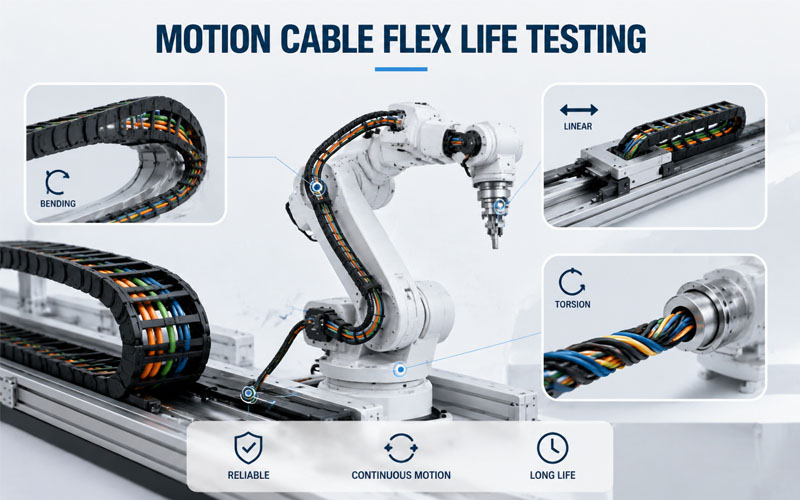
Why Flex Life Testing Matters
Traditional wire harness testing often focuses on electrical performance, including continuity, insulation resistance, and dielectric withstand testing. While these tests are essential, they do not accurately predict how a harness will perform under continuous movement.
Motion-related failures commonly include:
- conductor fatigue
- broken strands
- insulation cracking
- shielding damage
- terminal pullout
- connector loosening
- intermittent electrical signals
These issues may not appear during initial testing but can develop after thousands or millions of operating cycles.
Flex life testing helps identify these risks early in the development process.
Understanding Motion Profiles Before Testing
Before selecting a validation method, engineers should define the actual motion profile of the application.
Key parameters include:
- bend radius
- travel distance
- acceleration
- velocity
- torsion angle
- cycle frequency
- operating temperature
Different applications generate different failure mechanisms.
For example:
- robotic arms often experience combined bending and torsion
- drag chains primarily create repetitive bending stress
- automated gantries may introduce vibration and acceleration loads
- rotating equipment can generate continuous twisting forces
Testing should replicate the intended operating environment as closely as possible.
Bend Cycle Testing
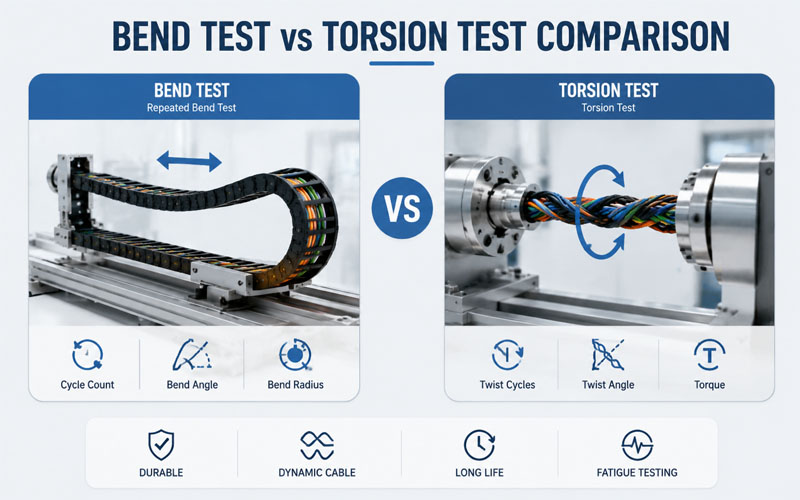
Bend cycle testing is one of the most common methods used to evaluate cable flex life.
The test repeatedly bends the cable through a specified radius while monitoring electrical continuity and mechanical integrity.
What Bend Cycle Testing Evaluates
This test helps identify:
- conductor strand fatigue
- insulation wear
- jacket cracking
- shielding degradation
- connector interface stress
The smaller the bend radius, the greater the mechanical stress applied to the cable.
Common Failure Indicators
Typical failure criteria include:
- open circuits
- increased resistance
- insulation damage
- visible conductor breakage
Monitoring throughout the test provides a more accurate understanding of failure progression.
Torsion Testing
Many robotic applications expose cables to significant twisting forces.
A cable may survive bending tests yet fail prematurely when subjected to torsional loads.
Why Torsion Testing Is Important
Continuous twisting can cause:
- conductor deformation
- shield separation
- insulation fatigue
- internal stress concentration
Torsion testing evaluates whether the cable construction can withstand repeated rotational movement without degradation.
Test Considerations
Important variables include:
- torsion angle per meter
- rotational speed
- cycle count
- cable mounting conditions
Testing should reflect actual robot joint movement whenever possible.
Drag Chain Testing
Drag chains create one of the most demanding environments for flexible cable assemblies.
The cable is continuously bent and straightened while moving back and forth through a defined travel path.
What Should Be Evaluated
During drag chain testing, engineers should monitor:
- conductor integrity
- electrical continuity
- jacket wear
- cable deformation
- shield performance
Cable Arrangement Matters
Testing should evaluate the complete harness assembly rather than individual cables alone.
Factors such as:
- cable spacing
- bundle configuration
- separator usage
- fill ratio
can significantly influence service life.
A well-designed cable may still fail if installed incorrectly within the drag chain.
Connector and Transition Point Validation
Many harness failures occur at the cable-to-connector interface rather than within the cable itself.
Transition points experience concentrated stress because movement is often restricted near connectors.
Areas Requiring Special Attention
High-risk locations include:
- connector exits
- strain relief points
- overmold transitions
- branch breakouts
- fixed-to-moving interfaces
Recommended Validation
Testing should verify:
terminal retention
contact stability
strain relief effectiveness
sealing integrity
These areas often determine the actual lifespan of the assembly.
Environmental Testing for Motion Applications
Motion-related stress rarely occurs in isolation.
Real operating environments may also include:
- temperature fluctuations
- humidity
- oil exposure
- dust contamination
- chemical exposure
Environmental testing should be combined with motion testing whenever practical.
Thermal Cycling
Repeated expansion and contraction can accelerate fatigue in conductors, terminals, and insulation systems.
Chemical Resistance Testing
Industrial environments frequently expose cables to:
- lubricants
- hydraulic fluids
- cleaning agents
- fuels
Material compatibility should be verified before production release.
Continuous Electrical Monitoring During Testing
Modern validation programs increasingly use real-time monitoring systems.
Instead of waiting until the test is complete, manufacturers continuously track:
- continuity
- resistance changes
- signal integrity
- shielding performance
This approach helps identify intermittent failures that may otherwise go undetected.
Intermittent faults are often the earliest warning signs of cable fatigue.
Defining Meaningful Pass Criteria
One common mistake is focusing only on cycle count.
A harness that survives a specified number of cycles may still experience unacceptable performance degradation.
Effective validation should establish clear pass criteria, including:
- no open circuits
- stable resistance values
- acceptable signal quality
- no visible insulation damage
- maintained connector retention
The goal is not simply surviving the test but maintaining reliable performance throughout the test period.
Validation Documentation and Production Consistency
Testing a prototype is only part of the process.
Manufacturers should also verify that production assemblies maintain the same performance level.
Important controls include:
- material traceability
- assembly process validation
- crimp quality verification
- connector inspection
- continuity testing
- final electrical testing
Without process consistency, production results may differ significantly from prototype performance.
How FPIC Supports Motion Application Harness Development
Motion applications require more than standard wire harness manufacturing. Successful projects often depend on selecting the correct cable construction, connector system, routing strategy, and validation approach early in development.
FPIC supports custom wire harness and connector projects for robotics, automation equipment, industrial machinery, and continuous-motion applications. Our engineering team works with customers to optimize harness architecture, evaluate flex-life requirements, and support scalable manufacturing solutions designed for long-term reliability.
Final Thoughts
Cable flex life testing is essential for understanding how a wire harness will perform under real motion conditions. Bend cycle testing, torsion testing, drag chain validation, environmental testing, and connector verification all contribute to a more accurate assessment of durability.
As robotic and automation systems continue to increase in complexity, harness manufacturers must move beyond basic electrical testing and adopt validation programs that reflect actual operating environments.
The most reliable wire harnesses are not simply designed for motion—they are validated for it.
FAQ
What is cable flex life testing?
Cable flex life testing evaluates how long a cable or wire harness can withstand repeated movement before experiencing electrical or mechanical failure.
Why is bend cycle testing important?
Bend cycle testing helps identify conductor fatigue, insulation damage, and other issues caused by continuous bending.
What is the difference between flex testing and torsion testing?
Flex testing focuses on bending movement, while torsion testing evaluates cable performance under repeated twisting motion.
Why should drag chain applications be tested separately?
Drag chain systems create unique bending and movement patterns that may not be fully represented by standard flex testing.
What is the most common failure point in motion applications?
Connector exits, strain relief areas, and cable transition points are among the most common locations for fatigue-related failures.
Developing a Harness for Robotic or Motion Applications?
Selecting the right cable is only part of the solution. Proper validation is essential for achieving long service life and reliable performance in dynamic environments. FPIC supports custom wire harness and connector development for robotics, automation equipment, and continuous-motion systems.
Contact FPIC to discuss your project requirements and validation goals.
Resources
- igus – Chainflex Test Laboratory: explains how continuous-flex cables are tested for bend cycles, drag chain performance, and long-term durability in motion applications.
- HELUKABEL – Robotic and Drag Chain Cable Technology: provides technical information on cable construction designed for torsion, bending, and robotic motion environments.
- LAPP – Continuous Flexing Cable Guide: discusses cable design principles and testing requirements for dynamic applications.
- UL Solutions – Wire and Cable Testing Services: outlines industry testing methods used to evaluate cable reliability, safety, and durability.
- IEEE Xplore – Reliability of Flexible Cable Systems: contains research papers and technical studies related to cable fatigue, motion performance, and failure mechanisms in dynamic applications.