Robot Drag Chain Cable Assembly: Common Failure Points and Design Countermeasures
As industrial automation and robotics continue to evolve, robot drag chain cable assemblies have become critical components in modern machinery.
They are widely used in:
- industrial robots
- CNC equipment
- gantry systems
- automated warehouses
- packaging machinery
- semiconductor equipment
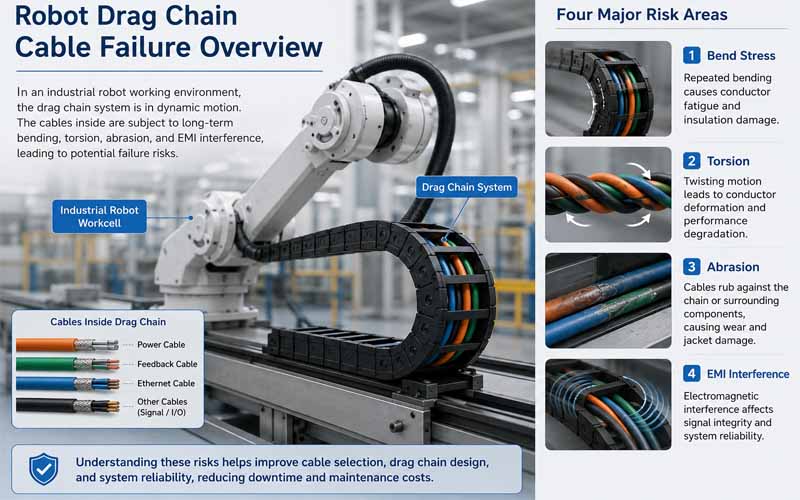
Unlike static wiring, drag chain cable assemblies operate under constant movement, bending, and acceleration.
As a result, cable failures often occur long before other electrical components wear out.
Understanding the most common failure mechanisms can help machine builders, OEMs, and maintenance teams significantly improve reliability and reduce downtime.
Why Drag Chain Applications Are Different
A standard industrial cable may perform well in fixed installations but fail quickly inside a drag chain.
Drag chain environments introduce:
- continuous bending
- repetitive flexing
- acceleration and deceleration
- vibration
- torsion
- mechanical abrasion
These stresses occur thousands or even millions of times throughout the equipment lifecycle.
Cable design must therefore focus on dynamic durability rather than only electrical performance.
Failure Point #1: Conductor Strand Breakage
One of the most common failures is conductor fatigue.
Repeated bending causes copper strands to experience cyclic stress.
Over time, individual strands begin to fracture.
Eventually:
- conductor resistance increases
- intermittent signals appear
- complete conductor failure occurs
Common Causes
- insufficient strand flexibility
- incorrect conductor construction
- cable bend radius violations
- excessive chain acceleration
Design Countermeasures
- use ultra-fine stranded conductors
- optimize strand lay length
- follow minimum bend radius guidelines
- validate cable flex life
Failure Point #2: Shielding Damage
Industrial automation environments contain significant electromagnetic interference (EMI).
Servo drives, motors, and switching power supplies generate noise that can affect sensitive signals.
Repeated movement may cause:
- shield cracking
- braid separation
- foil tearing
- grounding discontinuities
This can result in:
- encoder errors
- communication instability
- EMC failures
Design Countermeasures
- use high-flex shield constructions
- apply braided shields designed for dynamic motion
- ensure 360° shield termination
- verify transfer impedance performance
Failure Point #3: Jacket Abrasion
Cable jackets constantly rub against:
- drag chain links
- neighboring cables
- guide systems
Over time, abrasion may expose internal layers.
High-Risk Conditions
- high-speed applications
- long travel distances
- improperly filled cable chains
Design Countermeasures
- select abrasion-resistant jacket materials
- optimize chain fill ratio
- maintain proper cable separation
- use low-friction jacket compounds
Failure Point #4: Torsional Stress Failure
Many robotic applications involve twisting as well as bending.
Robot wrists and articulated arms often generate torsional movement.
Standard drag chain cables may not tolerate:
- ±180°
- ±360°
- continuous twisting cycles
Torsional stress can damage:
- conductors
- shielding
- insulation
Design Countermeasures
- use robot-rated torsion cables
- specify torsion cycle requirements during design
- verify application-specific movement profiles
Failure Point #5: Insulation Cracking
Thermal cycling and mechanical stress can degrade insulation materials.
Common symptoms include:
- cracks
- hardening
- loss of flexibility
Failure risks increase in environments involving:
- oil exposure
- UV exposure
- extreme temperatures
- chemical contamination
Design Countermeasures
- select application-specific insulation materials
- verify environmental compatibility
- perform accelerated aging validation
Failure Point #6: Connector and Termination Failure
Many cable failures actually originate at the termination.
Stress concentration near connectors may cause:
- conductor breakage
- shield discontinuity
- pull-out failures
Typical Causes
- insufficient strain relief
- improper cable clamping
- poor assembly practices
Design Countermeasures
- use engineered strain relief systems
- optimize connector backshell design
- validate pull-force performance
Failure Point #7: Incorrect Cable Chain Routing
Even a well-designed cable can fail prematurely if installed incorrectly.
Common installation mistakes include:
- crossing cables
- overfilling the chain
- inadequate separation
- violating bend radius limits
Design Countermeasures
- follow cable chain manufacturer guidelines
- maintain proper cable spacing
- avoid cable twisting during installation
The Importance of Cable Chain Fill Ratio
Overfilled chains create excessive friction.
A common recommendation is to leave sufficient free space between adjacent cables.
Benefits include:
- reduced abrasion
- lower operating temperature
- improved cable movement
Proper chain layout often has as much impact as cable design itself.
Why EMC Design Matters
Modern automation systems increasingly rely on:
- EtherCAT
- PROFINET
- EtherNet/IP
- encoder feedback systems
Communication reliability depends on maintaining shielding effectiveness throughout the cable life cycle.
EMC failures frequently appear before complete cable failure occurs.
Validation Tests for Drag Chain Cable Assemblies
High-quality cable assemblies should undergo:
Continuous Flex Testing
Millions of bending cycles.
Torsion Testing
Repeated twisting motion validation.
Abrasion Testing
Jacket wear resistance evaluation.
Temperature Cycling
Material durability assessment.
EMC Testing
Shield continuity verification.
Pull Force Testing
Termination robustness evaluation.
Questions Buyers Should Ask Suppliers
Before approving a drag chain cable assembly, buyers should ask:
- What flex life testing has been completed?
- What torsion capability is supported?
- Is the cable chain rated?
- What shielding construction is used?
- How is strain relief designed?
- What environmental validations are available?
- Can custom assemblies be supplied?
These questions often reveal the real reliability capability of a cable solution.
How FPIC Supports Robotic and Motion Applications
FPIC provides custom cable assemblies for:
- industrial robots
- servo systems
- automated production lines
- gantry systems
- warehouse automation
- motion control equipment
Our solutions include:
- drag chain cable assemblies
- robotic torsion cable assemblies
- M23 servo cable assemblies
- encoder and feedback cables
- custom overmolded cable solutions
We help customers optimize reliability under continuous motion conditions.
Final Thoughts
Robot drag chain cable failures are rarely random.
Most failures can be traced to:
- conductor fatigue
- shielding damage
- abrasion
- torsion stress
- termination weakness
- installation errors
By addressing these risks early in the design process, engineers can significantly improve equipment uptime and reduce maintenance costs.
In dynamic automation environments, cable reliability is often a key factor in overall system performance.
FAQ
What is the most common drag chain cable failure?
Conductor strand fatigue caused by repeated bending cycles.
Why do robot cables require torsion resistance?
Robot joints often introduce twisting motion in addition to bending.
Can standard industrial cables be used in drag chains?
Generally no. Dynamic motion applications require specialized cable constructions.
Why is shielding important in robotic cable assemblies?
Shielding protects communication and feedback signals from EMC interference.
What validation tests are recommended?
Flex life, torsion, abrasion, EMC, temperature cycling, and pull-force testing.
Looking for Reliable Robot Drag Chain Cable Assemblies?
FPIC provides custom drag chain, robotic, servo, and feedback cable assemblies engineered for continuous motion, harsh industrial environments, and long service life.
Contact us to discuss your automation and robotics cable requirements.
Resources
- igus – Cable Chain Engineering Guidelines
Best practices for drag chain cable installation and routing. - IEC 60204-1 – Safety of Machinery Electrical Equipment
Machinery electrical design requirements. - PROFINET Installation Guidelines
Industrial communication cabling recommendations. - ODVA EtherNet/IP Media Planning Guide
Ethernet-based industrial network cable requirements. - M23 Connector Applications for Motion Control Systems
Connector solutions for servo and robotic applications.