Harsh-Environment Wire Harness Design for Agricultural and Construction Equipment
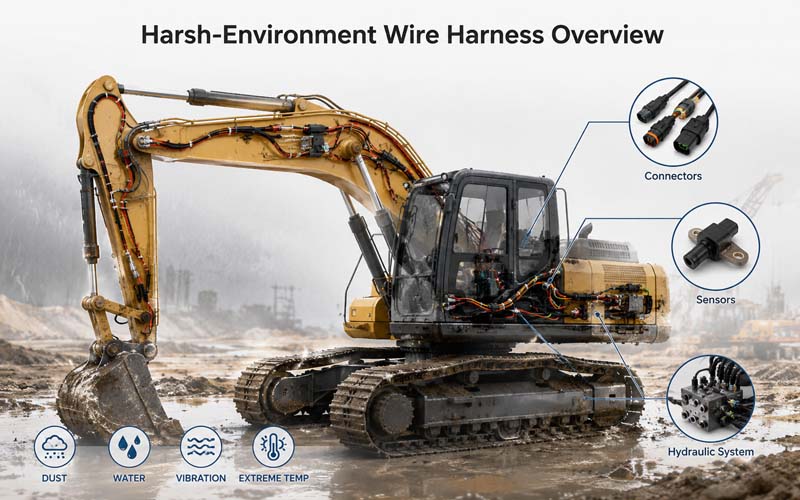
Agricultural and construction equipment operate in some of the most demanding environments for electrical systems. Unlike factory automation equipment installed in controlled facilities, tractors, excavators, loaders, harvesters, and off-highway vehicles are constantly exposed to vibration, shock, dust, mud, moisture, chemicals, and extreme temperatures.
In these applications, wire harness reliability directly impacts machine uptime, operator safety, and maintenance costs. A connector failure, damaged cable, or moisture intrusion issue can disable critical systems and lead to expensive field repairs.
Designing a wire harness for harsh environments requires much more than selecting the correct wire gauge. Engineers must consider environmental exposure, mechanical stress, sealing performance, serviceability, and long-term durability throughout the equipment lifecycle.
This article explores the key design principles for wire harnesses used in agricultural and construction machinery.
Why Harsh-Environment Applications Require Specialized Harness Design
Heavy equipment operates under conditions that are significantly more demanding than typical industrial machinery.
Common environmental challenges include:
- continuous vibration and shock loading
- exposure to water, mud, and dust
- direct sunlight and UV radiation
- hydraulic fluids, fuels, and chemicals
- extreme heat and cold
- frequent washing and pressure cleaning
- long operating hours in remote locations
A harness that performs well in a factory environment may fail quickly when exposed to these conditions.
Successful harsh-environment harness design begins with understanding the real operating environment rather than relying solely on electrical requirements.
Managing Vibration and Mechanical Fatigue
Vibration is one of the leading causes of wire harness failure in heavy equipment.
Construction and agricultural machines generate constant vibration through:
- diesel engines
- hydraulic systems
- rough terrain
- attachment movement
- chassis flexing
Over time, vibration can cause:
- conductor fatigue
- insulation wear
- terminal fretting
- connector loosening
- clamp failure
Secure Harness Retention
Proper retention prevents excessive movement and reduces fatigue loading.
Best practices include:
- strategically placed clamps
- vibration-resistant mounting systems
- adequate support near connectors
- protection at branch points
The objective is to control movement without over-constraining the harness.
Protect High-Stress Areas
The highest risk locations are usually:
- connector exits
- clamp transitions
- articulated joints
- frame pass-through points
- engine compartment interfaces
These areas should receive additional strain relief and abrasion protection.
Designing for Water, Mud, and Dust Exposure
Agricultural and construction equipment frequently operate in environments where contamination is unavoidable.
Rain, irrigation systems, mud, dust clouds, and high-pressure cleaning can all compromise electrical systems if sealing is inadequate.
Use Appropriate Sealed Connectors
Connector selection plays a critical role in environmental protection.
For outdoor heavy equipment applications, engineers commonly specify:
- IP67-rated connectors
- IP68-rated connectors
- sealed backshells
- integrated cable sealing systems
The sealing system should be evaluated as a complete assembly rather than focusing only on connector specifications.
Eliminate Water Collection Points
Harness routing should prevent water accumulation.
Avoid:
- low points where water can collect
- unsupported loops
- downward-facing connector interfaces
- routing paths that trap debris
Proper routing reduces long-term moisture exposure and minimizes corrosion risk.
Consider Pressure Washing Conditions
Many machines are regularly cleaned using high-pressure water systems.
Design reviews should evaluate:
- sealing integrity under direct spray
- connector orientation
- grommet performance
- enclosure penetration points
A harness that survives rain exposure may still fail under frequent washdown conditions.
Protecting Against Abrasion and Impact Damage
Heavy equipment environments contain numerous sources of physical damage.
Potential hazards include:
- metal brackets
- moving components
- hydraulic lines
- chassis edges
- rocks and debris
Use Mechanical Protection Strategically
Common protection methods include:
- corrugated conduit
- braided sleeving
- textile protection wraps
- abrasion-resistant tubing
- reinforced loom systems
The protection method should match the actual risk level rather than applying the same solution everywhere.
Maintain Clearance from Moving Components
Harness routing should account for:
- suspension movement
- steering articulation
- boom and arm movement
- engine vibration
- thermal expansion
Clearance should be verified throughout the full operating range of the equipment.
Managing Temperature Extremes
Agricultural and construction equipment may operate in environments ranging from sub-zero winter conditions to high-temperature summer job sites.
Additionally, localized heat sources such as engines, turbochargers, hydraulic systems, and exhaust components can significantly increase temperatures around the harness.
Select Materials for Real Operating Conditions
Material selection should consider:
- conductor insulation temperature rating
- jacket flexibility at low temperatures
- UV resistance
- chemical resistance
- long-term aging performance
A material that performs well in laboratory testing may not provide adequate durability in field applications.
Avoid Routing Near Heat Sources
Where possible, maintain distance from:
- exhaust systems
- engine blocks
- hydraulic pumps
- cooling system components
When separation is not possible, thermal shielding may be required.
Chemical Resistance Matters More Than Many Designers Expect
Agricultural and construction equipment are frequently exposed to:
- diesel fuel
- hydraulic oil
- lubricants
- fertilizers
- pesticides
- cleaning chemicals
Chemical attack can degrade insulation, weaken sealing materials, and shorten harness life.
Design teams should verify compatibility between cable materials and expected chemical exposure before finalizing specifications.
Serviceability Is Critical for Field Maintenance
Heavy equipment often operates in remote locations where service access is limited.
A poorly designed harness can dramatically increase repair time and maintenance costs.
Design for Easy Identification
Service technicians benefit from:
- clear wire labeling
- identifiable branch structures
- consistent connector coding
- accessible routing paths
Reducing troubleshooting time improves equipment availability.
Use Modular Harness Architecture
Whenever practical, divide the system into serviceable sections.
Examples include:
- engine harness
- cabin harness
- lighting harness
- sensor harness
- power distribution harness
Modular architecture simplifies replacement and reduces maintenance complexity.
Validation Requirements for Harsh-Environment Harnesses
Laboratory validation is essential before deployment.
Typical validation activities include:
- continuity testing
- insulation resistance testing
- vibration testing
- mechanical shock testing
- temperature cycling
- sealing validation
- chemical exposure testing
- salt spray testing
- connector retention testing
The objective is to confirm performance under conditions that closely represent actual field operation.
A harness that passes electrical testing alone may still fail if mechanical and environmental durability are not properly evaluated.
How FPIC Supports Heavy Equipment Harness Projects
For agricultural and construction equipment manufacturers, wire harness development requires balancing durability, manufacturability, and cost.
FPIC supports custom wire harness and connector projects for industrial and heavy-duty applications, providing assistance with connector selection, environmental protection strategies, prototype development, testing support, and scalable manufacturing.
By considering routing, sealing, mechanical protection, and serviceability early in the design process, equipment manufacturers can reduce maintenance issues and improve long-term reliability.
Final Thoughts
Harsh-environment wire harness design requires a comprehensive approach that addresses much more than electrical connectivity.
Vibration, moisture, dust, temperature extremes, abrasion, and chemical exposure all influence long-term reliability. The most successful designs integrate environmental protection, mechanical durability, and serviceability from the earliest stages of development.
For agricultural and construction equipment, a well-designed harness not only improves machine performance but also reduces downtime, simplifies maintenance, and lowers total ownership costs.
FAQ
What causes most wire harness failures in agricultural equipment?
The most common causes include vibration, moisture intrusion, abrasion, connector corrosion, and improper strain relief.
Why are sealed connectors important in construction equipment?
Sealed connectors help prevent water, dust, and contaminants from entering electrical interfaces, improving reliability in outdoor environments.
What protection methods are commonly used for heavy equipment harnesses?
Common solutions include corrugated conduit, braided sleeving, abrasion-resistant tubing, protective wraps, and reinforced loom systems.
How does vibration affect wire harness life?
Continuous vibration can cause conductor fatigue, insulation wear, terminal fretting, and connector loosening over time.
What tests should be performed on harsh-environment harnesses?
Typical tests include vibration testing, thermal cycling, sealing validation, insulation resistance testing, chemical exposure testing, and salt spray testing.
Need a Custom Wire Harness for Agricultural or Construction Equipment?
If your equipment operates in demanding outdoor environments, harness design decisions can significantly impact reliability and maintenance costs. FPIC supports custom wire harness and connector solutions for heavy-duty applications requiring durability, environmental protection, and long service life.
Contact FPIC today to discuss your project requirements.
Resources
- SAE J1455 – Recommended Environmental Practices for Electronic Equipment Design in Heavy-Duty Vehicles: provides guidance for vibration, temperature, humidity, shock, and environmental testing in heavy-duty vehicle applications.
- TE Connectivity – Rugged Connectivity for Off-Highway Equipment: discusses connector and harness design challenges for agricultural, construction, and heavy equipment environments.
- Deutsch Connectors Environmental Protection Guide: explains sealing technologies, environmental protection strategies, and connector performance in harsh operating conditions.
- Caterpillar Electrical Application and Installation Guide: outlines best practices for electrical system durability, routing, protection, and maintenance in heavy equipment.
- IPC/WHMA-A-620 Requirements and Acceptance for Cable and Wire Harness Assemblies: industry standard covering workmanship, assembly quality, inspection, and acceptance requirements for wire harness manufacturing.