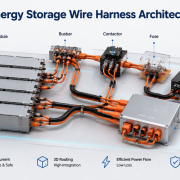
How to Design Low-Voltage and High-Current Wire Harness for BESS Cabinets
As Battery Energy Storage Systems (BESS) continue to increase in power density, the design of low-voltage, high-current wire harness has become a critical engineering challenge.
Unlike high-voltage EV systems, many BESS cabinets operate at relatively low voltages while carrying hundreds or even thousands of amperes. Under these conditions, conductor resistance, temperature rise, voltage drop, and connection reliability become far more significant than insulation voltage ratings alone.
A well-designed wire harness improves energy efficiency, minimizes heat generation, extends service life, and enhances overall system safety.
This article explores the key design considerations for low-voltage, high-current harnesses used in modern BESS cabinets.
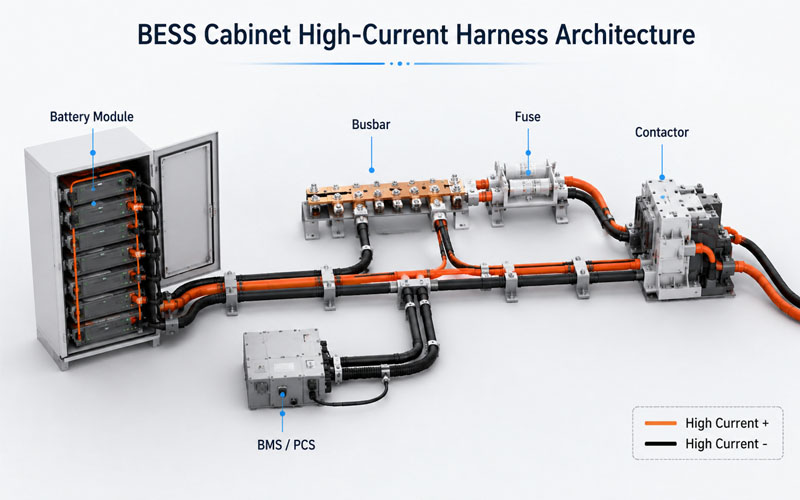
Why Low Voltage Means Higher Current
Electrical power follows a simple relationship:
Power = Voltage × Current
For the same power output, lowering the system voltage requires a proportional increase in current.
For example:
- 100 kW at 1000 V requires approximately 100 A.
- 100 kW at 250 V requires approximately 400 A.
As current increases:
- conductor losses increase
- temperature rises faster
- voltage drop becomes more significant
- connection quality becomes increasingly critical
For BESS designers, current management is often a greater challenge than voltage insulation.
Selecting the Correct Conductor Size
Choosing conductor size involves much more than checking an ampacity table.
Engineers should evaluate:
- continuous operating current
- overload conditions
- ambient temperature
- enclosure ventilation
- cable grouping
- installation method
- allowable voltage drop
Simply selecting the largest cable is rarely the best solution, as larger conductors increase:
- weight
- bending stiffness
- installation complexity
- material cost
The objective is to achieve the optimal balance between electrical performance and manufacturability.
Controlling Voltage Drop
In low-voltage systems, even small voltage drops can reduce efficiency.
Voltage drop depends on:
- cable length
- conductor resistance
- operating current
- connection quality
Excessive voltage drop can result in:
- lower charging efficiency
- inverter performance reduction
- unequal battery module loading
- increased power loss
Reducing cable length and optimizing routing are often as important as increasing conductor size.
Managing Temperature Rise
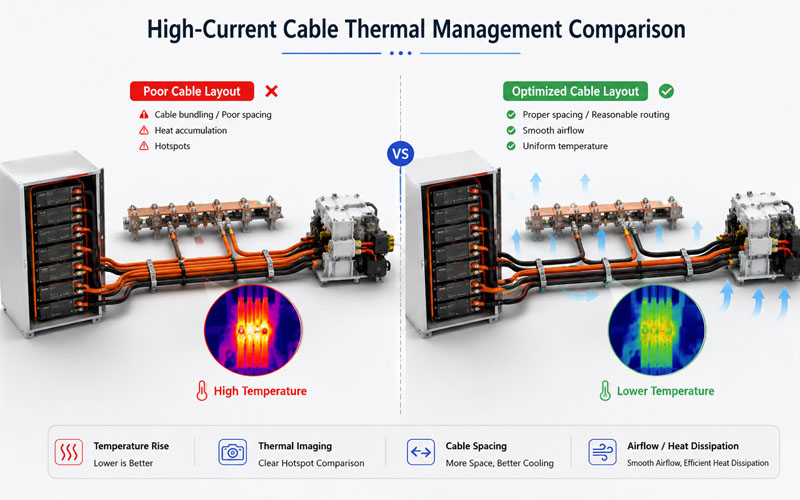
Heat generation is one of the primary design challenges in high-current cable assemblies.
Temperature rise is affected by:
- conductor resistance
- contact resistance
- cable spacing
- enclosure airflow
- continuous duty cycle
Localized heating frequently occurs at:
- busbar interfaces
- crimp terminals
- bolted connections
- connector contacts
Infrared thermal imaging is widely used during validation to identify potential hot spots before production.
Busbar and Terminal Interface Design
Electrical interfaces are often the weakest points within a BESS cabinet.
Proper interface design requires attention to:
- terminal plating
- crimp quality
- bolt torque
- contact pressure
- anti-loosening measures
Poor interfaces increase resistance, which directly increases heat generation under heavy load.
Engineers should also consider vibration caused by cooling fans and transportation.
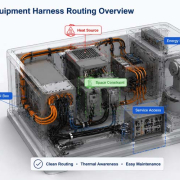
Cable Routing Inside BESS Cabinets
Compact cabinet layouts make routing increasingly important.
Good routing practices include:
- minimizing cable length
- maintaining adequate bend radius
- separating power and communication wiring
- avoiding sharp edges
- allowing airflow around high-current cables
Proper routing improves both electrical performance and maintenance accessibility.
Mechanical Protection
BESS cable assemblies must withstand transportation, installation, vibration, and long-term operation.
Common protection methods include:
- abrasion-resistant sleeves
- corrugated conduit
- insulated busbar covers
- cable clamps
- strain relief devices
Mechanical durability directly influences electrical reliability throughout the system’s service life.
Current Sharing in Parallel Conductors
Large BESS cabinets often use multiple conductors connected in parallel.
To achieve balanced current distribution:
- conductor lengths should be equal
- conductor sizes should match
- connection resistance should remain consistent
- routing symmetry should be maintained
Uneven current sharing may overload individual conductors while others remain underutilized.
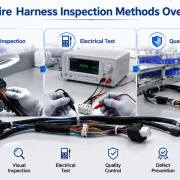
Validation Testing
Prototype validation should simulate actual operating conditions.
Recommended tests include:
- temperature rise testing
- current cycling
- insulation resistance
- Hi-Pot testing
- vibration testing
- pull force testing
- thermal cycling
- voltage drop measurement
Validation should focus on the complete assembly rather than individual components.
Standards for BESS Cable Assemblies
Depending on project requirements, engineers commonly reference:
- IEC 62933 — Electrical Energy Storage Systems
- UL 9540 — Energy Storage Systems and Equipment
- UL 1973 — Batteries for Stationary Applications
- IEC 61439 — Low-Voltage Switchgear and Controlgear Assemblies
Customer-specific validation procedures are also common in utility-scale energy storage projects.
How FPIC Supports BESS Wire Harness Development
FPIC designs and manufactures custom high-current wire harnesses for battery energy storage systems, battery cabinets, power distribution units, and energy storage containers.
Our engineering team supports customers with conductor selection, terminal crimp optimization, busbar interface design, cable routing, and production validation to deliver reliable cable assemblies capable of operating in demanding energy storage environments.
Final Thoughts
As BESS technology continues to evolve, wire harness design becomes increasingly important to system efficiency, safety, and reliability.
By optimizing conductor sizing, reducing voltage drop, controlling temperature rise, improving busbar interfaces, and validating designs under realistic operating conditions, engineers can significantly improve long-term system performance.
A reliable BESS is built not only on advanced batteries, but also on every electrical connection that links them together.
FAQ
Why do BESS cabinets require high-current wire harnesses?
Many battery energy storage systems operate at relatively low voltages while delivering very high power, resulting in extremely high operating currents.
Why is voltage drop more critical in low-voltage systems?
A small voltage drop represents a larger percentage of the system voltage, reducing efficiency and increasing power loss.
How can temperature rise be reduced?
Proper conductor sizing, optimized cable routing, secure busbar interfaces, and effective cabinet ventilation all help control operating temperatures.
Why are busbar interfaces important?
Poor contact resistance at busbar connections generates heat, reducing efficiency and shortening connector and terminal life.
Which validation tests are recommended?
Temperature rise, current cycling, insulation resistance, Hi-Pot, vibration, thermal cycling, and voltage drop testing are commonly used to validate BESS wire harnesses.
Looking for Custom High-Current Wire Harnesses for BESS?
Reliable battery energy storage systems require more than quality battery cells—they require dependable electrical connections. FPIC provides custom high-current wire harnesses and cable assemblies engineered for BESS cabinets, battery packs, and power distribution systems, helping customers improve efficiency, safety, and long-term reliability.
Contact FPIC today to discuss your BESS cable assembly requirements.
Resources
- IEC 62933 – Electrical Energy Storage (EES) Systems:
https://webstore.iec.ch/
International standards covering the safety, performance, and integration of electrical energy storage systems. - UL 9540 – Energy Storage Systems and Equipment:
https://www.ul.com/
Provides safety requirements for complete BESS installations and electrical system integration. - UL 1973 – Batteries for Stationary Applications:
https://www.ul.com/
Defines safety requirements for stationary battery systems and associated electrical interconnections. - TE Connectivity – Battery Energy Storage Solutions:
https://www.te.com/
Explains high-current connectors, busbar interfaces, and connectivity solutions for modern energy storage systems. - Phoenix Contact – Battery Energy Storage Connection Technology:
https://www.phoenixcontact.com/
Provides technical guidance on high-current connections, power distribution, and wiring technologies used in BESS applications.