How to Select Jacket, Shield and Strain Relief for Industrial Cable Assemblies
Industrial cable assemblies often operate in environments that are far more demanding than their appearance suggests. Exposure to oil, chemicals, vibration, mechanical movement, electromagnetic interference (EMI), temperature fluctuations, and repeated handling can all impact long-term performance.
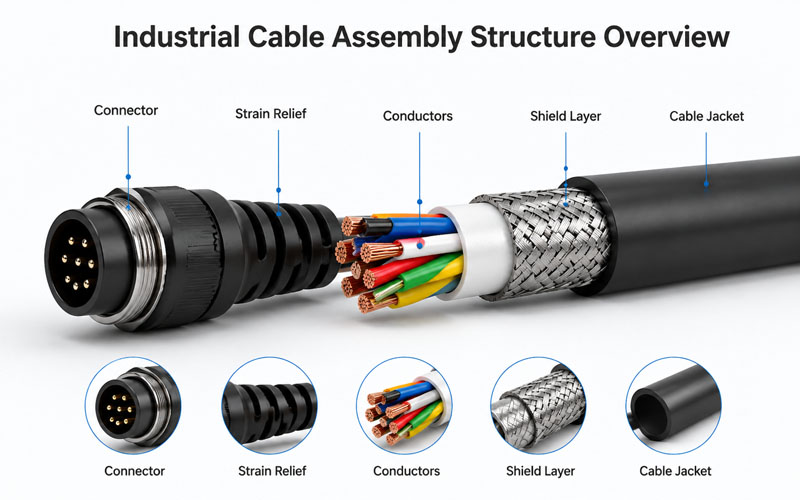
While conductor size and connector selection usually receive significant attention during design, three equally important elements are often overlooked: cable jackets, shielding systems, and strain relief structures.
Selecting the right combination of these components can dramatically improve cable assembly reliability, reduce maintenance costs, and extend service life. Conversely, poor material or design choices may lead to premature failures even when the electrical design itself is sound.
This article explains how engineers can evaluate and select jacket materials, shielding solutions, and strain relief methods for industrial cable assemblies.
Why These Three Elements Matter
Many cable assembly failures originate outside the conductor itself.
Common field failures include:
- jacket cracking
- insulation wear
- EMI-related communication issues
- connector damage
- conductor fatigue
- cable pullout
In many cases, the root cause is not the wire but inadequate protection against environmental and mechanical stress.
A robust industrial cable assembly must address:
- environmental exposure
- electromagnetic compatibility (EMC)
- mechanical load management
Jackets, shields, and strain relief systems are the primary tools used to achieve these goals.
Selecting the Right Cable Jacket Material
The cable jacket is the outermost protective layer of the assembly. It serves as the first line of defense against environmental and mechanical damage.
Understand the Operating Environment
Before selecting a jacket material, engineers should evaluate:
- operating temperature
- chemical exposure
- UV exposure
- moisture conditions
- abrasion risk
- flexing requirements
No single jacket material performs best in all environments.
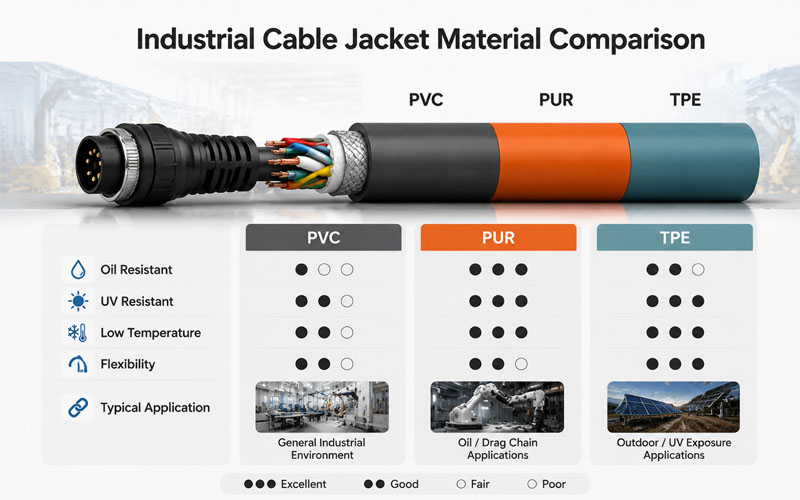
PVC Jackets
PVC remains one of the most commonly used cable jacket materials.
Advantages include:
- low cost
- good flexibility
- broad availability
- easy processing
However, PVC may not provide the best performance in:
- extreme temperatures
- continuous flexing applications
- aggressive chemical environments
PUR Jackets
Polyurethane (PUR) jackets are widely used in industrial automation and robotic systems.
Benefits include:
- excellent abrasion resistance
- superior oil resistance
- good flexibility
- long flex life
PUR is often preferred for:
- drag chain applications
- robotic cable assemblies
- machine tool environments
TPE and TPU Materials
Thermoplastic elastomers offer excellent flexibility and environmental resistance.
These materials are commonly selected when:
- dynamic movement is present
- low-temperature flexibility is required
- harsh industrial environments are expected
Jacket Selection Mistakes
Common errors include:
- choosing materials based only on cost
- ignoring chemical exposure
- underestimating UV exposure
- using static-rated materials in dynamic applications
The operating environment should always drive material selection.
Understanding Cable Shielding Requirements
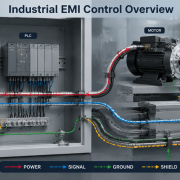
As industrial systems become increasingly connected, shielding plays a critical role in maintaining signal integrity.
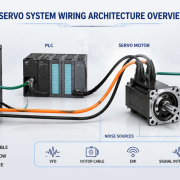
Variable frequency drives, servo systems, motors, wireless devices, and industrial networks all generate electromagnetic noise.
Without proper shielding, cable assemblies may experience:
- communication errors
- unstable sensor signals
- data loss
- increased system downtime
When Shielding Is Necessary
Shielding is commonly required for:
- Ethernet cables
- encoder cables
- servo motor cables
- sensor wiring
- communication networks
- VFD power cables
The required shielding level depends on both signal sensitivity and noise exposure.
Foil Shielding
Foil shields provide nearly complete coverage around conductors.
- Advantages include:
- excellent high-frequency protection
- lightweight construction
- lower cost
Foil shielding is commonly used in:
- industrial Ethernet
- communication cables
- data transmission systems
Braided Shielding
Braided shields use woven metal strands surrounding the cable core.
Benefits include:
- superior mechanical durability
- low impedance grounding path
- excellent performance at lower frequencies
Braided shields are often preferred in:
- servo systems
- motor cables
- harsh industrial environments
Combination Shields
Some applications use both foil and braided shields.
This approach provides:
- broad-frequency EMI protection
- improved EMC performance
- increased reliability in high-noise environments
Critical automation systems often benefit from combination shielding strategies.
Strain Relief: The Most Overlooked Reliability Feature
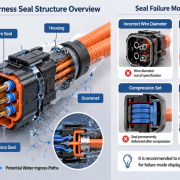
A cable assembly may use high-quality materials and connectors but still fail prematurely if mechanical loads are transferred directly into the termination area.
Strain relief is designed to prevent these loads from reaching the conductors and contacts.
Why Strain Relief Matters
Without proper strain relief, common failure modes include:
- conductor breakage
- terminal pullout
- crimp damage
- solder joint failure
- connector cracking
These failures typically occur at cable exits where stress is concentrated.
Common Strain Relief Methods
Industrial cable assemblies commonly use:
- molded strain relief boots
- cable glands
- backshell systems
- clamp-based retention
- overmolding
The selection depends on application requirements and installation conditions.
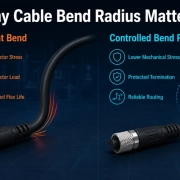
Consider Dynamic Movement
Applications involving:
- robotics
- drag chains
- automated machinery
- moving gantries
require more robust strain relief systems than static installations.
Designers should evaluate:
- bend radius
- movement direction
- cycle count
- cable weight
before selecting a strain relief solution.
Integrating Jacket, Shield and Strain Relief as a System
One of the most common design mistakes is evaluating these components independently.
For example:
- a flexible cable jacket may be paired with an overly rigid strain relief
- a high-performance shield may be improperly grounded
- a durable jacket may still fail due to poor routing
The most reliable cable assemblies are designed as complete systems.
Engineers should evaluate:
- environmental conditions
- EMC requirements
- mechanical loading
- maintenance requirements
- installation constraints
as part of a unified design process.
Validation Considerations
After material selection, validation testing is essential.
Typical tests include:
- flex testing
- pull testing
- abrasion testing
- EMC testing
- temperature cycling
- chemical exposure testing
- ingress protection testing
Testing helps confirm that the selected design performs as expected under real operating conditions.
How FPIC Supports Industrial Cable Assembly Development
Selecting jacket materials, shielding structures, and strain relief systems requires balancing performance, manufacturability, and cost.
FPIC supports custom cable assembly and connector projects across industrial automation, robotics, machine building, and harsh-environment applications. Our engineering team works closely with customers to evaluate operating conditions, optimize cable architecture, and develop reliable assembly solutions for long-term field performance.
Final Thoughts
Industrial cable assembly reliability depends on much more than conductor selection and connector quality.
The correct jacket material protects against environmental damage. Proper shielding maintains signal integrity. Effective strain relief prevents mechanical stress from damaging critical termination points.
When these three elements are designed together, cable assemblies achieve higher reliability, longer service life, and lower maintenance costs across demanding industrial applications.
FAQ
What is the purpose of a cable jacket?
A cable jacket protects the assembly from abrasion, chemicals, moisture, UV exposure, and environmental damage.
When should braided shielding be used instead of foil shielding?
Braided shielding is often preferred in applications requiring better mechanical durability and lower-frequency EMI protection.
Why is strain relief important in cable assemblies?
Strain relief prevents mechanical loads from reaching conductors and connectors, reducing fatigue and premature failure.
Which jacket material is best for drag chain applications?
PUR and certain TPE materials are commonly selected because of their flexibility, abrasion resistance, and long flex life.
Can shielding eliminate all EMI problems?
No. Effective EMC performance depends on proper cable design, grounding, routing, and system-level considerations.
Looking for a Custom Industrial Cable Assembly Solution?
Whether your application requires superior abrasion resistance, enhanced EMC protection, or high-flex performance, selecting the right cable architecture is critical. FPIC provides custom cable assemblies and connector solutions designed for demanding industrial environments.
Contact FPIC today to discuss your cable assembly requirements.
Resources
- LAPP – Industrial Cable Selection Guide: https://www.lapp.com/en/de/products/cables/c/113891
Provides guidance on selecting cable jacket materials, shielding structures, and application-specific cable solutions. - HELUKABEL – Cable Jacket Materials Overview: https://www.helukabel.com
Explains the characteristics of PVC, PUR, TPE, and other industrial cable jacket materials. - Belden – Shielding Effectiveness and EMC Design: https://www.belden.com
Discusses foil shielding, braided shielding, grounding strategies, and EMC considerations for industrial networks. - UL Solutions – Wire and Cable Testing Services: https://www.ul.com/services/wire-and-cable-testing
Outlines testing methods for mechanical durability, environmental performance, and cable reliability. - IPC/WHMA-A-620 Requirements and Acceptance for Cable and Wire Harness Assemblies: https://www.ipc.org
Industry-standard guidance covering cable assembly workmanship, inspection, and quality requirements.