Wire Harness Considerations for PCS, BMS and Battery Rack Integration
Modern Battery Energy Storage Systems (BESS) are no longer just collections of battery modules. They are highly integrated electrical systems where the Battery Rack, Battery Management System (BMS), and Power Conversion System (PCS) must communicate and operate seamlessly.
While battery performance often receives the most attention, improper wire harness design between these subsystems can lead to communication failures, voltage imbalance, electromagnetic interference (EMI), maintenance difficulties, and unexpected downtime.
A well-designed wire harness not only delivers power but also ensures reliable signal transmission, simplifies installation, and improves long-term serviceability.
This article discusses the key wire harness considerations for integrating PCS, BMS, and battery racks in modern energy storage systems.
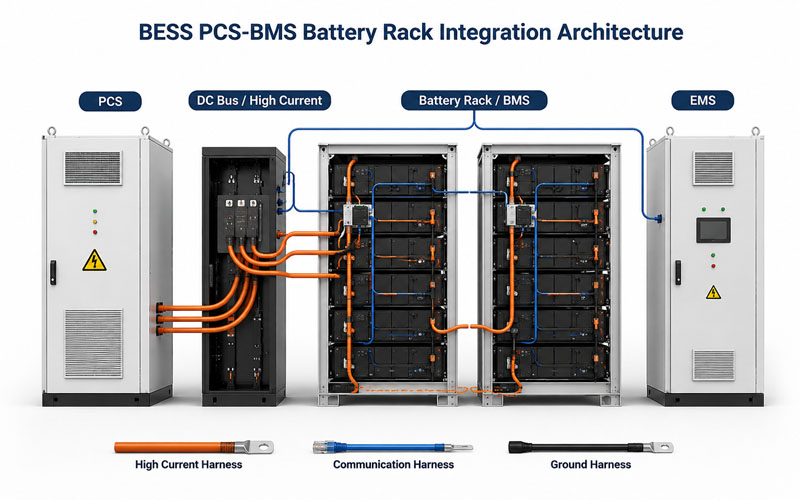
Understanding the Electrical Architecture of a BESS
A typical BESS consists of three major electrical subsystems:
- Battery Racks
- Battery Management System (BMS)
- Power Conversion System (PCS)
The wire harness acts as the communication and power backbone connecting these components.
Typical harness functions include:
- High-current power transmission
- Voltage sensing
- Temperature monitoring
- CAN Bus communication
- Ethernet communication
- Digital I/O signals
- Grounding connections
- Auxiliary power distribution
As system capacity increases, harness complexity grows significantly.
Separating Power and Signal Circuits
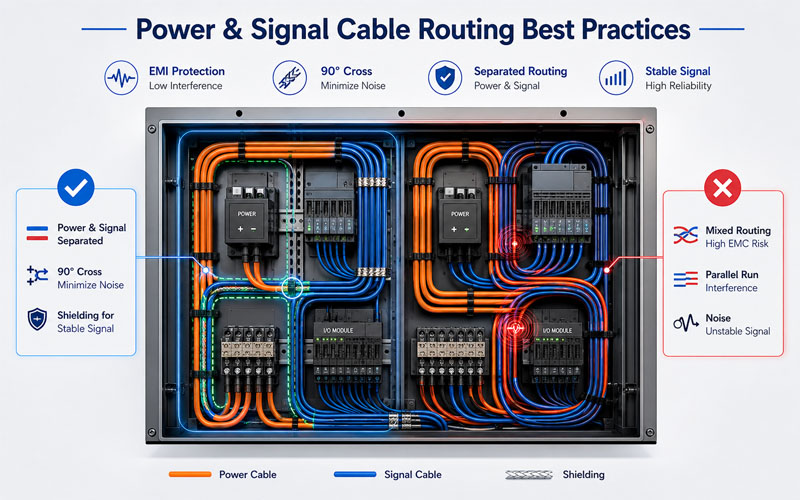
One of the most important design principles is keeping high-current and low-voltage circuits separated.
Power cables carrying hundreds of amperes generate electromagnetic fields that may interfere with sensitive communication and sensing signals.
Recommended practices include:
- Separate routing paths for power and signal cables
- Dedicated cable trays
- Shielded communication cables
- Controlled crossing angles (90° where necessary)
- Adequate spacing between cable bundles
Proper cable separation significantly improves signal integrity and EMC performance.
Reliable BMS Harness Design
The BMS continuously monitors battery health through multiple sensing circuits.
Typical BMS harnesses include:
- Cell voltage sensing
- Temperature sensor wiring
- Current sensing interfaces
- CAN Bus communication
- Alarm outputs
Because voltage sensing circuits carry low-level signals, they are particularly susceptible to electrical noise.
Design recommendations include:
- Twisted-pair conductors
- Shielded signal cables
- Stable grounding
- Secure connector locking
- Clear wire identification
Accurate measurements depend on stable electrical connections throughout the system.
Designing PCS Cable Assemblies
The PCS converts DC power from the battery into AC power for the electrical grid.
PCS cable assemblies must support:
- High continuous current
- Low contact resistance
- Mechanical durability
- Efficient heat dissipation
Key design considerations include:
- High-current terminals
- Busbar interfaces
- Crimp quality
- Cable flexibility
- Connector locking mechanisms
- Strain relief
Mechanical reliability is especially important because PCS equipment often experiences vibration from cooling fans and switching equipment.
EMC and Noise Reduction
Energy storage systems contain numerous switching devices that generate electromagnetic interference.
Major EMI sources include:
- PCS inverters
- DC/DC converters
- Contactors
- High-current cables
To improve EMC performance:
- Use shielded communication cables
- Properly terminate cable shields
- Minimize cable loop areas
- Avoid parallel routing of power and signal cables
- Establish low-impedance grounding paths
Good EMC design improves communication reliability and reduces false system alarms.
Connector Selection for Integrated Systems
Connectors should be selected based on both electrical and environmental requirements.
Important factors include:
- Current rating
- Voltage rating
- IP protection level
- Mating cycle life
- Vibration resistance
- Operating temperature
- Mechanical locking
In outdoor ESS installations, sealed connectors with IP67 or higher protection are commonly used.
Connector standardization also simplifies maintenance and spare parts management.
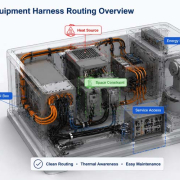
Cable Routing for Serviceability
A wire harness should not only perform well electrically—it should also simplify maintenance.
Good routing practices include:
- Logical cable grouping
- Clear labeling
- Adequate maintenance space
- Accessible connectors
- Modular cable assemblies
- Controlled bend radius
Technicians should be able to replace individual harnesses without dismantling large sections of the cabinet.
Serviceability directly affects maintenance cost and system availability.
Mechanical Protection Inside Battery Cabinets
Battery cabinets are exposed to:
- vibration
- transportation
- thermal cycling
- installation stress
Harness protection methods include:
- corrugated conduit
- braided sleeving
- cable clamps
- insulated mounting brackets
- abrasion-resistant protection
Mechanical stability prevents conductor fatigue and connector loosening during long-term operation.
Validation Before Production
Comprehensive testing ensures harness reliability.
Recommended validation includes:
- Continuity testing
- Insulation resistance testing
- Hi-Pot testing
- Temperature rise testing
- Vibration testing
- Thermal cycling
- EMC verification
- Connector insertion and extraction testing
Testing complete assemblies is far more representative than testing individual components alone.
Relevant Standards
Wire harnesses used in BESS integration commonly reference:
- IEC 62933 – Electrical Energy Storage Systems
- UL 9540 – Energy Storage Systems and Equipment
- UL 1973 – Batteries for Stationary Applications
- IEC 61000 – Electromagnetic Compatibility (EMC)
- IEC 62477 – Safety Requirements for Power Electronic Converter Systems
Compliance with these standards helps ensure safety, interoperability, and long-term reliability.
How FPIC Supports Integrated BESS Harness Solutions
Modern energy storage systems require customized wire harnesses capable of handling high current, reliable signal transmission, and complex cabinet layouts.
FPIC provides custom wire harnesses and cable assemblies for battery racks, BMS, PCS, and complete energy storage systems. From cable routing optimization and connector selection to EMC design and production validation, our engineering team helps customers improve system reliability while simplifying installation and maintenance.
Final Thoughts
The performance of a Battery Energy Storage System depends not only on batteries and power electronics but also on the quality of the electrical connections between them.
A carefully designed wire harness improves communication stability, reduces electromagnetic interference, enhances serviceability, and supports long-term system reliability.
As BESS installations continue to increase in size and complexity, integrated wire harness design is becoming a critical part of overall system engineering.
FAQ
Why is wire harness design important in BESS integration?
A properly designed harness ensures reliable power transmission, accurate signal communication, and easier maintenance between the PCS, BMS, and battery racks.
Why should power and signal cables be separated?
Separating power and signal cables reduces electromagnetic interference, improving communication reliability and measurement accuracy.
What communication protocols are commonly used in BMS wiring?
CAN Bus, RS-485, and Industrial Ethernet are widely used for communication between battery modules, BMS controllers, and PCS equipment.
Why is EMC important in energy storage systems?
Good EMC design prevents electrical noise from affecting communication signals, reducing false alarms and improving overall system stability.
Which tests are recommended before production?
Continuity, insulation resistance, Hi-Pot, vibration, thermal cycling, EMC verification, and connector durability tests are commonly performed.
Need Custom Wire Harnesses for Battery Energy Storage Systems?
Reliable BESS integration starts with dependable electrical connections. FPIC designs custom wire harnesses and cable assemblies for battery racks, BMS, PCS, and complete energy storage systems, helping customers improve reliability, simplify installation, and reduce maintenance costs.
Contact FPIC today to discuss your energy storage wire harness requirements.
Resources
- IEC 62933 – Electrical Energy Storage (EES) Systems
https://webstore.iec.ch/
Provides international standards for the planning, safety, and performance of electrical energy storage systems. - UL 9540 – Energy Storage Systems and Equipment
https://www.ul.com/
Defines safety requirements for integrated battery energy storage systems and associated electrical equipment. - IEC 61000 – Electromagnetic Compatibility (EMC)
https://webstore.iec.ch/
International EMC standards covering immunity and emission requirements for industrial electrical systems. - Phoenix Contact – Battery Energy Storage Connection Technology
https://www.phoenixcontact.com/
Explains connection technologies, communication interfaces, and power distribution solutions for BESS. - TE Connectivity – Energy Storage Connectivity Solutions
https://www.te.com/
Discusses connector systems, cable assemblies, and high-current interconnection technologies for battery energy storage applications.