Servo Cable vs Feedback Cable vs Power Cable: What Industrial Buyers Should Know
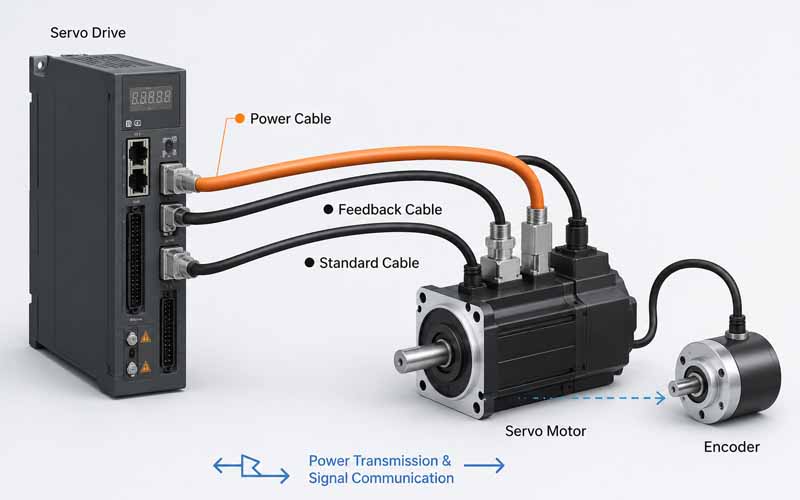 Learn the differences between servo cable, feedback cables, and power cables in industrial automation systems and how to select the right cable.
In industrial automation systems, the terms servo cable, feedback cable, and power cable are often used interchangeably.
However, these cables perform very different functions within a motion control system.
Choosing the wrong cable can lead to:
- unstable motor operation
- encoder communication errors
- EMC issues
- premature cable failure
- increased maintenance costs
For OEMs, machine builders, and industrial equipment buyers, understanding the differences between these cable types is essential when specifying automation systems.
This article explains how servo, feedback, and power cables differ and what buyers should evaluate before making a purchasing decision.
Understanding a Typical Servo System
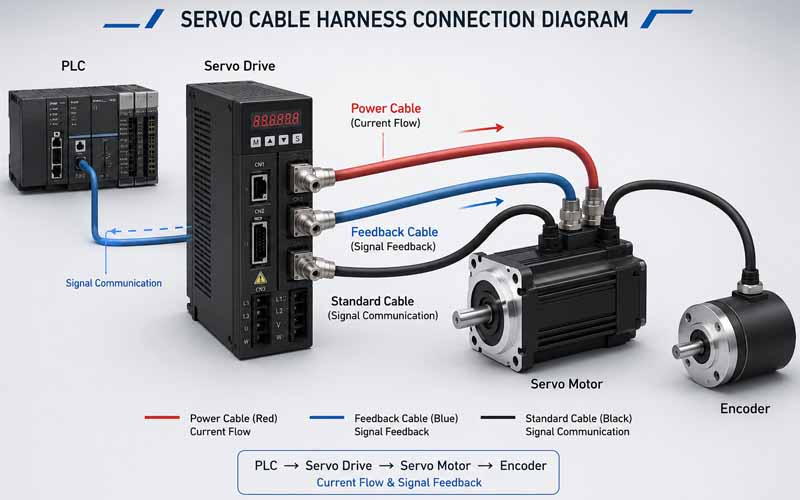
A modern servo system usually consists of:
- servo drive
- servo motor
- encoder or resolver
- control system
To operate correctly, the system requires both power transmission and signal communication.
This is where different cable types are used.
What Is a Servo Power Cable?
A servo power cable delivers electrical power from the servo drive to the motor.
Its primary purpose is to carry:
- motor supply voltage
- motor operating current
- braking current (if applicable)
Typical conductor configurations include:
- 3-phase power conductors
- protective earth (PE)
- brake conductors
Servo power cables are designed to handle:
- continuous motion
- high current loads
- frequent acceleration cycles
- industrial environments
Main Characteristics of Servo Power Cables
Common features include:
High Flexibility
Suitable for:
- drag chains
- robotic systems
- repetitive motion
Oil and Abrasion Resistance
Industrial machinery often exposes cables to:
- lubricants
- cutting fluids
- chemicals
Shielding
Shielding helps reduce:
- conducted noise
- radiated EMI
High Current Capacity
Conductor sizes are selected based on:
- motor power
- current requirements
- installation conditions
What Is a Feedback Cable?
A feedback cable transmits position and speed information from the motor encoder or resolver back to the servo drive.
Unlike power cables, feedback cables carry signals rather than motor power.
Typical transmitted information includes:
- position
- speed
- direction
- motor temperature
- diagnostic data
Without accurate feedback, servo control performance deteriorates rapidly.
Main Characteristics of Feedback Cables
Signal Integrity
Feedback signals are often:
- low voltage
- high frequency
- sensitive to interference
Twisted Pair Construction
Twisted pairs help reduce:
- noise pickup
- crosstalk
Enhanced Shielding
Feedback cables typically require:
- foil shielding
- braided shielding
- low transfer impedance
Precision Connector Interfaces
Common connector types include:
- M23
- M17
- RJ45 industrial interfaces
- proprietary servo connectors
What Is a Standard Power Cable?
A standard power cable simply transfers electrical energy between devices.
Typical applications include:
- control cabinets
- power distribution
- industrial equipment
- utility connections
Unlike servo power cables, standard power cables are usually not designed for:
- continuous motion
- torsion
- dynamic bending
Key Differences at a Glance
| Feature | Servo Power Cable | Feedback Cable | Standard Power Cable |
|---|---|---|---|
| Main Function | Motor Power Transmission | Signal Communication | General Power Distribution |
| Current Carrying | High | Very Low | Medium to High |
| Signal Transmission | No | Yes | No |
| Motion Capability | High | High | Usually Limited |
| Shielding Requirement | Moderate to High | Very High | Application Dependent |
| EMC Sensitivity | Medium | Very High | Low to Medium |
Why Feedback Cables Require More EMC Attention
One common misconception is that power cables are always more critical.
In reality, feedback cables are often more sensitive to EMC issues.
Potential problems include:
- encoder data loss
- position errors
- communication interruptions
- servo instability
Even minor signal degradation can affect machine accuracy.
Can Power and Feedback Be Combined?
Some modern servo systems use hybrid cables that combine:
- power conductors
- feedback pairs
- brake circuits
Advantages include:
- simplified installation
- reduced cable count
- lower assembly costs
However, careful EMC design is required to prevent interference.
Connector Considerations
Industrial buyers should evaluate connector compatibility.
Common servo connectors include:
M23 Connectors
Widely used for servo motors and feedback systems.
Circular Hybrid Connectors
Combine power and signal circuits.
Heavy-Duty Industrial Connectors
Used in large automation systems.
Connector quality directly affects system reliability.
Environmental Considerations
Cable selection should account for:
- temperature
- oil exposure
- moisture
- UV exposure
- vibration
- drag chain operation
Different environments require different jacket and shielding materials.
Common Purchasing Mistakes
Selecting by Conductor Size Alone
Cable performance depends on more than current rating.
Ignoring EMC Requirements
Feedback cable reliability depends heavily on shielding quality.
Using Standard Power Cable for Servo Motion
Static cables often fail prematurely in dynamic applications.
Overlooking Connector Compatibility
Incorrect interfaces create installation delays.
Underestimating Cable Movement Cycles
Motion applications require specialized flex-rated designs.
Questions Industrial Buyers Should Ask Suppliers
Before purchasing, buyers should confirm:
- Is the cable designed for servo applications?
- What motion cycle life has been validated?
- What shielding construction is used?
- Is the cable drag-chain rated?
- Which connector systems are supported?
- Is EMC performance documented?
- Can custom assemblies be supplied?
How FPIC Supports Industrial Motion Control Applications
FPIC provides custom cable assemblies for industrial automation systems, including:
- servo power cables
- encoder and feedback cables
- hybrid servo cables
- M23 cable assemblies
- drag-chain cable assemblies
- industrial circular connector solutions
Our engineering team supports cable selection based on motion profile, EMC requirements, and environmental conditions.
Final Thoughts
Servo power cables, feedback cables, and standard power cables serve different purposes within industrial automation systems.
Understanding these differences helps buyers improve:
- motion control performance
- system reliability
- EMC compliance
- maintenance efficiency
Selecting the right cable is not simply a matter of conductor size—it requires evaluating electrical, mechanical, and environmental requirements together.
FAQ
What is the difference between a servo cable and a feedback cable?
A servo power cable transmits motor power, while a feedback cable transmits encoder or resolver signals.
Can a standard power cable be used as a servo cable?
Generally no. Servo cables are designed for continuous motion and industrial automation environments.
Why is shielding important in feedback cables?
Shielding protects sensitive encoder signals from electrical noise and EMC interference.
What connector is commonly used for servo systems?
M23 connectors are widely used for both servo power and feedback applications.
Are hybrid servo cables a good option?
They can simplify installation, but EMC and signal separation must be carefully managed.
Looking for Custom Servo or Feedback Cable Assemblies?
FPIC provides industrial cable assemblies for automation, robotics, servo motors, and motion control systems, including custom M23, circular, and hybrid cable solutions.
Contact us to discuss your automation connectivity requirements.
Resources
- IEC 60204-1 – Safety of Machinery Electrical Equipment
Electrical requirements for industrial machinery. - PI (PROFIBUS & PROFINET International)
Industrial communication and motion control standards. - ODVA EtherNet/IP Motion Specifications
Motion control communication requirements. - Siemens Motion Control Cable Selection Guide
Practical servo and feedback cable application guidance. - M23 Connector Standards and Applications
Industrial connector solutions for servo systems.