Single Pair Ethernet Cable Assemblies for Industrial Devices: What Changes in Harness Design
Industrial communication networks are evolving rapidly.
For years, industrial Ethernet systems have relied on:
- Cat5e cables
- Cat6 cables
- 4-pair Ethernet architectures
- RJ45 connectors
- M12 D-coded and X-coded connectors
Today, a new technology is gaining momentum:
Single Pair Ethernet (SPE).
By transmitting Ethernet communication over a single twisted pair, SPE enables smaller, lighter, and more efficient cable assemblies.
For industrial device manufacturers, however, SPE is not simply a cable reduction exercise.
It changes connector selection, shielding strategy, EMC performance, power delivery, and overall harness architecture.
This article explains how SPE affects industrial cable assembly design and what OEMs should consider before adopting it.
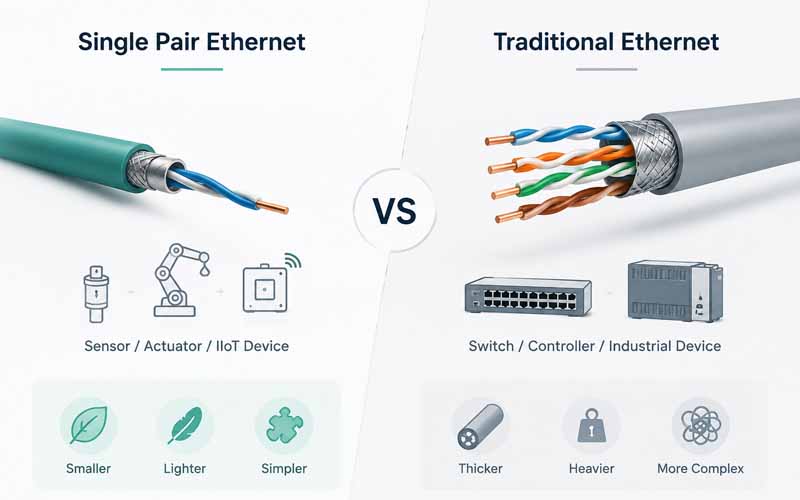
What Is Single Pair Ethernet?
Single Pair Ethernet uses one twisted pair instead of the traditional four twisted pairs used in conventional Ethernet.
The technology supports:
- Ethernet communication
- sensor connectivity
- actuator communication
- Industrial IoT devices
- edge computing systems
Depending on the protocol and distance requirements, SPE can support:
- 10 Mbps
- 100 Mbps
- 1 Gbps
while significantly reducing cable size.
Why Industrial Automation Is Moving Toward SPE
Several industry trends are accelerating SPE adoption:
More Connected Devices
Factories are deploying:
- smart sensors
- intelligent actuators
- vision systems
- IIoT nodes
The number of Ethernet-connected devices continues to grow.
Smaller Equipment
Machine builders increasingly demand:
- compact devices
- lightweight harnesses
- reduced installation space
Traditional Ethernet cables can become oversized for many field devices.
Simplified Network Architecture
SPE enables Ethernet communication closer to the device level.
This helps reduce protocol conversion layers and supports unified communication architectures.
How SPE Changes Harness Design
The most obvious change is cable construction.
However, the impact extends much further.
Smaller Cable Diameter
Traditional Industrial Ethernet cables typically contain:
- four twisted pairs
- shielding layers
- fillers
- jacket materials
SPE uses only one twisted pair.
Benefits include:
- smaller outside diameter
- lower cable weight
- reduced routing space
- easier installation
This is especially valuable in compact automation equipment.
Connector Selection Becomes Different
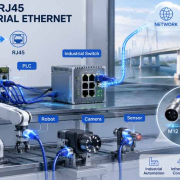
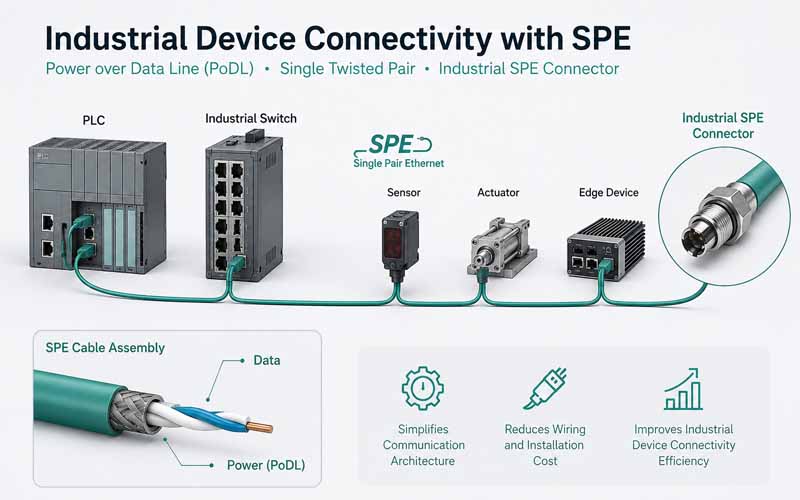
SPE does not use standard RJ45 interfaces in many field-level applications.
Instead, common SPE connector standards include:
- IEC 63171-2
- IEC 63171-5
- IEC 63171-6
- industrial SPE connector variants
Industrial SPE connectors are designed to support:
- compact packaging
- vibration resistance
- industrial EMC requirements
Connector selection becomes a key system design decision.
Power and Data Can Share the Same Pair
One of the most significant changes is support for:
Power over Data Line (PoDL)
Similar to PoE (Power over Ethernet), PoDL allows:
- communication
- power delivery
through the same twisted pair.
Benefits include:
- fewer cables
- simplified installation
- reduced harness complexity
This can dramatically change machine wiring architecture.
Shielding Requirements Do Not Disappear
A common misconception is that smaller cables require less EMC attention.
The opposite is often true.
Industrial environments contain:
- servo drives
- inverters
- switching power supplies
- high-current conductors
SPE cables still require careful consideration of:
- shielding effectiveness
- transfer impedance
- grounding strategy
- shield termination
EMC remains critical to communication reliability.
360° Shield Termination Remains Important
Industrial SPE assemblies should maintain:
- continuous shield paths
- low-impedance grounding
- 360° shield contact
Poor shield termination can create:
- packet errors
- communication instability
- increased susceptibility to interference
The principles remain similar to conventional Industrial Ethernet.
Pair Geometry Becomes More Critical
With only one communication pair available, signal quality becomes increasingly dependent on:
- pair twist consistency
- impedance control
- conductor symmetry
Manufacturing quality directly affects communication performance.
Harness suppliers must maintain tight process control.
Cable Routing Flexibility Improves
The reduced cable diameter offers advantages in:
- robotics
- compact machinery
- sensor networks
- automated production equipment
Engineers can route SPE assemblies through areas where conventional Ethernet cables may be difficult to install.
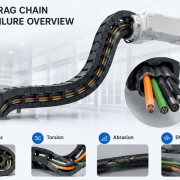
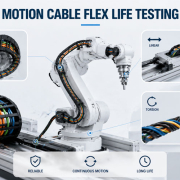
Dynamic Motion Applications Require Specialized Designs
Many SPE devices will be deployed in:
- robotic systems
- servo equipment
- drag chains
These environments still require:
- high-flex conductors
- torsion resistance
- abrasion resistance
Cable miniaturization does not eliminate mechanical durability requirements.
IP Protection Requirements Remain the Same
Industrial devices continue to require environmental protection.
Common requirements include:
IP67
For general factory automation.
IP68
For harsh industrial environments.
IP69K
For washdown applications.
Connector miniaturization must not compromise sealing performance.
SPE and Industry 4.0
SPE aligns closely with Industry 4.0 objectives.
Benefits include:
- direct Ethernet connectivity
- simplified architectures
- improved interoperability
- scalable sensor networks
Many industrial device manufacturers view SPE as a long-term technology platform.
Common Design Mistakes
Assuming SPE Is Just a Smaller Ethernet Cable
SPE affects the entire communication architecture.
Ignoring EMC Requirements
Smaller size does not reduce EMC sensitivity.
Overlooking Connector Standards
Multiple SPE connector ecosystems exist.
Compatibility should be evaluated early.
Underestimating Mechanical Requirements
Industrial environments still demand robust cable assemblies.
Focusing Only on Data Rate
Environmental and mechanical performance remain equally important.
Questions Buyers Should Ask SPE Harness Suppliers
Before approving an SPE cable assembly supplier, ask:
- Which SPE connector standard is supported?
- Is PoDL capability available?
- What shielding structure is used?
- How is shield termination implemented?
- What IP rating is achieved?
- Is the assembly suitable for dynamic motion?
- What EMC validation has been completed?
These questions help ensure long-term network reliability.
Typical Applications
Single Pair Ethernet cable assemblies are increasingly used in:
- industrial sensors
- smart actuators
- IIoT devices
- edge computing systems
- robotics
- machine vision
- process automation
- factory automation networks
How FPIC Supports SPE Cable Assembly Development
FPIC develops custom industrial communication cable assemblies including:
- SPE cable assemblies
- Industrial Ethernet harnesses
- M8 and M12 communication cables
- shielded data cable assemblies
- robotic communication cables
- custom overmolded connectivity solutions
Our engineering team supports connector selection, shielding optimization, EMC design, and environmental validation.
Final Thoughts
Single Pair Ethernet is changing how industrial devices are connected.
Compared with conventional Ethernet harnesses, SPE offers:
- smaller cable size
- reduced weight
- simplified installation
- integrated power and data capability
However, successful implementation still requires careful attention to:
- connector standards
- EMC performance
- shielding design
- environmental protection
- mechanical durability
As Industry 4.0 adoption accelerates, SPE is expected to become an increasingly important connectivity technology for industrial automation.
FAQ
What is Single Pair Ethernet?
Single Pair Ethernet transmits Ethernet communication using one twisted pair instead of four pairs.
Does SPE support power delivery?
Yes. Many SPE systems support Power over Data Line (PoDL).
Is shielding still necessary for SPE?
Absolutely. Industrial EMC environments still require effective shielding and grounding.
Can SPE be used in robotics?
Yes, provided the cable assembly is designed for dynamic motion and flex applications.
What is the main advantage of SPE?
Reduced cable size and simplified connectivity while maintaining Ethernet communication.
Looking for Custom Single Pair Ethernet Cable Assemblies?
FPIC provides SPE cable assemblies, Industrial Ethernet harnesses, M8/M12 communication cables, and custom connectivity solutions for automation, robotics, and Industrial IoT applications.
Contact us to discuss your Single Pair Ethernet connectivity requirements.
Resources
- IEC 63171 Series – Single Pair Ethernet Connectors
https://webstore.iec.ch - IEEE 802.3cg – 10BASE-T1L and 10BASE-T1S Standards
https://standards.ieee.org - PROFINET over SPE Technology Overview
https://www.profibus.com - ODVA Single Pair Ethernet Guidance
https://www.odva.org - SPE Industrial Networking White Paper – Phoenix Contact
https://www.phoenixcontact.com