How to Optimize Wire Harness Routing for Reliability and Maintenance
A wire harness can contain dozens or even hundreds of wires, terminals, connectors, protective components, and branch points.
Even when every individual component meets its specification, poor routing can still create reliability problems.
Improper routing may expose a harness to:
- Excessive bending
- Abrasion
- Vibration
- Heat
- Tensile stress
- Connector loading
- Difficult maintenance access
For automotive systems, industrial automation, robotics, energy storage equipment, agricultural machinery, and other demanding applications, routing design is therefore more than a packaging issue.
It is a reliability and serviceability decision.
A well-routed wire harness should not only fit inside the equipment.
It should remain protected, mechanically stable, electrically reliable, and accessible throughout its service life.
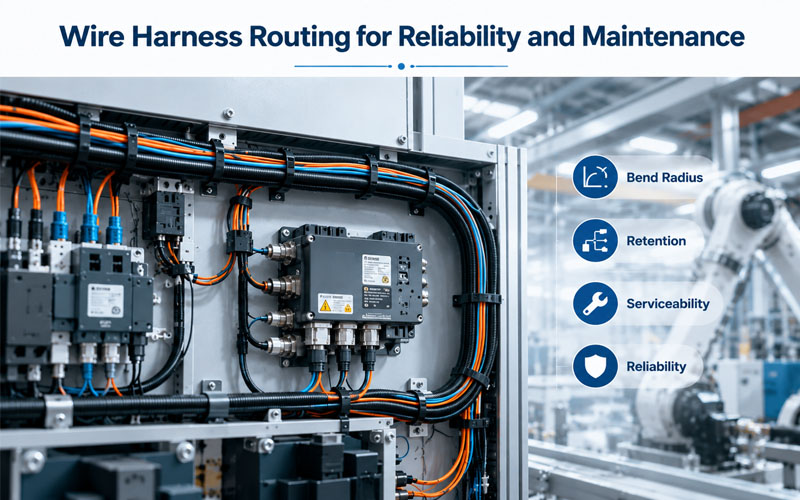
What Is Wire Harness Routing?
Wire harness routing is the planned path a harness follows between connectors, electrical components, sensors, control units, power sources, and other system interfaces.
A routing design determines:
- Harness path
- Branch locations
- Connector orientation
- Fixing points
- Bend locations
- Clearance from surrounding components
- Protection requirements
The objective is to control how the harness interacts with the surrounding system.
A good routing strategy balances:
Reliability + Packaging + Serviceability + Manufacturing
Why Wire Harness Routing Affects Reliability
A harness is exposed to mechanical and environmental conditions throughout its operating life.
Poor routing can introduce stress that may not appear during initial electrical testing.
For example, a harness routed too close to a sharp metal edge may initially pass continuity testing but eventually develop insulation damage after repeated vibration.
Similarly, a connector may function correctly during assembly but experience excessive mechanical loading because the harness is pulling against it.
This is why routing should be considered during the engineering design stage rather than treated as a final packaging task.
1.Control Bend Radius
One of the first routing considerations is bend radius.
Every cable and wire construction has a minimum recommended bending radius.
Repeatedly bending a harness tighter than its intended limit can cause:
- Conductor fatigue
- Insulation damage
- Shield deformation
- Increased mechanical stress
- Reduced flex life
Static vs Dynamic Routing
The required bend strategy depends on whether the harness moves.
Static Harness
Used in:
- Control cabinets
- Battery cabinets
- Fixed industrial equipment
The harness may only experience limited movement during installation or maintenance.
Dynamic Harness
Used in:
- Robotics
- Drag chains
- Moving machinery
- Automated equipment
Dynamic harnesses experience repeated bending and require much greater attention to:
- Bend radius
- Flexibility
- Cable construction
- Strain relief
A routing design that works for a static harness may fail quickly in a dynamic application.
2.Avoid Sharp Edges and Abrasion Points
Sharp edges are a common cause of long-term harness failure.
Potential contact points include:
- Sheet metal edges
- Brackets
- Screw heads
- Machined surfaces
- Equipment frames
Continuous vibration can cause the harness jacket or insulation to rub against these surfaces.
Over time, this can lead to:
Abrasion → Insulation Damage → Conductor Exposure → Electrical Failure
Routing should maintain adequate clearance from potential abrasion sources.
Where clearance is limited, designers can consider:
- Protective sleeves
- Corrugated tubing
- Braided sleeving
- Edge protection
- Grommets
3.Keep Harnesses Away From Excessive Heat
Temperature is another important routing consideration.
Harnesses routed near:
- Motors
- Exhaust components
- Heaters
- Power electronics
- High-temperature equipment
may experience elevated thermal exposure.
Excessive temperature can accelerate:
- Insulation aging
- Jacket degradation
- Seal deterioration
- Terminal performance changes
Routing should therefore consider both:
Normal Operating Temperature
and
Potential Peak Temperature
Thermal protection may include:
- Heat-resistant wire
- Protective sleeves
- Heat shields
- Increased clearance
4.Prevent Excessive Tensile and Connector Loading
A harness should not be used as a mechanical support for connected components.
If the routing path is too short or poorly positioned, the harness can apply continuous force to the connector.
This may create:
- Connector misalignment
- Terminal stress
- Seal deformation
- Intermittent contact
- Premature connector wear
A proper routing design provides enough slack and appropriate strain relief without creating unnecessary loops.
5.Position Branches Carefully
Branch points influence both assembly and maintenance.
Poorly positioned branches can cause:
- Difficult installation
- Excessive bending
- Connector interference
- Poor accessibility
A branch should ideally be positioned according to the actual geometry of the equipment.
Important considerations include:
- Connector location
- Component movement
- Fixing points
- Service access
- Manufacturing sequence
Branching should be planned during harness design rather than added as an afterthought.
6.Use Appropriate Fixing and Retention Points
Harnesses need controlled support.
Common retention methods include:
- Cable ties
- Clips
- P-clamps
- Mounting brackets
- Adhesive-backed supports
- Integrated harness retainers
The purpose is not simply to hold the harness in place.
Retention should control:
- Movement
- Vibration
- Sagging
- Contact with surrounding parts
However, excessive clamping force can also damage insulation.
The retention system therefore needs to provide secure positioning without creating excessive compression.
7.Separate Power and Sensitive Signal Circuits
Routing can also influence electromagnetic compatibility.
High-current power cables can generate electromagnetic interference that affects sensitive signal circuits.
Where applicable, designers should consider separating:
- Power circuits
- Signal circuits
- Communication cables
- Sensor wiring
For shielded cables, routing should also maintain proper:
- Shield continuity
- Grounding strategy
- Separation distance
This becomes particularly important in:
- Industrial Ethernet
- Sensor systems
- Motor control
- Robotics
- Automotive electronics
8.Consider Maintenance Access During Routing
A harness that is reliable but impossible to service is not an optimized design.
Maintenance engineers may need to:
- Disconnect connectors
- Replace sensors
- Inspect terminals
- Replace damaged sections
- Perform electrical testing
If connectors are buried behind other components, maintenance time increases significantly.
Good routing should provide:
✔ Connector accessibility
✔ Adequate hand clearance
✔ Visible identification labels
✔ Reasonable removal paths
✔ Accessible fixing points
9.Design for Installation and Removal
Serviceability should be considered in both directions.
The harness should be easy to:
Install → Connect → Secure → Inspect → Remove
A good routing design avoids unnecessary:
Crossovers
Tight loops
Hidden connectors
Difficult-to-access clips
Excessive retention points
This can reduce assembly time and simplify field maintenance.
10.Use Routing to Improve Harness Manufacturing
Routing design also affects manufacturing efficiency.
A complicated routing structure may require:
- More assembly fixtures
- More manual operations
- Additional protective components
- More inspection points
Manufacturers should therefore evaluate:
Design → Assembly → Installation → Service
as one complete process.
Standardizing branch locations, clip positions, and connector orientations can improve production consistency.
11.Routing Considerations for Different Applications
Different applications require different routing priorities.
| Application | Key Routing Considerations |
|---|---|
| Automotive | Vibration, heat, abrasion, packaging |
| Robotics | Dynamic bending, flex life, strain relief |
| Energy Storage | High-current routing, thermal clearance, serviceability |
| Industrial Automation | EMI control, mechanical protection, accessibility |
| Agricultural Equipment | Moisture, mud, vibration, abrasion |
| Medical Equipment | Clean routing, reliability, service access |
Wire Harness Routing Design Checklist
Before finalizing a harness routing design, engineers should review:
Mechanical
✔ Is the bend radius appropriate?
✔ Is the harness protected from abrasion?
✔ Are connectors free from excessive mechanical loading?
✔ Are retention points correctly positioned?
Thermal
✔ Is the harness sufficiently separated from heat sources?
✔ Is the cable temperature rating appropriate?
Electrical
✔ Are sensitive circuits separated where necessary?
✔ Is shielding maintained correctly?
Serviceability
✔ Can technicians access connectors?
✔ Can the harness be removed without unnecessary disassembly?
✔ Are labels visible?
Manufacturing
✔ Can the harness be assembled consistently?
✔ Are routing and fixing points clearly defined?
✔ Can the design be inspected efficiently?
Common Wire Harness Routing Mistakes
| Routing Mistake | Potential Consequence |
|---|---|
| Excessive bend | Conductor or insulation damage |
| Routing near sharp edges | Abrasion failure |
| Poor thermal clearance | Insulation aging |
| Excessive connector loading | Terminal or seal damage |
| Weak retention | Vibration and movement |
| Over-tight clamping | Insulation compression |
| Poor service access | Longer maintenance time |
| Poor power/signal separation | EMI problems |
How FPIC Supports Reliable Wire Harness Design
FPIC provides customized wire harness and cable assembly solutions for demanding industrial applications.
Engineering considerations can include:
✔ Wire and cable selection
✔ Connector selection
✔ Routing and branch design
✔ Strain relief
✔ Protective sleeving
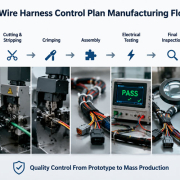
✔ Electrical testing
✔ Final inspection
By considering routing, manufacturing, testing, and application requirements together, FPIC helps OEM customers develop wire harness assemblies designed for reliable long-term operation.
Final Thoughts
Wire harness routing is not simply about making cables fit inside a machine.
It directly affects:
- Mechanical reliability
- Electrical performance
- Thermal durability
- EMI behavior
- Installation efficiency
- Maintenance time
The best routing strategy considers the complete lifecycle of the harness:
Design → Manufacturing → Installation → Operation → Maintenance
A reliable wire harness should stay where it belongs, remain protected from its environment, and remain accessible when service is required.
Good routing is therefore not just better packaging.
It is better engineering.
FAQ
Why is wire harness routing important?
Proper routing protects the harness from bending, abrasion, vibration, heat, and mechanical stress while improving installation and maintenance.
What is the minimum bend radius for a wire harness?
The required bend radius depends on the cable construction, conductor size, insulation, shielding, and whether the application is static or dynamic. The cable manufacturer’s specification should be followed.
How can wire harness routing prevent connector failure?
Proper routing prevents excessive tensile, bending, and lateral forces from being transferred to the connector and terminals.
Should power and signal wires be separated?
Where electromagnetic compatibility is a concern, appropriate separation and shielding strategies can help reduce interference between power and sensitive signal circuits.
How does routing affect wire harness maintenance?
Accessible connectors, clear routing paths, appropriate fixing points, and visible identification can significantly reduce inspection and replacement time.
Need a Reliable Custom Wire Harness?
FPIC provides customized wire harness and cable assembly solutions for automotive, energy storage, industrial automation, robotics, and other demanding applications.
From routing and component selection to assembly and electrical testing, FPIC supports OEM customers throughout the product development and manufacturing process.
Contact FPIC today to discuss your wire harness requirements.
Resources
- IPC/WHMA-A-620 – Requirements and Acceptance for Cable and Wire Harness Assemblies
https://www.ipc.org/
Industry reference for cable and wire harness assembly requirements and acceptance criteria. - SAE International
https://www.sae.org/
Provides engineering standards and technical resources relevant to automotive electrical and wiring systems. - IEC Standards
https://www.iec.ch/
International standards covering electrical equipment, cables, connectors, and related engineering requirements.