How Automated Crimping Machines Improve Wire Harness Consistency
Crimping is one of the most critical processes in wire harness manufacturing. The connection between a wire and terminal must provide reliable electrical conductivity and sufficient mechanical strength while maintaining consistent quality across thousands or even millions of production cycles.
Manual or semi-automatic crimping can be effective for certain production requirements, but process variation can increase as production volume, product complexity, and quality requirements grow.
Automated crimping machines provide a more controlled manufacturing environment by combining automatic wire processing, terminal feeding, crimping, process monitoring, and production data collection.
The objective is not simply to increase production speed. A well-controlled automated crimping process helps reduce variation and create more consistent wire harness assemblies.
1.Why Crimping Consistency Matters
A wire harness may contain dozens or hundreds of crimped terminals.
Each connection must meet the required mechanical and electrical characteristics.
Poor crimping can result in:
- High contact resistance
- Weak mechanical connection
- Wire pull-out
- Conductor damage
- Incorrect terminal deformation
- Inconsistent crimp height
- Insufficient conductor compression
- Excessive conductor compression
- Intermittent electrical performance
Some crimp defects may be visible during inspection, while others can remain hidden until the harness experiences vibration, thermal cycling, mechanical stress, or long-term electrical loading.
Therefore, crimping consistency is not only a production issue. It is directly related to wire harness reliability.
2.What Is an Automated Crimping Machine?
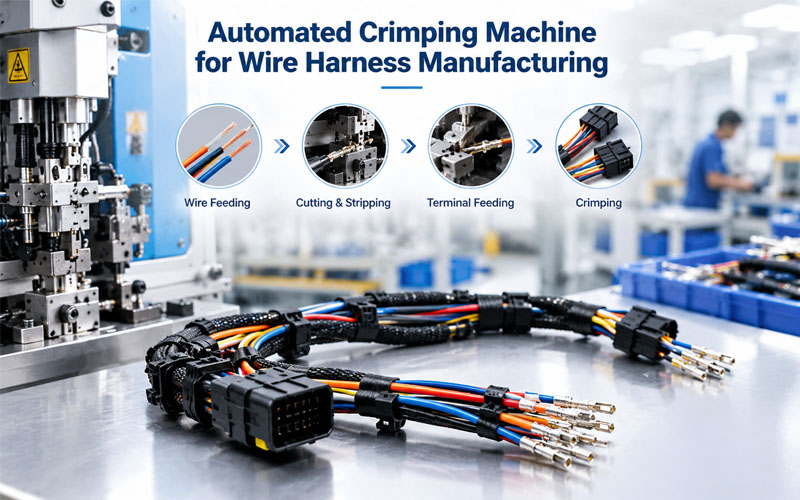
An automated crimping machine integrates multiple wire-processing operations into a controlled production system.
Depending on the machine configuration, it may perform:
Wire Feeding → Measuring → Cutting → Stripping → Terminal Feeding → Crimping → Quality Monitoring
Some systems can also perform additional operations such as seal insertion, double-end processing, wire marking, or automated terminal handling.
Compared with a standalone manual crimping process, automation provides greater control over the relationship between the wire, terminal, tooling, and production parameters.
3.Consistent Crimping Starts With Controlled Parameters
Crimp quality depends on several interrelated parameters.
Common factors include:
- Wire size
- Conductor material
- Terminal specification
- Terminal material
- Crimp height
- Crimp width
- Crimp tooling
- Applicator condition
- Strip length
- Conductor position
- Insulation support
- Crimp force
A major advantage of automated equipment is that these parameters can be established as part of a controlled production setup.
Instead of relying heavily on manual adjustment for every cycle, the machine can repeatedly execute the defined process conditions.
This helps reduce variation between operators and production batches.
4.Automatic Wire Cutting Improves Length Consistency
Before crimping begins, the wire must be processed to the correct length.
Inconsistent wire length can create problems during final harness assembly, particularly when multiple branches must follow a defined routing path.
Automated wire processing equipment can control:
- Cutting length
- Feed distance
- Stripping length
- Production quantity
- Wire identification
For high-volume production, automatic length control reduces the possibility of variations caused by manual measurement.
This creates a more consistent starting point for downstream crimping and harness assembly.
5.Automatic Stripping Protects the Conductor
Stripping is another important step in crimp preparation.
If too much insulation is removed, the exposed conductor may be longer than required.
If too little insulation is removed, the conductor may not enter the terminal correctly.
Poor stripping can also damage conductor strands.
Automated stripping systems can control stripping length and process movement with greater repeatability.
The goal is to create a consistent conductor exposure that matches the terminal’s specified crimping area.
6.Terminal Feeding Reduces Assembly Variation
Terminal positioning is critical to the crimping process.
The terminal must enter the crimping area in the correct orientation and position.
Automated terminal feeding systems can continuously supply terminals to the applicator while maintaining controlled positioning.
This reduces the need for operators to manually position individual terminals.
For high-volume production, consistent terminal feeding contributes to stable production rhythm and reduces the risk of incorrect positioning.
7.Controlled Crimping Reduces Process Variation
The actual crimping operation is where wire and terminal become a permanent mechanical and electrical connection.
An automated machine applies a defined mechanical movement through a dedicated crimping tool or applicator.
The result depends on the correct relationship between:
Wire + Terminal + Applicator + Crimp Parameters
When these variables are properly controlled, repeated cycles can achieve a much narrower process variation than an uncontrolled manual process.
This is particularly valuable for large production runs where even a small variation can become significant across thousands of assemblies.
8.Crimp Height and Crimp Width Need Control
Crimp height is one of the important dimensional indicators of crimp quality.
An excessively high crimp may not provide sufficient conductor compression.
An excessively low crimp may damage conductor strands or create other mechanical and electrical concerns.
Crimp width and terminal deformation also need to remain within the applicable engineering requirements.
Automated equipment helps maintain the mechanical relationship between the terminal and tooling.
However, automation does not eliminate the need for engineering verification.
Crimp samples should still be inspected and validated according to the applicable product specifications, customer requirements, and industry standards.
9.Crimp Force Monitoring Adds Another Quality Layer
Modern automated crimping equipment can be equipped with crimp force monitoring (CFM).
CFM measures the force profile during the crimping cycle.
An abnormal force curve may indicate conditions such as:
- Missing wire
- Incorrect terminal
- Incorrect wire size
- Terminal feeding problems
- Tool wear
- Material variation
- Crimping abnormalities
The exact detection capability depends on the machine, tooling, sensor system, and process setup.
The key benefit is that quality monitoring can move closer to the manufacturing process itself.
Instead of relying entirely on final inspection, manufacturers can detect certain process abnormalities during production.
10.Automation Supports In-Process Quality Control
A strong automated crimping process should not depend only on final inspection.
Quality can be controlled at several levels:
Level 1: Process Setup
Verify the correct wire, terminal, tooling, and production parameters.
Level 2: In-Process Monitoring
Monitor relevant production conditions and, where available, crimp force or other process signals.
Level 3: Dimensional Inspection
Check crimp height, crimp width, strip length, and terminal deformation.
Level 4: Mechanical Testing
Perform pull-force testing where required.
Level 5: Electrical Testing
Verify continuity, resistance, or other applicable electrical characteristics.
This layered approach creates stronger process control than relying on a single final inspection.
11.Automation Reduces Operator-to-Operator Variation
Manual production is influenced by operator technique and experience.
Different operators may apply slightly different methods when:
- Positioning wires
- Adjusting tools
- Feeding terminals
- Setting strip length
- Checking finished crimps
Automation standardizes repetitive operations.
This does not mean operator skill becomes unimportant.
Operators and technicians are still responsible for:
- Machine setup
- Tooling installation
- Parameter verification
- Material confirmation
- Quality inspection
- Troubleshooting
- Preventive maintenance
The difference is that automation reduces the amount of variation generated during repetitive production cycles.
12.Tooling Condition Is Still Critical
An automated machine cannot compensate for unsuitable or worn tooling.
Crimping tools and applicators experience mechanical wear over time.
Tool condition can influence:
- Crimp dimensions
- Terminal deformation
- Crimp force
- Mechanical strength
- Process stability
Therefore, automated crimping should include appropriate tooling inspection and maintenance.
A robust production system should track tooling condition and establish maintenance or replacement criteria based on engineering requirements and actual process performance.
13.Automated Crimping Improves Production Traceability
Modern manufacturing increasingly requires more than a finished-product inspection record.
Production teams may need to know:
- Which work order was processed?
- Which wire and terminal were used?
- Which machine produced the connection?
- Which tooling was installed?
- When was the operation completed?
- What inspection results were recorded?
- Was the product reworked?
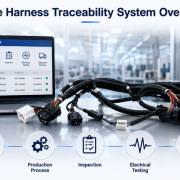
When automated crimping equipment is connected to a manufacturing execution system or other production management platform, relevant process data can become part of a broader digital traceability chain.
Material → Machine → Process → Inspection → Finished Harness
This can make quality investigations faster and more structured.
14.Automated Crimping Supports High-Volume Production
Automation becomes particularly valuable when production involves:
- Large quantities
- Repetitive wire-terminal combinations
- Tight process tolerances
- Multiple production shifts
- Consistent output requirements
- High traceability requirements
The economic value is not limited to faster production.
Consistent automated processing can also help reduce:
- Rework
- Scrap
- Operator-dependent variation
- Production interruptions
- Quality investigation time
However, automation should be selected according to actual production requirements rather than simply choosing the most advanced machine available.
15.Automation Does Not Replace Crimp Validation
A common misconception is that an automated machine automatically guarantees a good crimp.
It does not.
The machine provides a controlled production platform, but the process still needs to be properly engineered and validated.
Important validation activities may include:
- Crimp height measurement
- Crimp width measurement
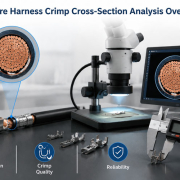
- Cross-section inspection
- Pull-force testing
- Conductor positioning inspection
- Terminal deformation inspection
- Electrical testing
- Tooling verification
- Process capability analysis
The exact validation method should be based on the terminal manufacturer’s specifications, customer requirements, applicable standards, and product risk.
16.Process Capability Is More Important Than One Good Sample
A single acceptable crimp does not prove that a production process is stable.
For high-volume manufacturing, the focus should be on repeatability and process capability.
A controlled process should demonstrate that important characteristics remain within the defined specification over time.
Production teams can use statistical process monitoring to identify trends before they become major quality problems.
For example, a gradual change in crimp height may indicate tooling wear or process drift.
Detecting the trend early allows maintenance or parameter adjustment before a large quantity of product is affected.
17.Automated Crimping and Final Harness Assembly
Crimping is only one stage of wire harness manufacturing.
After terminals are processed, they may be assembled into:
- Connectors
- Branches
- Protective sleeves
- Clips
- Labels
- Tapes
- Conduits
- Overmolded assemblies
Therefore, crimping quality must be considered as part of the complete harness manufacturing process.
A consistent crimp makes downstream assembly more predictable and helps reduce variation during final harness inspection and electrical testing.
18.How Manufacturers Can Build a More Consistent Crimping Process
A practical approach can include:
1.Standardize Material Selection
Confirm wire and terminal compatibility before production.
2.Establish Correct Tooling
Use the appropriate applicator and tooling for the terminal specification.
3.Define Process Parameters
Set and document required crimp and stripping parameters.
4.Validate the Initial Setup
Perform dimensional, mechanical, and electrical checks before mass production.
5.Monitor Production
Use in-process inspection and available machine monitoring functions.
6.Control Tooling Maintenance
Monitor tool condition and replace components when required.
7.Record Production Data
Connect process and inspection information to the relevant production order.
8.Analyze Process Trends
Use production data to identify drift, recurring defects, and improvement opportunities.
This approach turns automated crimping from a simple production machine into part of a broader quality-control system.
19.Automated Crimping at FPIC
For customized wire harness production, consistent crimping is an important part of overall manufacturing quality.
FPIC’s wire harness manufacturing process combines controlled wire processing, terminal crimping, electrical testing, inspection, and production management to support different customer specifications and production volumes.
Where automated equipment is appropriate for the product, process automation helps improve repeatability while digital production records support traceability and quality analysis.
The objective is not automation for its own sake, but stable and repeatable manufacturing performance.
Final Thoughts
Automated crimping machines can significantly improve wire harness consistency by controlling repetitive processes, reducing operator-dependent variation, and supporting in-process monitoring.
However, reliable crimp quality depends on more than machine automation.
The complete system should combine:
Correct Materials + Proper Tooling + Controlled Parameters + Process Monitoring + Validation + Traceability
When these elements work together, automated crimping becomes an important foundation for stable wire harness production and long-term product reliability.
FAQ
What is the main benefit of an automated crimping machine?
The main benefit is repeatability. Automated equipment can perform wire processing and crimping with more consistent parameters and less operator-dependent variation.
Does automated crimping guarantee crimp quality?
No. Automation improves process control but does not replace engineering validation, dimensional inspection, pull-force testing, tooling maintenance, and electrical testing.
What is crimp force monitoring?
Crimp force monitoring measures the force profile during a crimping cycle. Abnormal patterns can help identify certain process conditions such as missing wires, incorrect materials, or tooling problems.
Why is crimp height important?
Crimp height provides an important dimensional indication of how the terminal has been compressed around the conductor. It must be controlled according to the applicable terminal and process specifications.
Can automated crimping improve wire harness traceability?
Yes. When automated crimping equipment is connected to production management or MES systems, process information can be associated with production orders and finished assemblies.
Is automated crimping suitable for low-volume production?
It depends on product complexity, repeatability requirements, tooling investment, and production volume. Semi-automatic or flexible equipment may be more appropriate for certain low-volume or frequently changing products.
Looking for consistent crimping and reliable customized wire harness production?
FPIC supports customized wire harness projects with controlled wire processing, terminal crimping, electrical testing, inspection, and production traceability.
Contact our engineering team to discuss your wire harness requirements.
Resources
- IPC/WHMA-A-620 – Cable and Wire Harness Assemblies: Provides industry requirements and acceptance criteria for cable and wire harness assemblies.
- TE Connectivity – Application Tooling: Provides technical information on tooling and application equipment used for terminal processing and crimping.
- TE Connectivity – Crimp Quality: Provides engineering information related to crimp quality and terminal application.
- Molex – Wire Processing: Provides information on wire processing and terminal application technologies.
- Komax – Wire Processing Solutions: Provides information on automated wire processing and crimping technologies for cable and wire harness manufacturing.