How Automation Improves Wire Harness Production Efficiency
Wire harness manufacturing involves a sequence of operations that must work together to deliver the correct electrical connections, dimensions, and physical configuration. As product variants increase and delivery schedules become tighter, manufacturers face growing pressure to improve productivity without compromising quality.
Automation offers one way to address these challenges. Automated wire processing equipment, controlled crimping systems, machine vision, and electrical testing can reduce repetitive manual work and improve process consistency. However, automation does not improve every operation equally, and installing equipment alone does not guarantee higher production efficiency.
The greatest benefits often come from identifying bottlenecks, standardizing repeatable processes, and integrating equipment with the surrounding production workflow.
This article explains how automation improves wire harness production efficiency, which operations offer practical opportunities, and how manufacturers can evaluate automation investments based on measurable manufacturing results.
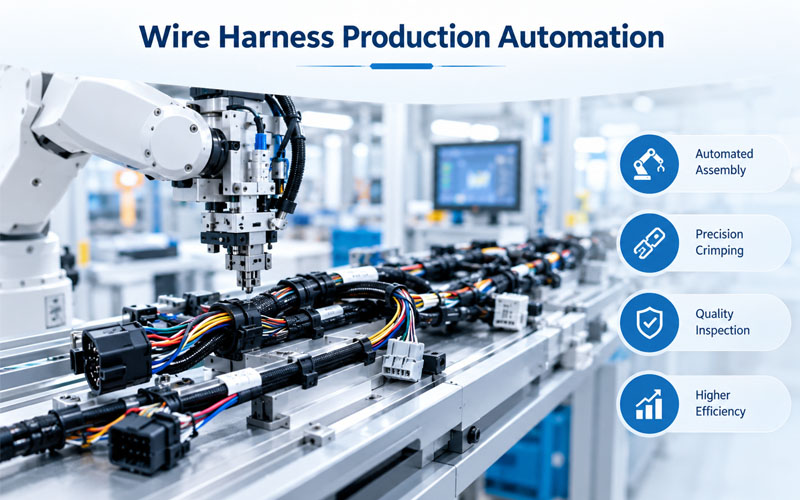
1.Why Wire Harness Manufacturing Needs Automation
Wire harness production combines repetitive processing tasks with assembly operations that require flexibility and careful handling.
Some processes, such as wire cutting and stripping, use programmable dimensions and repeatable machine movements. Other operations, including complex routing, branching, taping, and connector assembly, may involve flexible wires, numerous component variants, and difficult-to-standardize handling.
Research published in Procedia CIRP describes these differences and identifies product variety, flexible components, and assembly complexity as important challenges in achieving higher automation levels. [1]
Several manufacturing pressures make process automation increasingly relevant.
1.1 Rising production volume and shorter lead times
When demand increases, manual operations may become bottlenecks. Operators must handle more parts, repeat the same movements, and coordinate with upstream and downstream processes.
Automation can increase output at suitable process stages, reduce repetitive handling, and improve production scheduling. Its effect on overall lead time, however, depends on whether the automated operation is actually limiting throughput.
1.2 Consistency across repeated operations
Manual processes can vary with operator technique, fatigue, training, and work conditions.
Automated equipment can execute defined movements and processing parameters more consistently. This is particularly valuable for repetitive wire preparation, terminal crimping, marking, and standardized electrical tests.
The equipment still requires appropriate setup, maintenance, and verification. Automation reduces certain sources of variation; it does not eliminate process risk.
1.3 Better use of skilled labor
Automation can reduce the time operators spend on repetitive tasks, allowing them to focus on setup verification, complex assembly, troubleshooting, inspection, and process improvement.
For wire harnesses with many custom configurations, human judgment remains important. A practical automation strategy therefore considers how people and equipment can work together rather than assuming every manual task should be eliminated.
2.Key Wire Harness Manufacturing Processes That Benefit from Automation
Automation opportunities differ by product design, production volume, process stability, and equipment capability. The following areas are common starting points.
2.1 Automated wire cutting and stripping
Wire cutting and stripping are suitable for automation when wire specifications and processing requirements are clearly defined.
Programmable wire processing equipment can control cut length, strip length, and other supported operations. Depending on the machine configuration, it may also support wire marking, seal insertion, or other preparation steps.
Potential efficiency benefits include:
- More consistent wire dimensions.
- Reduced manual measuring and cutting.
- Faster processing of repetitive wire lists.
- Less handling between individual preparation steps.
- Easier changeover through stored programs and standardized setups.
To achieve these benefits, manufacturers need accurate wire data, suitable tooling, and verified machine programs. Incorrect input data can reproduce the same error across an entire production batch.
2.2 Automated and controlled crimping
Crimping is another important area for automation because connection quality depends on the compatibility of the conductor, terminal, tooling, and process settings.
Automated or semi-automated crimping systems can improve cycle consistency, support repeatable tooling setup, and reduce reliance on manual force application.
Depending on the equipment, process monitoring may also identify abnormal crimping behavior for further investigation.
Efficiency improvements should be evaluated alongside connection quality. A higher crimping rate is not beneficial if tooling wear, poor material presentation, or incorrect setup causes increased rejects and rework.
For technical guidance on the connection process itself, see FPIC’s related article on controlling crimp quality in large cross-section power harnesses.
2.3 Automated terminal and connector processing
Some terminal preparation and connector assembly operations can be automated when component geometry, presentation, and insertion requirements are sufficiently standardized.
Depending on the design, suitable equipment may support terminal handling, seal insertion, contact positioning, or connector loading.
These operations are often more difficult to automate than straightforward wire processing. Small components, varied connector designs, flexible wires, and tight insertion requirements can increase tooling and integration complexity.
A useful starting point is to automate stable, repetitive sub-operations while retaining appropriate human verification for complex or variable assembly tasks.
2.4 Automated electrical testing
Electrical test systems can verify defined circuit characteristics more consistently than informal manual checks.
Depending on the test specification, automated systems may support continuity testing, open-circuit and short-circuit detection, circuit mapping, insulation resistance measurement, and other required tests.
Automation can also improve test repeatability and reduce manual recording work when test results are linked to production records.
However, electrical testing is primarily a verification activity. It does not automatically correct an upstream manufacturing problem, and it cannot detect every possible mechanical or visual defect.
For this reason, electrical testing should complement—not replace—process controls at cutting, crimping, connector assembly, and other critical stages.
3.How Automation Improves Production Efficiency
The value of automation is best understood through its effects on the complete production system rather than the cycle time of an individual machine.
3.1 Shorter cycle times at suitable operations
Automated equipment can execute repeatable movements and processing sequences at a consistent rate.
For example, a programmable wire processing system can perform defined cutting and stripping operations without requiring an operator to measure each wire manually. A properly configured crimping system can also reduce repetitive handling during terminal application.
The actual improvement depends on the previous process, machine configuration, product mix, and operating conditions. Manufacturers should measure the before-and-after cycle time rather than assume a fixed percentage gain.
3.2 Reduced setup and changeover losses
Production efficiency is affected not only by processing speed but also by the time required to switch between products.
Different wire cross-sections, terminal types, lengths, colors, and connector configurations may require equipment adjustments, tooling changes, program selection, and first-piece verification.
Useful automation practices include:
- Storing approved machine programs by product or job number.
- Standardizing tooling identification and setup instructions.
- Preparing materials and tools before changeover.
- Verifying the selected program against the production order.
- Checking the first processed pieces before releasing the batch.
For high-mix production, reducing setup time can be more valuable than increasing the machine’s maximum operating speed.
3.3 Lower rework and material waste
Automated processing can reduce errors associated with inconsistent manual execution, especially when the process is repeatable and the equipment is correctly configured.
Potential benefits include fewer incorrect cut lengths, more consistent terminal application, and reduced manual transcription errors.
However, automated equipment can also create repeated defects when incorrect settings or data go undetected. Effective automation therefore combines standardized inputs, setup verification, process monitoring, and defined reaction plans.
3.4 Improved production flow
An efficient production line depends on how materials and work orders move between operations.
If a high-speed cutting machine produces wires faster than downstream assembly can process them, work-in-process inventory may accumulate. Similarly, an automated inspection station can become a bottleneck if it cannot keep pace with production.
To avoid these problems, manufacturers should evaluate:
- Cycle time at each operation.
- Queue time between operations.
- Work-in-process levels.
- Material replenishment and handling.
- Equipment availability and changeover time.
- Downstream capacity and staffing.
Automation creates the greatest system-level value when the production flow is balanced and bottlenecks are addressed.
4.The Role of Vision Systems and Digital Production Data
Machine vision and production data systems can support automation by improving defect detection, process visibility, and decision-making.
These technologies are related to production efficiency, but they should be treated as supporting capabilities rather than guaranteed productivity improvements.
4.1 Machine vision for selected inspection tasks
Machine vision can inspect visible characteristics such as terminal position, component presence, connector orientation, and label information when the inspection system is appropriately designed and validated.
Its value depends on lighting, camera positioning, component presentation, defect visibility, and the ability to handle product variation.
For more detail, read FPIC’s article on vision inspection in wire harness manufacturing.
4.2 Digital records for process coordination
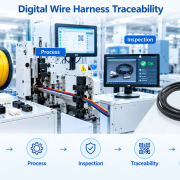
Digital production systems can connect work orders, machine settings, inspection results, and finished-product records.
When implemented effectively, this information helps production teams identify recurring problems, investigate downtime, and understand where process variation occurs.
Useful records may include:
- Production quantity and cycle-time data.
- Machine downtime and changeover reasons.
- Inspection and test results.
- Material and tooling identification.
- Rejects, rework, and corrective actions.
The goal is not simply to collect more data. The goal is to make information reliable and actionable so that manufacturing decisions can be based on actual process performance.
5.Why Full Automation Is Not Always the Best Solution
Wire harness manufacturing presents challenges that make complete automation difficult for some product families.
Research on automated wiring harness manufacturing identifies high product variety, flexible cable behavior, numerous component types, and equipment investment as important limitations. [2]
These constraints mean that automation decisions should be based on the operation and product family rather than a general goal of maximizing automation.
5.1 High product variety
A manufacturer producing many customized harnesses may face frequent changes in wire lengths, colors, terminal types, connector housings, and routing configurations.
Dedicated equipment can deliver strong performance for stable, repetitive products but may lose efficiency when changeovers are frequent or complex.
For high-mix production, flexible equipment, modular fixtures, standardized tooling, and quick-change systems may be more appropriate than a highly specialized line.
5.2 Flexible wires are difficult to handle
Unlike rigid components, wires can bend, twist, overlap, and change position during handling.
Operations such as routing multiple branches, inserting terminals into connector housings, and applying tape around irregular shapes can require precise positioning and feedback.
Automation may therefore need specialized fixtures, vision guidance, force monitoring, or a hybrid human-machine approach. These additional requirements can increase integration complexity.
5.3 Equipment cost and utilization
Automation involves more than the purchase price of a machine. Total cost may include tooling, integration, programming, training, maintenance, floor space, validation, and production downtime during installation.
A machine that performs well technically may still be economically unsuitable if annual demand is too low or product changeovers consume too much time.
Investment decisions should consider realistic utilization and the full cost of operating the system.
5.4 Maintenance and technical skills
Automated equipment requires preventive maintenance, troubleshooting capability, and controlled software or program changes.
If spare parts, technical support, or trained personnel are unavailable, an equipment failure can stop production more severely than a failure in a flexible manual workstation.
Maintenance planning and operator training should therefore be included in the automation business case.
6.How to Evaluate the Return on Automation Investment
A structured evaluation helps manufacturers distinguish measurable benefits from assumptions.
Step 1: Establish the current baseline
Measure the existing process before selecting equipment. Useful baseline indicators include:
- Cycle time per operation.
- Output per shift.
- Direct labor hours per accepted unit.
- Scrap and rework rates.
- Changeover time.
- Equipment downtime.
- Work-in-process inventory.
- On-time delivery performance.
Use representative production data covering the normal product mix rather than a single ideal production run.
Step 2: Identify the main constraint
Determine which operation limits total output or creates the most quality-related losses.
If crimping is already faster than downstream connector assembly, installing a higher-speed crimping machine may not improve overall throughput.
In that situation, the more effective investment may be an assembly fixture, a better material presentation method, or a change to the production sequence.
Step 3: Estimate total implementation cost
Include equipment, tooling, integration, validation, training, maintenance, and expected downtime during implementation.
For customized products, also consider the cost of product changeovers and the effort required to maintain programs and tooling across different configurations.
Step 4: Estimate realistic benefits
Potential benefits include reduced direct labor time, higher accepted output, less rework, shorter changeovers, and lower material waste.
Avoid counting the same benefit twice. For example, reduced labor time and increased output may be related outcomes of the same capacity improvement.
Step 5: Calculate payback using verified assumptions
A simplified payback calculation is:
[
\text{Payback Period}=
\frac{\text{Total Initial Investment}}
{\text{Annual Net Benefit}}
]
Annual net benefit should account for recurring operating costs and should reflect realistic demand and machine utilization.
This calculation is a screening tool, not a complete financial evaluation. Depending on the project, manufacturers may also need to consider depreciation, financing, maintenance risk, and the expected useful life of the equipment.
Step 6: Validate the result after implementation
Compare actual production results against the original baseline after the process stabilizes.
Check whether the expected improvements were achieved without increasing defects, changeover losses, maintenance burden, or downstream congestion.
If the results differ from expectations, use the data to identify the gap and adjust the process.
7.A Practical Roadmap for Wire Harness Automation
A phased approach can reduce investment risk and help manufacturers build automation capability over time.
| Phase | Main focus | Typical actions | Intended outcome |
|---|---|---|---|
| Phase 1: Standardize | Process stability | Update work instructions, verify product data, standardize tooling and inspection criteria | Reduce avoidable variation |
| Phase 2: Automate repeatable tasks | Wire preparation and selected termination operations | Introduce suitable cutting, stripping, marking, or crimping equipment | Improve repeatability and processing capacity |
| Phase 3: Connect verification | Inspection and testing | Integrate validated vision or electrical test systems where appropriate | Improve defect detection and reduce manual recording |
| Phase 4: Optimize flow | Production coordination | Analyze bottlenecks, changeovers, downtime, and work-in-process | Improve system-level throughput |
| Phase 5: Review performance | Continuous improvement | Compare actual results with baseline and revise the control strategy | Sustain measurable gains |
This sequence is a general framework, not a mandatory implementation order. A manufacturer with a major electrical testing bottleneck may need to prioritize testing before investing in additional wire processing capacity.
The roadmap should reflect the actual production constraints and the technical requirements of each product family.
How FPIC Approaches Manufacturing Efficiency
For customized wire harness projects, production efficiency depends on the relationship between product design, material selection, processing methods, assembly requirements, and inspection.
FPIC provides wire harness and cable assembly solutions for industrial, medical, automotive, and energy-related applications. Early alignment on drawings, wire specifications, terminal systems, production volumes, and inspection requirements helps establish a manufacturing approach suited to the project.
Automation is most effective when the process is sufficiently standardized and the selected equipment matches the real production demand. For complex or frequently changing assemblies, a combination of automated processing, suitable fixtures, skilled operators, and defined quality controls may provide a more practical result than pursuing full automation.
Conclusion
Automation can improve wire harness production efficiency by increasing repeatability, reducing manual handling, shortening selected cycle times, and strengthening process monitoring.
However, the benefits depend on product variety, production volume, equipment capability, changeover requirements, and the balance between upstream and downstream operations.
The most effective strategy is to identify the main production constraint, standardize the process, automate suitable operations, and measure the results against a reliable baseline. By combining appropriate equipment with sound engineering, quality controls, and continuous improvement, manufacturers can pursue higher productivity without sacrificing product reliability.
FAQ
Which wire harness manufacturing processes are easiest to automate?
Wire cutting, stripping, marking, and selected crimping operations are common starting points because they involve repeatable processing steps. Suitability still depends on conductor construction, terminal design, product mix, and required process flexibility.
Does automation always reduce wire harness production costs?
No. Automation can reduce labor time and process variation, but equipment investment, maintenance, tooling, programming, and changeover costs can offset the benefits. A cost evaluation should use realistic production volumes and utilization.
Can automated equipment eliminate wire harness assembly errors?
No. Automation can reduce certain manual errors, but incorrect programs, unsuitable tooling, material variation, and equipment faults can still cause defects. Appropriate setup verification, process monitoring, and testing remain necessary.
Is full automation suitable for high-mix wire harness production?
Not always. High product variety and flexible cable routing can make dedicated automation difficult to justify. Flexible equipment, modular fixtures, and hybrid manual-automated processes may be more suitable for products with frequent design changes.
How should manufacturers measure automation efficiency?
Useful metrics include accepted output per shift, cycle time, labor hours per accepted unit, changeover time, downtime, scrap, rework, and work-in-process. Measures should be compared with a representative baseline and should reflect actual production conditions.
What should manufacturers consider before investing in automation?
Evaluate the current bottleneck, product mix, annual demand, process stability, equipment flexibility, total implementation cost, maintenance capability, training needs, and expected quality impact. Pilot testing can help verify assumptions before a larger investment.
Looking for a wire harness manufacturing partner for your next project?
Share your drawings, product specifications, expected volumes, and testing requirements with FPIC. Early engineering alignment can help identify suitable manufacturing processes and establish a practical path from prototype development to stable production.
Contact FPIC to discuss your customized wire harness requirements.
Resources
- Manufacturing Processes of Automotive High-Voltage Wire Harnesses: State of the Art, Current Challenges and Fields of Action to Reach a Higher Level of Automation
Research review examining automotive high-voltage harness manufacturing, current automation capabilities, and the technical challenges that limit further automation. - Approaches for Automated Wiring Harness Manufacturing: Function Integration with Additive Manufacturing
Discusses the distribution of automation across wire processing and assembly, along with product variability, flexible components, and investment considerations. - Overview of the State of the Art in the Production Process of Automotive Wire Harnesses, Current Research and Future Trends
Reviews established wire harness manufacturing processes, available machinery, automation opportunities, and remaining technical challenges. - Revolutionizing Wire Harness Manufacturing with Automation
Industry perspective on automated wire processing, assembly limitations, and the challenges of handling complex harness configurations. - Cost Reduction in Wire Harness Assembly
Discusses production equipment, changeover time, utilization, and the importance of evaluating automation investments against actual manufacturing needs.