Why Traceability Matters in Custom Wire Harness Manufacturing
In modern industries, a wire harness is no longer just a collection of wires and connectors.
It is a critical system component that supports:
- Power distribution
- Signal transmission
- Communication
- Safety functions
For applications such as automotive systems, industrial automation, energy storage, robotics, and medical equipment, customers require more than product delivery.
They need confidence that every harness has been:
- Manufactured correctly
- Tested properly
- Built with approved materials
- Recorded through every production stage
This is where traceability becomes essential.
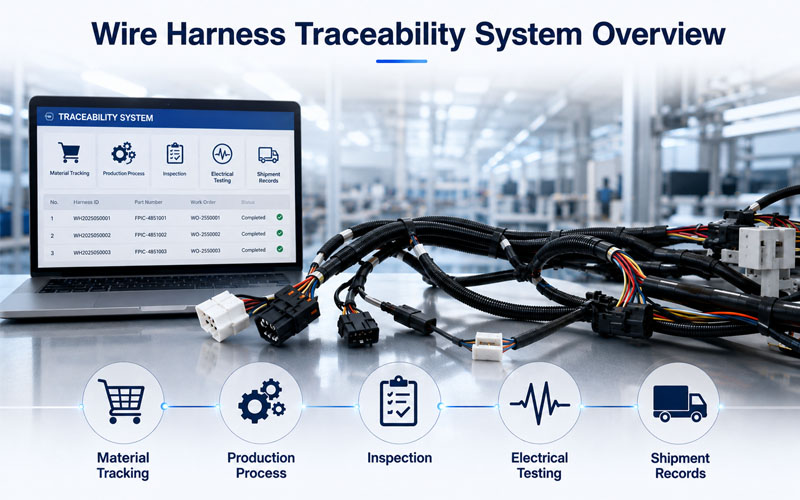
A strong traceability system allows manufacturers to track the complete history of a wire harness, from incoming materials to final shipment.
What Is Wire Harness Traceability?
Wire harness traceability is the ability to track and record key information throughout the manufacturing process.
A complete traceability system may include:
- Material information
- Production records
- Operator records
- Equipment parameters
- Inspection results
- Electrical test data
- Shipment information
Instead of only knowing what was produced, manufacturers can understand:
When was it produced?
Which materials were used?
Which processes were completed?
Who inspected it?
Did it pass testing?
Why Traceability Is Important for Custom Wire Harness
Custom wire harnesses often have:
- Different wire specifications
- Multiple connector types
- Unique assembly requirements
- Customer-specific drawings
- Complex testing requirements
Unlike standard products, custom harnesses usually require strict production control.
Without traceability, manufacturers may face difficulties in:
- Identifying failure causes
- Controlling production changes
- Managing customer complaints
- Performing corrective actions
1.Material Traceability: Knowing What Goes Into Every Harness
The quality of a wire harness starts with the materials.
A traceability system helps record:
Wire Information
Including:
- Supplier
- Part number
- Wire specification
- Batch information
Connector and Terminal Information
Including:
- Component model
- Supplier information
- Lot number
- Material verification
Auxiliary Materials
Including:
- Seals
- Sleeves
- Tapes
- Protective components
Material traceability helps manufacturers quickly identify whether a quality issue is related to:
- Raw materials
- Supplier variation
- Manufacturing processes
2.Process Traceability: Controlling Every Manufacturing Step
A reliable wire harness is built through controlled processes.
Important production records may include:
Cutting and Stripping Process
Tracking:
✔ Wire length
✔ Stripping parameters
✔ Machine settings
Incorrect cutting or stripping can affect:
- Assembly accuracy
- Crimp reliability
- Electrical performance
Crimping Process
Crimp quality is one of the most critical areas.
Traceability may include:
- Crimp machine ID
- Tooling information
- Crimp parameters
- Inspection results
This helps ensure consistent terminal connections.
Assembly Process
Records may include:
- Operator information
- Assembly instructions
- Connector verification
- Visual inspection results
3.Testing Data Traceability
Testing is a key part of wire harness quality control.
A complete traceability system can store:
Electrical Test Results
Including:
- Continuity test
- Short circuit test
- Resistance measurement
- Hi-Pot testing
Inspection Records
Including:
- Visual inspection
- Dimension verification
- Connector checks
Final Approval Status
Including:
- Pass/fail records
- Quality approval
- Shipment release
This provides evidence that each harness meets customer requirements.
4.Faster Root Cause Analysis and Corrective Action
When a field issue occurs, time is critical.
Without traceability, manufacturers may need to investigate:
- Which materials were used?
- Which production line made the product?
- Which process parameters were applied?
This can take significant time.
With traceability, manufacturers can quickly identify:
- Production date
- Material batch
- Process history
- Test records
This improves:
✔ Root cause analysis
✔ Corrective action efficiency
✔ Customer communication
5.Supporting Automotive and High-Reliability Applications
Industries with strict quality requirements often require strong traceability systems.
Examples include:
Automotive
Requirements may include:
- Production records
- Process control
- Defect prevention
- Supplier quality management
Energy Storage Systems
Traceability helps control:
- High-current harness production
- Safety-related components
- Testing verification
Medical Equipment
Traceability supports:
- Quality documentation
- Regulatory requirements
- Product reliability
6.Digital Traceability in Modern Wire Harness Manufacturing
Many manufacturers use digital systems to improve production visibility.
Examples include:
Barcode and QR Code Tracking
Used for:
- Material identification
- Work order tracking
- Production history
Manufacturing Execution Systems (MES)
Used for:
- Production monitoring
- Data collection
- Process control
Warehouse Management Systems (WMS)
Used for:
- Material location control
- FIFO management
- Inventory accuracy
Digital traceability reduces manual errors and improves manufacturing transparency.
7.How FPIC Implements Wire Harness Traceability
FPIC applies controlled production management for customized wire harness and cable assembly manufacturing.
Traceability practices include:
- Material identification
- Production process records
- Quality inspection records
- Electrical testing data
- Production history management
With digital manufacturing management and controlled processes, FPIC helps customers achieve reliable and consistent wire harness production.
Traceability vs Traditional Production Control
| Traditional Production | Traceable Production |
|---|---|
| Limited production records | Complete manufacturing history |
| Difficult defect investigation | Faster root cause analysis |
| Manual tracking | Digital data management |
| Higher quality risks | Better process control |
| Limited customer visibility | Improved transparency |
Final Thoughts
Traceability is not only a documentation requirement.
It is a powerful quality management tool.
For custom wire harness manufacturing, traceability helps ensure:
✔ Correct materials
✔ Controlled processes
✔ Verified testing
✔ Faster problem solving
✔ Consistent production quality
As wire harness applications become more complex, manufacturers with strong traceability systems provide customers with greater confidence and reliability.
A high-quality harness is not only manufactured—it is fully controlled and traceable.
FAQ
What is traceability in wire harness manufacturing?
Traceability is the ability to track materials, processes, testing results, and production history throughout the manufacturing lifecycle.
Why is traceability important for custom wire harnesses?
Custom harnesses have complex designs and requirements. Traceability helps control quality and quickly identify issues.
What information should a wire harness traceability system include?
It should include material records, production data, inspection results, testing information, and shipment records.
How does traceability improve quality control?
It enables faster defect investigation, better process monitoring, and more effective corrective actions.
Is traceability required for automotive wire harnesses?
Automotive applications commonly require strong process control and traceability to support quality management requirements.
Need a Reliable Custom Wire Harness Manufacturer?
FPIC provides customized wire harness and cable assembly solutions with controlled manufacturing processes, inspection systems, and production traceability.
From prototype development to mass production, FPIC helps OEM customers achieve reliable and consistent harness quality.
Contact FPIC today to discuss your wire harness requirements.
Resources
- IPC/WHMA-A-620 – Requirements and Acceptance for Cable and Wire Harness Assemblies
https://www.ipc.org/
Industry standard covering wire harness workmanship and acceptance criteria. - IATF 16949 Automotive Quality Management System
https://www.iatfglobaloversight.org/
Automotive quality requirements emphasizing process control and defect prevention. - ISO 9001 Quality Management Systems
https://www.iso.org/iso-9001-quality-management.html
Quality management principles supporting manufacturing consistency. - WHMA – Wire Harness Manufacturer’s Association
https://www.whma.org/
Industry resources for wire harness manufacturing practices.