How Engineering Change Management Prevents Wire Harness Errors
Engineering changes are a normal part of wire harness development and manufacturing. A customer may request a different wire length, an engineer may revise a connector specification, or a production team may identify an assembly issue that requires a process adjustment.
Although these changes may appear minor, their impact can extend across the entire manufacturing process. A revised terminal specification can affect tooling, crimp parameters, inspection criteria, and material purchasing. A connector pinout change can influence wiring diagrams, electrical test programs, assembly instructions, and finished-product identification.
Without a structured engineering change management (ECM) process, different departments may work with different versions of the same product information. This creates a risk of incorrect components, outdated work instructions, wiring mistakes, and mixed-revision production batches.
For wire harness manufacturers, effective change management is therefore not simply a documentation activity. It is an essential part of product configuration control, manufacturing quality, and production traceability.
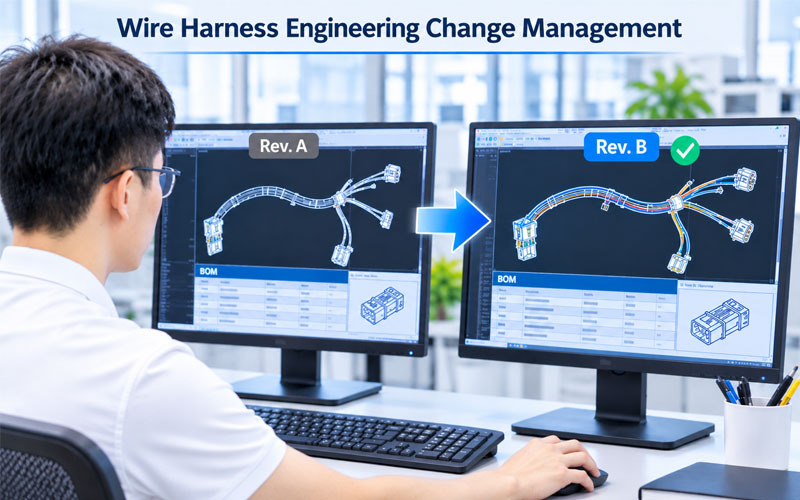
1.Why Engineering Changes Create Risks in Wire Harness Manufacturing
Wire harnesses consist of interconnected components and manufacturing operations. A change to one element can influence several other parts of the assembly.
For example, changing a wire specification may affect terminal compatibility, stripping parameters, crimp tooling, and electrical performance. If the change is implemented in purchasing but not communicated to production and quality teams, the result may be an assembly that contains the correct-looking material but does not meet the approved requirements.
1.1 Common sources of engineering changes
Engineering changes can originate from different stages of a product’s lifecycle.
| Change source | Typical example | Potential manufacturing impact |
|---|---|---|
| Customer design update | Revised drawing or pin assignment | Incorrect wiring or assembly if the old version remains in use |
| Component substitution | Alternative terminal or connector | Compatibility and performance risks |
| Design optimization | Modified wire length or branch position | Routing and dimensional variation |
| Manufacturing improvement | Revised crimping or assembly method | Process validation and tooling updates |
| Quality corrective action | Change to a defective assembly feature | Inspection and control plan revisions |
| Supplier change | Material source or manufacturing location change | Material consistency and approval risks |
| Regulatory or application requirement | Updated material or performance requirement | Specification and validation changes |
1.2 How uncontrolled changes lead to errors
The most common problem is not necessarily the change itself. It is the failure to coordinate its implementation.
Consider a simple example: a customer changes a wire from one specification to another with a different insulation thickness.
If the engineering team updates the drawing but the production department continues using the previous crimping setup, the new wire may not achieve the required termination quality. If purchasing also retains the old BOM, different materials may be issued to production under the same product identification.
The resulting risks may include:
- Incorrect wire or terminal combinations.
- Outdated connector pin assignments.
- Incorrect crimp dimensions or tooling settings.
- Inconsistent branch lengths and routing.
- Conflicting inspection and test requirements.
- Mixed product revisions within one production batch.
- Difficulty identifying affected inventory after a defect is discovered.
A controlled change process helps prevent these problems by ensuring that every affected function receives the same approved information before implementation.
2.Establish a Formal Engineering Change Request Process
A reliable engineering change management system begins with a documented method for requesting, reviewing, approving, and implementing changes.
Not every suggestion should immediately become a production instruction. Each proposed change needs to be evaluated before it is released.
2.1 Record the change request clearly
An Engineering Change Request (ECR) provides a structured record of the proposed modification.
A useful ECR should include:
- Product name, part number, and current revision.
- Description of the proposed change.
- Reason for the change.
- Affected drawings, BOM items, and technical specifications.
- Relevant customer requirements.
- Expected implementation timing.
- Initial assessment of potential risks.
The request should describe exactly what is changing and why. For example, “improve connector assembly” is too vague. A more useful description would identify the connector part number, affected cavity or locking feature, current configuration, proposed configuration, and reason for the modification.
2.2 Distinguish between requested and approved changes
An ECR is a request, not authorization to modify production.
After technical review and approval, an Engineering Change Order (ECO), Engineering Change Notice (ECN), or equivalent controlled document can define the approved implementation.
Terminology varies between organizations, but the important distinction is that a proposed change must not be treated as an approved production revision until the required authorization has been completed.
This separation reduces the risk of informal instructions, unapproved substitutions, or undocumented modifications entering production.
3.Conduct a Cross-Functional Impact Assessment
A change to one wire harness component can affect multiple manufacturing functions. Therefore, engineering review should not be limited to the person who proposed the modification.
A cross-functional impact assessment helps identify indirect consequences before implementation.
3.1 Evaluate the technical impact
The review should consider whether the change affects:
- Fit: Connector dimensions, wire lengths, branch positions, and installation space.
- Form: Connector configuration, terminal arrangement, wire routing, and protective covering.
- Function: Electrical connections, signal transmission, grounding, and circuit behavior.
- Performance: Current capacity, voltage requirements, temperature resistance, vibration performance, and environmental protection.
- Durability: Terminal retention, insulation integrity, sealing, and resistance to operating conditions.
These considerations are particularly important when a change involves high-current power harnesses, automotive assemblies, medical equipment wiring, or industrial applications with demanding environmental requirements.
3.2 Evaluate the manufacturing impact
The same review should assess whether the change affects the production system.
| Department | Key questions |
|---|---|
| Engineering | Do drawings, specifications, and electrical diagrams need revision? |
| Purchasing | Are new materials or suppliers required? |
| Warehouse | How should old and new materials be identified and separated? |
| Production | Do work instructions, tooling, or assembly sequences need updating? |
| Quality | Are inspection criteria, test programs, or control plans affected? |
| Planning | Does the change affect production schedules or existing orders? |
| Customer service | Is customer notification or formal approval required? |
For example, changing a connector housing may require more than updating its part number. The terminal compatibility, cavity arrangement, secondary locking mechanism, assembly tooling, and electrical test connections may also need to be reviewed.
The objective is to identify all affected processes before the change reaches the production floor.
4.Maintain Strict Drawing and BOM Revision Control
Drawing and BOM revision control is one of the most important safeguards against wire harness manufacturing errors.
A wire harness may have several related documents, including assembly drawings, wiring diagrams, connector pinout tables, material lists, process specifications, and inspection instructions. If these documents are updated independently, conflicting information can easily enter production.
4.1 Keep all product information aligned
Each released revision should be clearly identified and linked to the relevant product configuration.
For example, a controlled documentation package may include:
- Approved wire harness assembly drawing.
- Current wiring diagram and connector pinout.
- Approved Bill of Materials.
- Wire and terminal specifications.
- Connector and accessory specifications.
- Manufacturing process flow.
- Work instructions and tooling settings.
- Inspection plan and electrical test requirements.
When a change is approved, every affected document should be reviewed and updated. Unaffected documents do not necessarily need a new revision, but their status should remain clear.
4.2 Prevent obsolete documents from reaching production
A common source of production errors is the continued use of outdated drawings or printed work instructions.
Effective controls include:
- Maintaining a centralized source for released documents.
- Clearly identifying current revisions and approval status.
- Restricting access to modify controlled documents.
- Removing or marking obsolete production copies.
- Ensuring workstations use the latest approved instructions.
- Recording the revision used for each production order or batch.
Digital document control can help reduce the risk of outdated information being used across different workstations or shifts.
However, simply uploading a new drawing is not enough. The organization must also verify that the previous version is no longer being used where the change applies.
5.Control Material Changes and Component Substitutions
Material changes deserve particular attention because wire harness components are not always interchangeable, even when their appearance or dimensions seem similar.
A terminal with a different plating specification, a wire with different insulation properties, or a connector with a modified cavity arrangement may affect product performance or manufacturing compatibility.
5.1 Verify component compatibility
Before approving a material substitution, engineering and quality teams should evaluate relevant characteristics.
| Component | Important verification points |
|---|---|
| Wire | Conductor size, insulation material, temperature rating, voltage rating, and flexibility |
| Terminal | Compatible conductor range, plating, contact design, and crimp requirements |
| Connector housing | Cavity configuration, terminal compatibility, locking features, and sealing design |
| Seal | Dimensions, material properties, compression, and environmental requirements |
| Protective sleeve | Temperature resistance, abrasion protection, flexibility, and installation compatibility |
| Labels | Identification content, material durability, and customer requirements |
A substitute should not be approved solely because it fits physically. Its suitability must be evaluated against the approved technical requirements.
5.2 Maintain material traceability
When a material change is implemented, the manufacturer should be able to identify which batches used the previous component and which used the revised component.
Useful records may include:
- Supplier and material part number.
- Material lot or batch number.
- Approved material revision.
- Receiving inspection results, where applicable.
- Production order and assembly batch.
- Effective date of the change.
This information becomes especially important if a supplier later reports a material issue or a customer identifies a defect in a specific production batch.
6.Validate Manufacturing Process Changes Before Implementation
Engineering changes do not always involve product design. They may also affect how a wire harness is manufactured.
Examples include changing crimping equipment, modifying stripping parameters, adjusting an assembly fixture, changing a sealing process, or moving production to another manufacturing location.
Even when the finished product specification remains unchanged, the manufacturing process may behave differently.
6.1 Identify which processes require validation
Depending on the nature and risk of the change, verification activities may include:
- Wire cutting and stripping checks.
- Crimp height and width measurements, where specified.
- Crimp pull-force testing, where applicable.
- Terminal insertion and retention verification.
- Connector locking and secondary lock checks.
- Continuity and short-circuit testing.
- Insulation resistance or dielectric testing, where required.
- Dimensional inspection of critical harness features.
- Environmental or mechanical validation when affected requirements justify it.
The exact validation plan should be based on the change’s potential impact, customer requirements, and applicable product standards.
6.2 Use controlled trial production
For significant changes, a trial build can help confirm that the revised process works under realistic manufacturing conditions.
A practical sequence is:
- Confirm the approved change documentation.
- Update the relevant materials, tooling, and work instructions.
- Produce a controlled trial quantity.
- Inspect critical dimensions and assembly features.
- Perform the required electrical and mechanical tests.
- Review the results against approved acceptance criteria.
- Obtain the required internal and customer approvals.
- Release the revised process for production.
For automotive programs, applicable customer-specific requirements and production approval obligations must also be considered. A process change may require additional validation, a production trial run, customer notification, or documented approval before implementation.
7.Manage Work-in-Progress and Inventory During Revision Changes
One of the most overlooked challenges in engineering change management is deciding what to do with products and materials that already exist when a new revision becomes effective.
Updating the drawing does not automatically update the physical inventory.
If old and new components are mixed, production may unknowingly build different configurations under the same order or product identification.
7.1 Define the disposition of existing materials
Before implementation, the change review should determine whether existing inventory can:
- Be used without modification.
- Be consumed before a defined effective date.
- Be reworked under an approved instruction.
- Be returned to the supplier.
- Be scrapped or otherwise removed from production use.
The decision depends on technical compatibility, customer approval, traceability requirements, and the specific change.
7.2 Define a clear revision cutover point
A controlled cutover should identify when the new revision becomes effective.
Possible controls include:
- Effective production order or work order.
- Defined material lot or batch.
- Specific production date or shift.
- Approved serial number or production range.
- Customer-authorized implementation point.
The manufacturer should also verify whether work in progress, finished goods, and goods already shipped are affected.
A clearly defined cutover prevents mixed-revision production and makes later quality investigations more efficient.
8.Communicate Changes Across Departments and Suppliers
Even a technically correct change can fail if the relevant people do not receive the updated information in time.
Engineering, procurement, warehouse, production, quality, planning, and suppliers may all work with different systems. Effective communication ensures that the same approved change is understood and implemented consistently.
8.1 Use a controlled change notification
A change notification should clearly communicate:
- What has changed.
- Why the change was introduced.
- Which product numbers and revisions are affected.
- Which documents or materials must be updated.
- When the change becomes effective.
- What actions each department must complete.
- Whether customer or supplier approval is required.
8.2 Confirm implementation, not just distribution
Sending an email or releasing a new drawing does not prove that the change has been implemented.
A stronger process requires confirmation from affected departments.
For example:
- Purchasing confirms the revised material has been ordered.
- Warehouse confirms old and new materials are properly identified.
- Production confirms updated instructions are available.
- Quality confirms inspection and test requirements are revised.
- Planning confirms affected production orders are aligned.
This implementation feedback helps close the gap between document approval and actual production control.
9.Use Digital Traceability to Strengthen Engineering Change Management
As product variants and production volumes increase, managing engineering changes through spreadsheets, email attachments, and manually distributed documents can become difficult.
Digital manufacturing systems can improve visibility by linking product revisions with materials, work orders, process records, and inspection results.
9.1 Connect revision information with production records
Depending on the system architecture, manufacturers can use ERP, MES, document management systems, or other digital tools to manage:
- Approved drawing and BOM revisions.
- Engineering change status and approval history.
- Material lot and supplier information.
- Production order and batch identification.
- Work instruction versions.
- Inspection and electrical test results.
- Change implementation dates and responsible personnel.
For example, when a production order is released, the system can reference the applicable BOM revision and manufacturing instructions. This reduces reliance on manually checking multiple documents.
9.2 Make quality investigations more efficient
If a customer reports a wiring error, revision-related issue, or component problem, traceable production records can help identify the affected product range.
Instead of reviewing every historical order manually, the quality team can narrow the investigation using relevant information such as:
- Product revision.
- Production date and batch.
- Material lot.
- Workstation or equipment.
- Applicable process settings.
- Inspection and test records.
Digital traceability does not replace engineering review or physical verification. It provides the information needed to make investigations more accurate and targeted.
10.A Practical Engineering Change Management Checklist
Before implementing a wire harness engineering change, the responsible team should review the following points.
- The change request clearly identifies the affected product and current revision.
- The reason and technical requirements of the change are documented.
- Fit, form, function, performance, and durability impacts have been assessed as applicable.
- Manufacturing and supply chain impacts have been reviewed.
- Required internal approvals have been completed.
- Customer approval or notification has been obtained where required.
- Drawings, wiring diagrams, BOMs, and specifications have been updated.
- Material substitutions have been evaluated and approved.
- Tooling, equipment, and work instructions have been reviewed.
- Inspection plans and electrical test programs have been updated where necessary.
- Trial production or additional validation has been completed when required.
- Old materials and work in progress have a documented disposition.
- The effective revision and cutover point are clearly defined.
- Relevant departments and suppliers have confirmed implementation.
- Production and quality records support traceability to the approved revision.
A checklist should be adapted to the complexity and risk of each change. Minor documentation corrections may require limited review, while changes affecting electrical performance, safety, sealing, or critical manufacturing processes may require more extensive verification and approval.
How FPIC Approaches Engineering and Manufacturing Coordination
Reliable wire harness production depends on keeping engineering requirements and manufacturing execution aligned.
FPIC has 23 years of experience in connector and cable assembly manufacturing. For customized wire harness projects, early communication about drawings, material specifications, application conditions, and production requirements helps identify potential manufacturing issues before they become recurring problems.
When a design or process change is proposed, it is important to understand not only what component is changing but also how that change may affect assembly methods, tooling, inspection, and product traceability.
For OEM projects involving multiple harness configurations or ongoing design revisions, structured technical communication can help reduce misunderstandings and support a more controlled transition from engineering updates to production implementation.
Conclusion
Engineering changes are inevitable in wire harness manufacturing, but the errors they create are often preventable.
A structured engineering change management process connects design revisions with material control, manufacturing procedures, quality inspection, inventory management, and production traceability.
By documenting each change, assessing its impact, obtaining the necessary approvals, validating affected processes, and confirming implementation across departments, manufacturers can reduce revision-related errors and maintain consistent product quality.
Ultimately, effective engineering change management ensures that every team works from the same approved product information—and that every production batch reflects the intended design.
FAQ
What is engineering change management in wire harness manufacturing?
Engineering change management is a controlled process for reviewing, approving, documenting, and implementing changes to wire harness designs, materials, specifications, and manufacturing processes. It helps ensure that all affected departments use the correct approved information.
What is the difference between ECR, ECO, and ECN?
An Engineering Change Request (ECR) proposes a change for evaluation. An Engineering Change Order (ECO) typically documents an approved change and its implementation requirements. An Engineering Change Notice (ECN) communicates an approved change to affected departments or stakeholders. Exact terminology varies between organizations.
How can drawing revision errors affect wire harness production?
Using outdated drawings may result in incorrect wire lengths, pin assignments, connector configurations, terminal specifications, or assembly instructions. These errors can lead to rework, electrical failures, mixed-revision batches, and customer complaints.
Does a material substitution require engineering approval?
Material substitutions should be evaluated against the approved technical requirements before implementation. Changes affecting compatibility, electrical performance, environmental resistance, or customer-specific specifications may require formal engineering and customer approval.
How should manufacturers manage old inventory after an engineering change?
Manufacturers should assess existing materials, work in progress, and finished goods before the new revision takes effect. Each affected item should have a documented disposition, such as approved use, rework, return, or scrapping, with a clearly defined revision cutover point.
Why is traceability important in engineering change management?
Traceability helps manufacturers identify which product revision, material lot, production process, and inspection records apply to a particular assembly or batch. This makes quality investigations, containment actions, and corrective measures more accurate.
Which quality standards address engineering change control?
ISO 9001 includes requirements for reviewing and controlling changes affecting production and service provision. IATF 16949 adds automotive-specific expectations for managing product and manufacturing process changes, including risk assessment, validation, documentation, and applicable customer approvals. Customer-specific requirements should also be reviewed.
Need a wire harness manufacturing partner for a customized or evolving design?
FPIC supports connector and wire harness manufacturing projects through technical communication, manufacturing coordination, and quality-focused production practices.
Share your drawings, BOM, technical specifications, or proposed design changes with our team to discuss your project requirements.
Resources
- ISO 9001 – Quality Management Systems
The international quality management standard. Its change-control requirements provide a framework for reviewing production changes, recording authorization, and identifying necessary actions. - IATF Global Oversight – IATF 16949 Resources
Official resources related to the automotive quality management system, including interpretations and customer-specific requirements relevant to product and manufacturing process changes. - IATF 16949 – Frequently Asked Questions
Official IATF FAQ material that provides clarification on selected requirements, including temporary changes to process controls. - Infineon – Change Management
An industry example of a structured change management approach involving cross-functional evaluation, risk assessment, and controlled implementation. - NQA – A Guide to IATF 16949
An overview of automotive quality management practices, including the management of product and manufacturing process changes.