How to Use Cross-Section Analysis to Improve Crimp Reliability
Crimping is one of the most critical processes in wire harness manufacturing.
A properly crimped terminal creates a stable mechanical and electrical connection between the wire conductor and terminal.
However, many crimp defects cannot be identified through appearance inspection alone.
A terminal may look acceptable externally but contain hidden problems such as:
- Insufficient conductor compression
- Incorrect crimp height
- Poor conductor positioning
- Excessive wire damage
- Internal voids
- Insufficient contact area
This is why professional wire harness manufacturers use cross-section analysis as an advanced method to verify crimp quality.
By cutting and analyzing the internal structure of a crimped terminal, engineers can understand whether the crimp process is producing reliable connections.
What Is Cross-Section Analysis in Crimp Inspection?
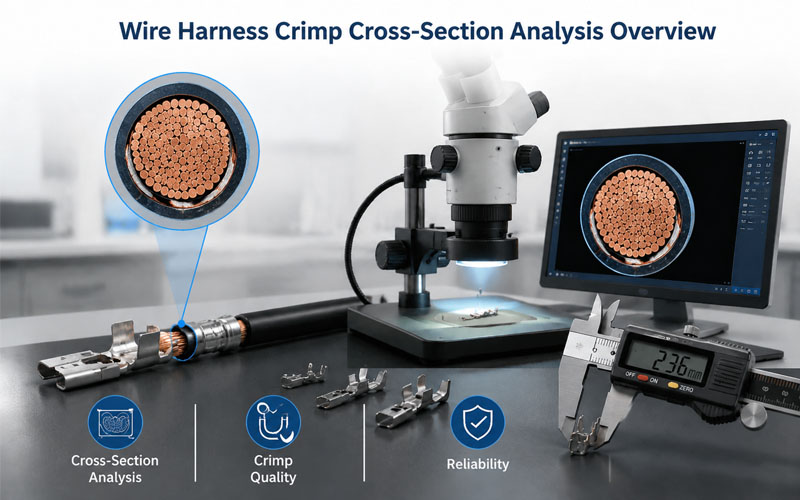
Cross-section analysis is a destructive inspection method used to examine the internal structure of a terminal crimp.
The process typically includes:
- 1.Cutting a crimped terminal sample
- 2.Mounting and polishing the cross-section
- 3.Observing the internal structure under magnification
- 4.Measuring critical crimp parameters
- 5.Comparing results with quality requirements
Unlike visual inspection, which only checks the external appearance, cross-section analysis reveals what happens inside the terminal barrel.
Why Crimp Reliability Matters in Wire Harness Assemblies
A wire harness may contain hundreds or thousands of crimp connections.
Each connection must provide:
- Stable electrical conductivity
- Mechanical strength
- Low contact resistance
- Long-term durability
Poor crimp quality can lead to:
- Intermittent electrical failures
- Increased resistance
- Heat generation
- Signal interruption
- Field reliability issues
In applications such as automotive systems, robotics, industrial automation, and energy storage, a single unreliable crimp can affect overall system performance.
1.Verify Crimp Height and Compression Quality
One of the most important measurements in cross-section analysis is crimp height.
Crimp height determines how much the terminal barrel compresses the conductor.
Incorrect crimp height may cause:
Too High
Possible issues:
- Insufficient compression
- Loose conductor contact
- Increased electrical resistance
Too Low
Possible issues:
- Excessive conductor damage
- Broken wire strands
- Reduced mechanical strength
Cross-section analysis allows engineers to confirm whether the terminal is properly compressed.
2.Evaluate Conductor Placement
The position of the conductor inside the terminal barrel directly affects reliability.
A good crimp should show:
✔ Proper wire insertion depth
✔ Even conductor distribution
✔ Full contact between conductor and terminal
✔ Correct insulation support position
Common defects include:
- Wire not fully inserted
- Uneven conductor placement
- Insulation trapped in conductor area
- Excessive exposed wire length
These issues may not always be visible from the outside.
3.Identify Internal Crimp Defects
Cross-section analysis can reveal hidden problems such as:
Wire Strand Damage
Caused by:
- Incorrect stripping
- Excessive crimp force
- Poor tooling condition
Insufficient Compression
Caused by:
- Incorrect tooling setup
- Wrong terminal-wire combination
- Process variation
Terminal Deformation
Caused by:
- Improper crimp parameters
- Incorrect applicator adjustment
Voids or Gaps
Caused by:
- Poor conductor positioning
- Inconsistent crimping conditions
These defects can increase contact resistance and reduce service life.
4.Optimize Crimp Tooling and Process Parameters
Cross-section analysis is not only a quality inspection method.
It is also a process improvement tool.
Manufacturers use analysis results to optimize:
- Crimp height
- Crimp force
- Applicator settings
- Terminal selection
- Wire compatibility
A typical improvement cycle includes:
- 1.Produce sample crimps
- 2.Perform cross-section analysis
- 3.Adjust tooling parameters
- 4.Validate results
- 5.Release process for production
This helps establish a stable and repeatable crimping process.
5.Cross-Section Analysis vs Other Inspection Methods
Different inspection methods provide different information.
| Method | Detects | Limitations |
|---|---|---|
| Visual Inspection | External appearance, terminal position, damage | Cannot see internal crimp quality |
| Pull Force Test | Mechanical strength | Does not show internal structure |
| Electrical Test | Continuity, resistance, insulation performance | Cannot identify crimp geometry |
| Cross-Section Analysis | Internal compression, conductor placement, crimp structure | Destructive testing |
For high-reliability harnesses, these methods work together.
6.When Should Cross-Section Analysis Be Used?
Cross-section analysis is especially valuable during:
New Product Introduction (NPI)
Used to validate:
- New terminals
- New wires
- New tooling
- New processes
Process Changes
Required when changing:
- Terminal supplier
- Wire specification
- Crimp tooling
- Manufacturing parameters
Mass Production Verification
Used for:
- Periodic quality checks
- Process audits
- Failure investigation
Customer Quality Requirements
Many automotive and industrial customers require documented crimp validation.
How FPIC Uses Crimp Quality Control to Improve Reliability
FPIC applies controlled crimping processes for customized wire harness and cable assembly manufacturing.
Quality practices include:
- Crimp parameter verification
- Terminal and wire compatibility evaluation
- Pull force testing
- Cross-section analysis
- Electrical performance testing
- Production traceability
Through process validation and continuous improvement, FPIC helps customers reduce connection failures and achieve stable performance in demanding applications.
Final Thoughts
A reliable crimp connection cannot be judged only by appearance.
Cross-section analysis provides engineers with a detailed view of the internal crimp structure and helps identify problems before products reach the field.
By combining:
- Proper tooling
- Process control
- Cross-section verification
- Electrical testing
manufacturers can create wire harness assemblies with better reliability and longer service life.
For OEM customers, understanding how a supplier validates crimp quality is an important part of selecting a reliable manufacturing partner.
FAQ
What is cross-section analysis in wire harness manufacturing?
Cross-section analysis is a destructive inspection method that cuts and examines a crimped terminal to verify internal connection quality.
Why is cross-section analysis important for crimp quality?
It reveals hidden defects such as poor compression, incorrect conductor placement, and internal damage that visual inspection cannot detect.
Can pull force testing replace cross-section analysis?
No. Pull force testing measures mechanical strength, while cross-section analysis evaluates the internal structure of the crimp.
How often should manufacturers perform cross-section analysis?
It depends on customer requirements and process control plans. It is commonly used during validation, process changes, audits, and periodic verification.
What industries require strict crimp validation?
Automotive, energy storage, industrial automation, aerospace, and medical applications often require high crimp reliability.
Need Reliable Wire Harness Crimping and Quality Control?
FPIC provides customized wire harness and cable assembly solutions with controlled crimp processes, inspection methods, and electrical testing capabilities.
From engineering validation to mass production, FPIC helps OEM customers achieve reliable and consistent connections.
Contact FPIC today to discuss your wire harness requirements.
Resources
- IPC/WHMA-A-620 – Requirements and Acceptance for Cable and Wire Harness Assemblies
https://www.ipc.org/
Industry standard covering wire harness workmanship, inspection, and acceptance requirements. - IEC 60352 – Solderless Connections – Crimped Connections
https://www.iec.ch/
Provides guidance related to crimp connection performance and testing methods. - USCAR-21 – Performance Specification for Automotive Electrical Connections
Automotive industry reference for evaluating electrical connection performance. - IATF 16949 Automotive Quality Management System
https://www.iatfglobaloversight.org/
Quality management requirements focused on defect prevention and process consistency. - WHMA – Wire Harness Manufacturer’s Association
https://www.whma.org/
Industry resources related to wire harness manufacturing practices.