Top Root Causes of Intermittent Failure in Wire Harness Assemblies
Intermittent failures are among the most difficult problems to diagnose in wire harness assemblies.
Unlike complete failures, intermittent issues may appear randomly—causing equipment shutdowns, unstable signals, unexpected alarms, or temporary loss of communication.
For OEM manufacturers and system integrators, these failures can result in expensive troubleshooting, production downtime, and increased warranty costs.
The challenge is that an intermittent failure is often not caused by a single component. It is usually the result of small mechanical, electrical, or manufacturing variations that accumulate over time.
This article explores the most common root causes of intermittent wire harness failures and explains how manufacturers can prevent them through better design, process control, and testing.
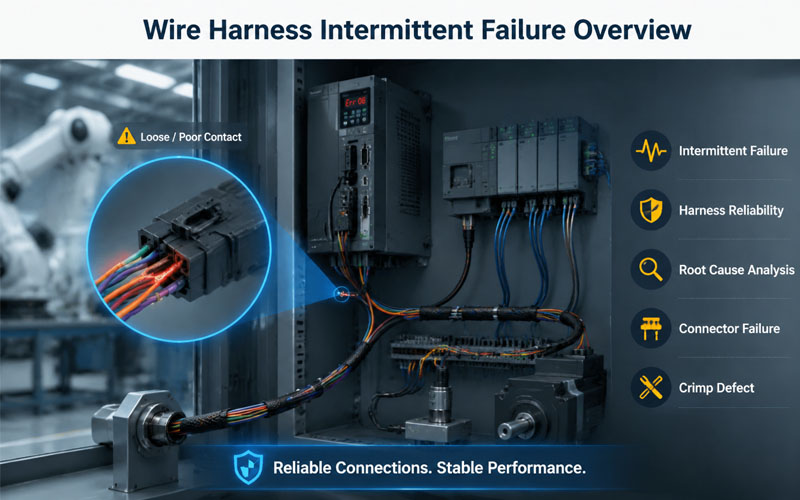
What Is an Intermittent Wire Harness Failure?
An intermittent failure occurs when an electrical connection temporarily loses continuity or performance but appears normal again after movement, vibration, temperature changes, or mechanical stress.
Common symptoms include:
- Random signal loss
- Equipment resets
- Communication interruptions
- Sensor errors
- Temporary power drops
- Unstable system operation
Because the failure may disappear during inspection, identifying the root cause requires a systematic analysis approach.
1.Poor Crimp Quality and Unstable Terminal Connections
Crimping is one of the most critical processes in wire harness manufacturing.
A poor crimp may initially pass electrical testing but develop problems during field operation.
Common crimp-related issues include:
- Insufficient crimp force
- Incorrect crimp height
- Loose wire strands
- Excessive conductor damage
- Improper terminal selection
- Incomplete wire insertion
Over time, vibration and thermal cycling can increase contact resistance and create intermittent electrical connections.
Prevention Methods
Manufacturers should control:
- Crimp height measurement
- Pull-force testing
- Crimp force monitoring
- Terminal-wire compatibility
- Regular tooling calibration
A stable crimp process is the foundation of long-term harness reliability.
2.Connector Mating and Contact Problems
Connectors are designed to provide stable electrical contact, but improper mating or unsuitable connector selection can create failures.
Common connector-related causes include:
- Incomplete terminal insertion
- Damaged contact springs
- Poor locking engagement
- Incorrect mating cycle rating
- Contact contamination
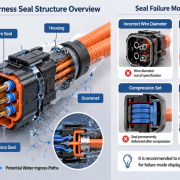
In harsh environments, moisture, dust, and corrosion can further reduce contact reliability.
Prevention Methods
Solutions include:
- Proper connector selection
- Secondary locking mechanisms
- IP-rated protection
- Contact plating optimization
- Mating inspection procedures
3.Vibration and Mechanical Stress
Many wire harnesses operate in environments with continuous movement, including:
- Robotics
- Automotive systems
- Construction equipment
- Industrial machinery
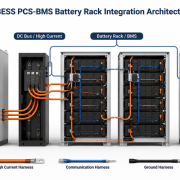
- Energy storage systems
Repeated vibration can cause:
- Terminal fretting
- Wire fatigue
- Connector loosening
- Insulation damage
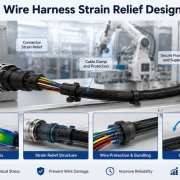
- Strain relief failure
Mechanical stress is especially dangerous because the failure may only occur under operating conditions.
Prevention Methods
Manufacturers should consider:
- Proper cable routing
- Correct bend radius
- Strain relief design
- Vibration-resistant connectors
- Flexible cable selection
4.Incorrect Cable Routing and Bend Radius
A harness may perform correctly during initial testing but fail after installation if routing requirements are ignored.
Excessive bending can cause:
- Conductor fatigue
- Shield damage
- Insulation cracking
- Internal wire breakage
For moving applications, such as robotic arms and drag chains, cable flexibility and bending cycles must be considered during design.
Prevention Methods
Key considerations include:
- Minimum bend radius
- Dynamic flex testing
- Cable support points
- Proper harness fixation
5.Environmental Exposure
Wire harness assemblies often operate in demanding conditions.
Environmental factors include:
- Temperature cycling
- Humidity
- Chemicals
- Dust
- Water exposure
- UV radiation
These conditions can gradually degrade:
- Cable insulation
- Connector seals
- Terminal surfaces
- Shielding performance
Prevention Methods
Manufacturers should evaluate:
- IP protection requirements
- Material compatibility
- Temperature ratings
- Corrosion resistance
- Environmental testing
6.Shielding and Grounding Issues
For applications involving high-speed signals, motors, or industrial communication systems, improper shielding can create intermittent problems.
Typical causes include:
- Poor shield termination
- Incorrect grounding method
- Excessive cable noise exposure
- Damaged shielding layers
Symptoms may include:
- Communication errors
- Signal instability
- Unexpected system alarms
Prevention Methods
Engineers should control:
- Shield termination methods
- Grounding strategy
- Cable separation
- EMC testing requirements
7.Manufacturing Variation and Assembly Errors
Even a well-designed harness can fail if manufacturing processes are inconsistent.
Common assembly issues include:
- Wrong wire length
- Incorrect connector orientation
- Missing seals
- Incorrect labeling
- Poor terminal positioning
These defects may not always appear during initial testing.
Prevention Methods
Manufacturers can improve consistency through:
- Standardized work instructions
- Assembly fixtures
- Barcode verification
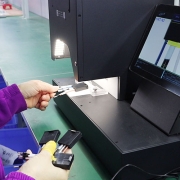
- CCD inspection
- Operator training
- Production traceability
How Manufacturers Prevent Intermittent Failures
Reliable harness manufacturing requires prevention at every stage.
Key quality practices include:
Design Validation
- Application analysis
- Material selection
- Mechanical testing
- Environmental evaluation
Process Control
- Controlled crimping
- Standardized assembly
- Inspection checkpoints
Final Testing
- Continuity testing
- Insulation resistance testing
- Hi-Pot testing
- Functional verification
Preventing intermittent failures requires combining engineering design with disciplined manufacturing processes.
How FPIC Helps Reduce Wire Harness Reliability Risks
FPIC designs and manufactures customized wire harnesses and cable assemblies for industrial automation, energy storage systems, robotics, automotive applications, and other demanding industries.
Through controlled manufacturing processes, precision crimping, automated inspection, and comprehensive electrical testing, FPIC helps customers reduce failure risks and improve long-term field reliability.
From prototype development to mass production, every harness is manufactured with reliability, consistency, and application requirements in mind.
Final Thoughts
Intermittent wire harness failures are difficult because they often appear unpredictable.
However, most failures can be traced back to preventable issues such as poor crimping, connector problems, vibration stress, environmental exposure, or inconsistent manufacturing processes.
A reliable wire harness is not created by testing alone.
It requires:
- Correct design
- Proper material selection
- Controlled manufacturing
- Complete inspection
- Application-specific validation
For OEM customers, choosing a supplier with strong engineering and quality systems is one of the most effective ways to reduce field failures.
FAQ
Why are intermittent wire harness failures difficult to diagnose?
Because the connection may work normally during inspection and only fail under vibration, temperature changes, or operating conditions.
What is the most common cause of wire harness intermittent failure?
Poor crimp quality and unstable terminal connections are among the most common causes.
Can vibration cause wire harness failures?
Yes. Continuous vibration can loosen terminals, damage wires, and create intermittent electrical contact.
How can manufacturers prevent intermittent failures?
Manufacturers can reduce failures through proper design, controlled assembly processes, inspection, and electrical testing.
Does electrical testing detect all harness problems?
Not always. Some mechanical and environmental failures require additional validation, such as vibration testing, flex testing, or environmental testing.
Need Reliable Wire Harness Solutions for Your Application?
FPIC provides custom wire harness and cable assembly solutions for industrial automation, robotics, energy storage, automotive, and other high-reliability applications.
With controlled manufacturing processes, precision assembly, and comprehensive testing capabilities, FPIC helps OEM customers achieve stable performance and reduce field failures.
Contact FPIC today to discuss your wire harness requirements.
Resources
- IPC/WHMA-A-620 – Requirements and Acceptance for Cable and Wire Harness Assemblies
https://www.ipc.org/
Industry standard covering workmanship requirements, inspection criteria, and acceptance guidelines for wire harness assemblies. - WHMA – Wire Harness Manufacturer’s Association
https://www.whma.org/
Provides industry resources and best practices for wire harness manufacturing and quality improvement. - ISO 16750 – Road Vehicles Environmental Conditions and Testing
https://www.iso.org/
Provides environmental testing guidance for electrical and electronic components used in vehicle applications. - IEC 60529 – Degrees of Protection Provided by Enclosures (IP Rating)
https://www.iec.ch/
Defines protection levels against dust and water ingress for electrical equipment. - IATF 16949 Automotive Quality Management System
https://www.iatfglobaloversight.org/
Automotive quality management standard focused on defect prevention and process consistency.