How to Build a Wire Harness Control Plan for Mass Production
Mass production of wire harness requires more than a qualified design and capable manufacturing equipment. As production volume increases, maintaining consistent quality across thousands or millions of assemblies becomes one of the biggest challenges for manufacturers and OEM customers.
A wire harness control plan provides a structured approach to controlling manufacturing processes, identifying potential risks, defining inspection requirements, and ensuring every harness meets the required specifications.
For industries such as automotive, energy storage, industrial automation, robotics, and medical equipment, an effective control plan is essential for reducing defects and improving long-term product reliability.
What Is a Wire Harness Control Plan?
A wire harness control plan is a documented manufacturing quality management tool that defines:
- What processes need to be controlled
- What parameters need to be monitored
- What inspections are required
- Who is responsible for each step
- How defects are handled
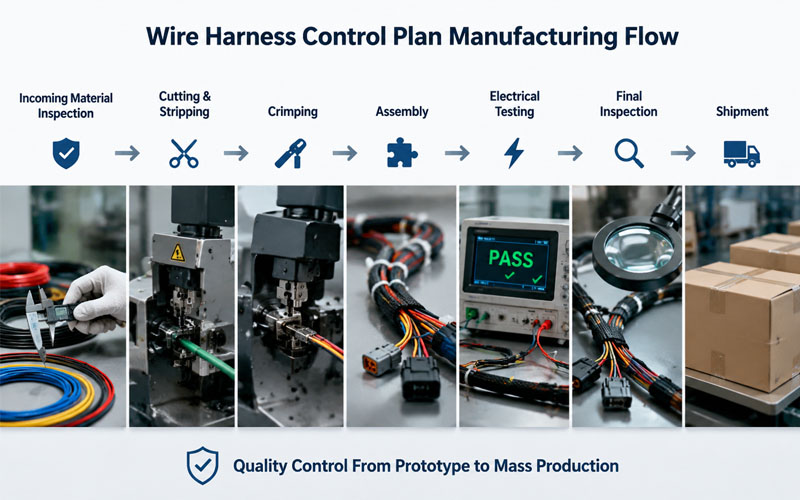
The purpose is to ensure that every production stage is controlled, from incoming materials to final shipment.
A well-designed control plan transforms quality control from a reactive inspection activity into a proactive prevention system.
Why Control Plans Matter in Wire Harness Manufacturing
Wire harnesses contain many components, including:
- Wires
- Terminals
- Connectors
- Seals
- Protective sleeves
- Labels
- Fixing components
Each component and process introduces potential variation.
Without effective process control, manufacturers may experience:
- Incorrect wire preparation
- Poor crimp quality
- Terminal insertion errors
- Wrong connector assembly
- Missing components
- Electrical test failures
- Field reliability issues
A control plan helps prevent these problems before products reach customers.
Step 1: Identify Critical Manufacturing Processes
The first step in building a control plan is identifying every critical process step.
Typical wire harness manufacturing processes include:
Material Inspection
Verify:
- Wire specifications
- Terminal dimensions
- Connector models
- Material certificates
- Incoming quality requirements
Wire Cutting and Stripping
Control:
- Cutting length
- Strip length
- Wire damage prevention
- Equipment calibration
Incorrect stripping can affect crimp quality and electrical performance.
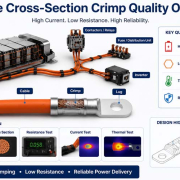
Terminal Crimping
Crimping is one of the most critical wire harness processes.
Control items include:
- Crimp height
- Crimp width
- Pull force
- Terminal positioning
- Wire insertion depth
Manufacturers may use crimp force monitoring and cross-section analysis to verify process stability.
Connector Assembly
Control:
- Terminal insertion position
- Locking confirmation
- Seal installation
- Connector orientation
Incorrect terminal positioning can cause open circuits or intermittent failures.
Final Electrical Testing
Typical tests include:
- Continuity testing
- Insulation resistance testing
- High-voltage testing
- Short circuit detection
- Pin assignment verification
Electrical testing confirms that every harness meets functional requirements before shipment.
Step 2: Define Control Methods and Inspection Frequency
A good control plan clearly defines:
- Inspection method
- Measurement equipment
- Sampling frequency
- Acceptance criteria
- Reaction plan
Example:
| Process | Control Item | Inspection Method |
|---|---|---|
| Crimping | Crimp height | Measuring equipment |
| Terminal insertion | Position accuracy | Visual inspection / CCD |
| Electrical testing | Continuity | Automated tester |
| Labeling | Identification accuracy | Barcode verification |
The level of control should match product risk and application requirements.
Step 3: Use Error-Proofing to Prevent Defects
The best quality systems prevent mistakes before they happen.
Common error-proofing methods include:
- Connector keying
- Barcode scanning
- Digital work instructions
- Assembly fixtures
- Terminal detection systems
- Automated inspection
These methods reduce dependence on manual judgment and improve repeatability.
Step 4: Integrate Traceability Into Production
For OEM projects, traceability is increasingly important.
A complete traceability system can record:
- Material batches
- Production operators
- Equipment information
- Inspection results
- Testing data
- Production time
Traceability helps manufacturers quickly identify root causes and implement corrective actions.
Step 5: Continuously Improve the Control Plan
A control plan should evolve with production experience.
Manufacturers should regularly review:
- Customer feedback
- Quality issues
- Process capability data
- Production trends
- Corrective actions
Continuous improvement helps maintain stable quality during long-term mass production.
How FPIC Builds Quality Control Into Wire Harness Production
FPIC provides customized wire harnesses and cable assemblies for industrial automation, energy storage systems, robotics, automotive applications, and other demanding industries.
Our manufacturing processes include standardized work instructions, controlled crimping processes, automated inspection, electrical testing, and production traceability.
By integrating process control throughout manufacturing, FPIC helps customers achieve consistent quality from prototype development to high-volume production.
Final Thoughts
A wire harness control plan is not simply a quality document—it is a roadmap for reliable mass production.
By controlling critical processes, monitoring key parameters, preventing errors, and maintaining traceability, manufacturers can reduce variation and deliver consistent harness performance.
For OEM buyers, choosing a supplier with a mature control plan means lower quality risks, improved production stability, and greater confidence throughout the product lifecycle.
FAQ
What is a wire harness control plan?
A wire harness control plan is a documented process management tool that defines manufacturing controls, inspections, responsibilities, and quality requirements.
Why is a control plan important for mass production?
It helps maintain consistent quality, reduce manufacturing variation, and prevent defects during high-volume production.
What are the most critical wire harness control points?
Common critical points include wire cutting, stripping, crimping, terminal insertion, connector assembly, and electrical testing.
How does traceability improve wire harness quality?
Traceability allows manufacturers to track materials, processes, and test results, making it easier to identify and correct quality issues.
Is final inspection enough for wire harness quality control?
No. Effective quality systems focus on preventing defects through controlled processes rather than relying only on final inspection.
Looking for a Reliable Wire Harness Manufacturing Partner?
FPIC supports OEM customers with custom wire harness and cable assembly solutions from prototype to mass production. With controlled manufacturing processes, automated inspection, and complete quality management systems, we help customers achieve reliable and consistent harness performance.
Contact FPIC today to discuss your wire harness production requirements.
Resources
- IPC/WHMA-A-620 – Requirements and Acceptance for Cable and Wire Harness Assemblies
https://www.ipc.org/
Industry-recognized standard defining workmanship requirements and acceptance criteria for wire harness assemblies. - AIAG Advanced Product Quality Planning (APQP)
https://www.aiag.org/
Provides structured quality planning methods for manufacturing processes and production readiness. - AIAG Production Part Approval Process (PPAP)
https://www.aiag.org/
Defines requirements for demonstrating manufacturing process capability and production consistency. - ISO 9001 Quality Management Systems
https://www.iso.org/iso-9001-quality-management.html
International framework for process control, continuous improvement, and quality management. - IATF 16949 Automotive Quality Management System
https://www.iatfglobaloversight.org/
Automotive industry quality standard focusing on defect prevention and process control.