Why Wire Harness Change Control Matters in Production
Wire harness change control is the structured process used to evaluate, approve, implement, verify, and trace a product or process change. When a customer drawing moves from Rev.A to Rev.B, the work is not finished when the new PDF is saved. The corresponding BOM, wire list, material status, crimp specifications, work instructions, inspection plan, test program, and production records must reach the same approved configuration at a defined point in time.
That coordination is especially important for custom cable assemblies. Wire type and length, terminals, pin assignments, branch geometry, protection, labeling, workmanship, and electrical performance are interdependent. If one function keeps using obsolete information, the factory can build a mixed configuration that looks correct or even passes a basic continuity test.
Effective engineering change control prevents that gap. It establishes what is changing, why it is changing, which records and physical items are affected, who must approve it, when the new configuration becomes effective, and what evidence is required before production release.
What Engineering Change Control Means for a Wire Harness
Engineering change control manages the transition from one approved product-and-process baseline to another. A baseline is the coordinated set of information authorized for production, not just the drawing revision printed in the title block.
The baseline may include:
- Customer drawing, specifications, wiring diagram, pin map, and approved deviations
- BOM, approved manufacturer part numbers, alternates, and supplier requirements
- Cut list, branch dimensions, terminal specifications, tooling, and crimp parameters
- Work instructions, fixtures, control plan, inspection plan, and acceptance criteria
- Electrical-test limits, fixture and program versions, packaging, and identification
ISO 10007:2017 places change control within configuration management, together with planning, configuration identification, status accounting, and audit. For harness manufacturing, the organization must identify the approved configuration, control changes, record their status, and verify the resulting output.
Revision Control and Change Control Are Related, but Different
Revision control identifies which version of a document or data set is current. Change control governs the decision and transition behind that revision.
A drawing may be correctly labeled Rev.B while the shop floor uses a Rev.A cut list, the warehouse issues an obsolete connector, or the tester runs an old pin map. The change process must connect all affected items and define the cut-in point.
Organizations use ECR, ECO, and ECN differently. An ECR may propose a change, an ECO may authorize it, and an ECN may release or communicate it. What matters is controlled input, impact assessment, approval, effectivity, implementation, and records.
Why Small Harness Changes Can Create Large Production Risks
A harness is an interface product. It must fit the customer’s equipment, mate with other components, carry the specified circuit, survive the application environment, and remain manufacturable. Changing one element can affect several others.
A replacement terminal may fit the housing yet differ in plating, barrel geometry, wire range, rating, retention, seal compatibility, or tooling. A length change can affect routing, breakouts, labels, fixtures, packaging, and installation. A test-program update can alter the circuits or limits used to determine pass/fail.
Common change-control failures include:
- The drawing changes but the BOM or wire list does not
- A substitute part is purchased before technical and customer approval
- New and old material are stored under indistinguishable status
- Work instructions show an outdated pinout or connector orientation
- An applicator, terminal, or wire changes without crimp revalidation
- The assembly is tested with an obsolete program
- First-article approval is completed, but the production order points to an older revision
- Reworked WIP is mixed with units built entirely to the new revision
These are system-interface failures. A robust process makes the correct revision easy to use and blocks obsolete information or materials at the point of use.
What Must Be Included in the Controlled Baseline?
The exact scope depends on the project, but the following matrix helps an OEM and its harness supplier identify affected configuration items before releasing a change.
| Controlled item | Typical change examples | Potential downstream impact |
|---|---|---|
| Drawing and specifications | Length, tolerance, protection, label, note, revision | Measurement method, work instruction, inspection record, fit |
| BOM and approved parts | Terminal, connector, wire, seal, sleeve, supplier | Purchasing, incoming inspection, tooling, reliability, inventory |
| Wire list and pin map | Circuit, color, gauge, cavity, splice | Cutting, assembly sequence, test fixture, test program |
| Process definition | Strip length, crimp setting, soldering, routing | Equipment setup, operator training, process verification |
| Tooling and fixtures | Applicator, locator, assembly fixture, test adapter | Crimp geometry, orientation, dimensional control, test validity |
| Quality plan | Characteristic, limit, method, frequency | FAI scope, inspection forms, gauges, reaction plan |
| Production and test software | Program logic, pin table, test limits, version | False acceptance, false rejection, traceability |
| Packaging and identification | Label data, bag, tray, quantity, marking | Revision identification, handling, shipment acceptance |
The list should cover both documents and physical inventory. A released BOM change has limited value if the previous component remains available for unrestricted issue.
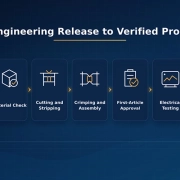
How Wire Harness Change Control Works
A practical process prevents mixed configurations without turning every clerical edit into full requalification.
1. Record and Classify the Request
Record the requester, reason, affected part, current revision, proposal, urgency, and supporting files. Classify the change as customer, design, material, process, test, corrective, or document related, and distinguish permanent changes from temporary deviations.
2. Identify Every Affected Item
Trace the change into documents, parts, programs, fixtures, open orders, inventory, WIP, finished goods, and approvals. Use a “where-used” review when one terminal, wire, drawing, or test module serves multiple harnesses.
3. Assess Technical, Quality, Supply, and Commercial Impact
Assess fit, form, function, safety, compliance, reliability, manufacturing parameters, inspection, supply, and cost. Involve the relevant engineering, quality, purchasing, production, warehouse, planning, commercial, and customer representatives. Approval authority should follow the contract and quality agreement.
4. Define Verification and Approval Requirements
Define the necessary evidence: document review, sample build, dimensions, electrical or functional tests, crimp verification, environmental testing, partial or full FAI, PPAP elements, or customer approval. Address affected risks without automatically repeating unrelated tests.
5. Update and Release Connected Data
Revise and approve all affected master data and instructions. Prevent a Rev.B drawing from being paired with an incompatible BOM or test program, and withdraw or electronically block obsolete versions.
6. Establish Effectivity and Material Disposition
Define when the new configuration applies by date, order, lot, serial number, shipment, or controlled inventory depletion. Address old material, open orders, WIP, finished goods, field stock, and repair stock.
7. Verify the First Changed Output and Close the Change
After training and setup, verify representative output. Close the change only when required actions are complete, exceptions have approved dispositions, and production, inspection, and test records prove the defined cut-in occurred.
What Should Happen When Drawing Rev.B Replaces Rev.A?
Compare the revisions characteristic by characteristic. Do not rely only on revision clouds; confirm dimensions, notes, tolerances, part numbers, pin assignments, materials, referenced specifications, and whether matching BOM and electrical data were released.
Review every controlled item. A branch-length change may affect the cut list, fixture, instruction, inspection line, packaging, and first-article measurement. A pin change requires synchronized wire lists, connector views, instructions, fixture wiring, and test logic.
Then define effectivity. State whether Rev.B applies to a specific customer order, work order, lot, date, or serial number. Identify the final Rev.A quantity and first Rev.B quantity. If both revisions must temporarily coexist, they need separate identification, physical status, records, and customer authorization.
At production, the work order must call the correct drawing and BOM, the operator must access the released instruction, the tester must load the approved program, and the inspection record must identify Rev.B.
How Should Alternate Terminals or Connectors Be Approved?
Do not approve an alternate because it looks similar, mates once, or shares a generic description. Compare complete manufacturer part numbers and application-relevant characteristics.
For a connector or terminal change, review as applicable:
- Mating interface, keying, cavity arrangement, polarization, and retention
- Wire-size and insulation-diameter range
- Terminal and housing compatibility, including secondary locks and seals
- Contact material, plating, temperature rating, and environmental suitability
- Electrical ratings and any application derating requirements
- Compatible applicator, locator, press, and terminal application specification
- Crimp height, conductor position, insulation support, and pull-force criteria
- Regulatory, customer-approved-source, or material-compliance requirements
- Need for fit checks, crimp validation, FAI, functional testing, or customer approval
IEC 60352-2:2024 provides general requirements, test methods, and practical guidance for solderless crimped connections within its defined scope. The applicable terminal manufacturer specification, customer drawing, contract, and product requirements still govern the actual acceptance limits.
A temporary deviation needs an approved quantity or expiry, identification, and final disposition. It must not quietly become a permanent BOM alternate.
When Do Wire-Length and Crimp Changes Require Revalidation?
Not every change requires a complete new qualification, but every technical change requires a documented impact decision.
A wire- or branch-length change normally requires updates to the drawing or cut list, instruction, and dimensional checks. Measure the first changed assembly from specified datums under a defined condition; continuity cannot prove correct routing or reach.
Reconfirm crimp characteristics when the terminal, wire construction, conductor size, insulation range, applicator, locator, press, setup, or process specification changes. Evidence may include visual inspection, crimp height, pull force, or cross-section analysis. These methods provide different evidence and are not automatically interchangeable.
The correct revalidation scope can be:
- Full FAI: appropriate when a major configuration or production transfer affects many characteristics
- Partial FAI: verifies the changed characteristics and linked downstream features
- Process revalidation: focuses on tooling, parameters, capability, or special-process output
- Document-only verification: suitable when an editorial change has no product or process impact
Record the decision and rationale. A contract or quality plan may prescribe a specific response. SAE AS9102C is an aerospace-specific FAI example and does not automatically apply to industrial cable assemblies.
How Should Obsolete Material and Work in Process Be Controlled?
Once a change is approved, inventory status must match engineering status. Old terminals, housings, wire, labels, and partly built harnesses should be identified by part number, manufacturer part number, lot, quantity, location, and production status.
Controls include physical segregation, status labels, barcode or system blocks, and restricted issue locations. Approved disposition may be use before cut-in, use under deviation, rework, return, service stock, or scrap. Record the approver and covered orders or quantities.
WIP needs special attention because its configuration may be difficult to see. A harness cut to Rev.A but terminated after Rev.B release is not automatically Rev.B. Its traveler should show the completed operations and whether rework or reinspection is required.
Why Work Instructions, Test Programs, and Inspection Records Must Change Together
The work instruction tells production how to build the harness. The inspection record tells quality what to verify. The test program decides whether defined electrical results pass. If any one remains obsolete, the released engineering change can be defeated on the factory floor.
Treat test files as controlled configuration items. Record the identifier and revision, restrict editing, validate changes, and associate the program with the applicable harness revision. A wrong program can reject conforming product or accept an incorrect circuit when its expected pin map is also wrong.
Revise inspection forms when the characteristic, tolerance, method, gauge, frequency, or criterion changes. Historical records must retain the revision used at the time.
At release, remove obsolete paper copies, confirm digital access shows approved versions, and complete required training before the new process becomes effective.
How Can a Supplier Prove the Correct Revision Was Produced?
Proof is a connected record chain, not a revision mark viewed alone. For a lot or serial number, the supplier should be able to reconstruct the authorized baseline and required execution evidence.
That chain may include:
- Customer order and approved change authorization
- Effective drawing, BOM, wire list, and deviation status
- Work order or traveler identifying the build revision
- Material part numbers, supplier or manufacturer identity, and relevant lot records
- Released work-instruction and tooling versions
- Test-program identifier and result record
- First-article, in-process, and final-inspection records
- Nonconformance and rework history, where applicable
- Finished-product label, lot, serial number, and shipment record
Traceability depth should reflect requirements and risk. The records must answer what was authorized, what was issued, what was built and tested, and where the product went.
How FPIC Supports Engineering Changes in Custom Harness Projects
FPIC supports custom wire harness production through engineering review, material control, manufacturing, inspection, testing, and repeat-order management. Its OEM/ODM services can coordinate drawing and BOM review, sample development, production preparation, and change communication according to the project requirements.
FPIC’s documented quality-assurance framework includes incoming, in-process, first-article, final, and outgoing inspection; controlled work instructions; electrical and dimensional testing; terminal pull-force testing; quality records; and batch traceability. The company’s quality page also identifies PLM for engineering changes, BOM structure, and version control; ERP for orders and materials; MES for shop-floor work instructions and production tracking; and WMS for material and barcode-controlled inventory.
Digital systems support control but do not replace engineering judgment. Each change still needs defined scope, effectivity, approvals, validation, stock disposition, and required records.
Customers can also review FPIC’s manufacturing capabilities and traceability approach when defining how a changed configuration will move from engineering release into repeat production.
What OEM Buyers Should Define with Their Harness Supplier
Before production begins, the customer and supplier should agree on:
- Which drawing, BOM, software, and specification files form the approved baseline
- Which party can approve design, material, supplier, process, and test changes
- How ECNs, revised files, and acknowledgments will be transmitted
- Whether substitutions require written approval before purchase or use
- What triggers a partial FAI, full FAI, PPAP update, or other validation
- How effectivity will be identified by order, lot, serial number, or date
- How old material, open orders, WIP, finished goods, and service stock will be handled
- What revision and traceability information must appear in inspection and shipment records
- How temporary deviations expire and how emergency changes are later formalized
- How long change, inspection, test, and traceability records must be retained
Procurement should not evaluate an alternate on price and lead time alone. Engineering and quality impact determine whether it reduces risk or shifts cost into validation, rework, service, or disruption.
Conclusion
Engineering change control protects the connection between product intent and factory execution. It ensures that a new drawing revision reaches the BOM, materials, tooling, instructions, inspection plan, test program, work order, and traceability records at the same controlled cut-in point.
The best process is neither a paperwork exercise nor a blanket requirement to requalify everything. It is a risk-based method that identifies affected characteristics, obtains the right approvals, controls old and new configurations, verifies the first changed output, and preserves evidence for the production lot.
If your project involves a new custom cable assembly, component substitution, drawing revision, production transfer, or repeat-order update, send FPIC your technical package. Include the current and proposed drawings, BOM, pin definition, change summary, quantities, application requirements, validation expectations, and target effectivity. FPIC can review the manufacturing and quality-control scope with your team.
Email: info@sz-fpi.com
Frequently Asked Questions
What is an ECN in wire harness production?
An engineering change notice communicates or releases an approved change. Terminology varies, but the record should identify affected parts and documents, approval, effectivity, validation, and material disposition—not serve only as a revision announcement.
Does every drawing revision require a new first article inspection?
No. A major dimensional, material, circuit, tooling, or process change may require full FAI; a limited change may need partial FAI; and an editorial correction may require document verification only. Customer or regulatory requirements can override this risk-based approach.
Can a connector or terminal be substituted if it fits?
Fit alone is insufficient. Approval may consider the complete part number, mating and retention, wire range, plating, ratings, environment, seals, housing, application tooling, crimp requirements, compliance, tests, and customer authorization.
Can electrical testing confirm that the correct revision was built?
Only partly. An approved program verifies defined electrical requirements but not every material, dimension, label, protection feature, crimp characteristic, or document status. Revision assurance also needs configuration, material, process, inspection, and traceability evidence.
How should old materials be handled after an engineering change?
Identify and segregate old materials, block unintended issue, and document disposition: controlled use, deviation, rework, return, service stock, or scrap. WIP and finished goods need the same review.
What records prove that production used the correct revision?
Useful evidence includes the approved change, effective drawing and BOM, work order, material and lot records, work-instruction and tooling versions, test-program version and results, inspection or FAI records, deviation and rework history, finished-product identification, and shipment traceability.
Resources
- ISO/TC 176/SC 2 – ISO 10007:2017 Configuration Management
The official ISO committee page describes configuration management planning, configuration identification, change control, status accounting, and configuration audit. - IPC – IPC/WHMA-A-620F Standard
IPC’s current cable and wire harness assembly standard addresses materials, methods, tests, and acceptance criteria. It applies when required by the contract, drawing, or quality plan. - IEC – IEC 60352-2:2024 Solderless Crimped Connections
The IEC publication provides general requirements, test methods, and practical guidance for solderless crimped connections within its defined conductor and product scope. - SAE International – AS9102C First Article Inspection Requirements
SAE identifies AS9102C as an aerospace standard for performing and documenting first article inspection; its application depends on sector and contractual requirements. - FPIC – Wire Harness Quality Assurance and Testing
FPIC’s quality page documents process control, inspection and testing capabilities, engineering-data systems, quality records, and batch traceability.