High-Voltage Wire Harness Validation: HiPot, IR and Continuity Test Strategy
As electric vehicles (EVs), battery energy storage systems (ESS), and industrial electrification continue to expand, high-voltage wire harness reliability has become a critical safety requirement.
Unlike low-voltage systems, high-voltage harnesses must withstand hundreds or even thousands of volts while maintaining insulation integrity over many years of operation.
A robust validation strategy typically centers on three core electrical tests:
- Continuity Test
- Insulation Resistance (IR) Test
- High Potential (HiPot) Test
Each test evaluates a different aspect of harness performance. Together, they provide a layered verification approach that helps identify assembly defects, insulation weaknesses, and latent safety risks.
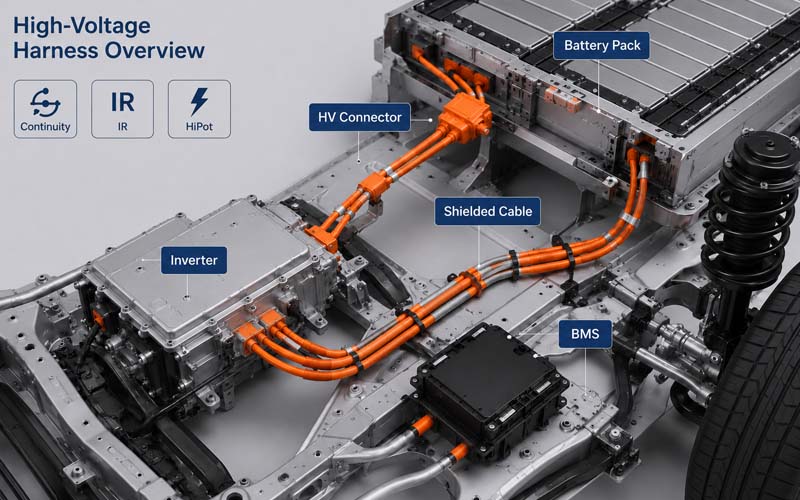
Why High-Voltage Harness Validation Is Essential
High-voltage harness failures can lead to:
- electrical leakage
- system shutdown
- insulation breakdown
- safety hazards
- regulatory non-compliance
Potential root causes include:
- damaged insulation
- incorrect terminal assembly
- contamination
- insufficient creepage and clearance
- manufacturing defects
Because many defects are not visible, electrical validation is mandatory before shipment and often repeated during product qualification.
Overview of the Three Core Test Methods
| Test Method | Primary Purpose | Typical Faults Detected |
|---|---|---|
| Continuity Test | Verify correct circuit connection | Open circuits, miswiring |
| Insulation Resistance Test | Measure leakage resistance | Contamination, insulation degradation |
| HiPot Test | Verify dielectric withstand capability | Weak insulation, breakdown risk |
These methods are complementary rather than interchangeable.
1.Continuity Test
Purpose
Continuity testing verifies that each conductor is connected correctly from end to end.
It confirms:
- correct pin-to-pin mapping
- low electrical resistance
- absence of open circuits
- no wiring swaps
What It Detects
Typical faults include:
- broken conductors
- missing crimps
- incorrect terminal insertion
- wiring errors
Limitations
Continuity testing does not evaluate insulation performance. A harness may pass continuity while still having dangerous leakage or insulation weaknesses.
2.Insulation Resistance (IR) Test
Purpose
IR testing measures resistance between conductors and between conductors and shield or ground.
The test detects unwanted leakage paths.
Typical Test Conditions
DC test voltage (commonly 500 V to 1,500 V)
Measurement in megaohms (MΩ) or gigaohms (GΩ)
What It Detects
- moisture contamination
- conductive debris
- damaged insulation
- partial dielectric degradation
Interpretation
Higher insulation resistance indicates better isolation.
However, IR testing is performed at a relatively moderate voltage and may not reveal weak spots that only fail under higher stress.
3.High Potential (HiPot) Test
Purpose
HiPot testing applies a significantly higher voltage than normal operating voltage to verify dielectric strength.
This test evaluates whether the insulation can withstand abnormal electrical stress without breakdown.
Typical Test Parameters
- AC or DC high voltage
- Controlled ramp-up and dwell time
- Leakage current monitoring
What It Detects
- pinholes in insulation
- insufficient spacing
- material defects
- manufacturing damage
Why HiPot Is Critical
A harness may show excellent IR values but still fail HiPot if localized weak points exist.
HiPot provides the highest confidence in insulation robustness.
Relationship Between Continuity, IR and HiPot
These tests form a hierarchical validation strategy.
Continuity
Confirms the circuit is connected correctly.
Insulation Resistance
Confirms leakage is acceptably low.
HiPot
Confirms insulation survives high-voltage stress.
Passing all three tests provides comprehensive assurance of electrical integrity.
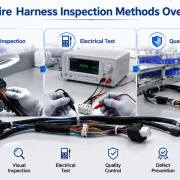
Typical Validation Workflow
A common production and qualification sequence is:
1.Visual inspection
2.Continuity test
3.Insulation resistance test
4.HiPot test
5.Final inspection and documentation
This sequence moves from basic functionality to increasingly stringent electrical stress testing.
Key Factors Affecting Test Results
Several design and manufacturing factors influence performance:
- insulation material quality
- creepage and clearance distances
- connector sealing
- shielding termination
- contamination control
- crimp quality
Even minor process variation can affect high-voltage test outcomes.
Designing for Successful Validation
To improve pass rates and long-term reliability:
Maintain Adequate Creepage and Clearance
Ensure spacing meets system voltage and pollution degree requirements.
Control Manufacturing Cleanliness
Remove conductive particles, moisture, and residue.
Protect Insulation During Assembly
Avoid cuts, compression damage, or abrasion.
Validate Under Real Conditions
Perform testing after thermal cycling, vibration, and humidity exposure.
Common Testing Mistakes
Relying Only on Continuity Testing
This confirms wiring but not insulation safety.
Using IR Without HiPot
Moderate voltage may miss localized dielectric weaknesses.
Ignoring Environmental Effects
Moisture and aging can significantly reduce insulation performance.
Inadequate Test Parameter Definition
Improper voltage, dwell time, or leakage thresholds may produce misleading results.
Industry Standards and References
Common validation standards include:
- ISO 6469
- LV216
- USCAR
- IEC 60664
- IEC 60512
OEM-specific requirements may define detailed acceptance criteria.
How FPIC Supports High-Voltage Harness Validation
FPIC supports EV, ESS, and industrial customers with:
- high-voltage harness design optimization
- controlled assembly processes
- 100% continuity, IR, and HiPot testing
- validation support aligned with customer specifications
- traceable quality documentation
By integrating design, manufacturing, and testing, we help reduce field failure risk and accelerate product qualification.
Final Thoughts
High-voltage wire harness validation requires more than a single electrical test.
Continuity, insulation resistance, and HiPot each address different aspects of electrical integrity.
Together, they form a comprehensive strategy to verify:
- correct wiring
- insulation quality
- dielectric withstand capability
For safety-critical EV and ESS applications, this layered approach is essential for both compliance and long-term reliability.
FAQ
What is the difference between IR and HiPot testing?
IR measures leakage resistance at moderate voltage, while HiPot applies higher stress to verify dielectric withstand capability.
Can a harness pass IR but fail HiPot?
Yes. Localized insulation defects may only appear under higher voltage.
Is continuity testing sufficient for high-voltage harnesses?
No. Continuity confirms wiring correctness but does not evaluate insulation integrity.
Why is HiPot testing important in EV systems?
Because it verifies that insulation can withstand abnormal voltage conditions safely.
Are all three tests necessary?
For most high-voltage applications, yes. Each test covers different failure modes.
Validate Your High-Voltage Harness with Confidence
Reliable EV and ESS systems require robust electrical validation.
FPIC provides custom high-voltage wire harness assemblies with 100% continuity, IR, and HiPot testing to support safety-critical applications.