What Makes an ESS Harness Different from a Standard Industrial Harness
At first glance, an Energy Storage System (ESS) wire harness may look similar to a conventional industrial cable assembly. Both use conductors, terminals, connectors, insulation, and protective coverings to transmit power and signals.
However, beneath these similarities lie significant engineering differences.
Unlike standard industrial equipment, ESS harnesses must safely deliver high continuous current, maintain stable communication between battery management systems, withstand demanding thermal conditions, and operate reliably for more than a decade with minimal maintenance.
Designing an ESS harness therefore requires a completely different engineering approach.
This article explains the key differences between ESS wire harnesses and conventional industrial harnesses, helping engineers select the right cable assembly for modern battery energy storage applications.
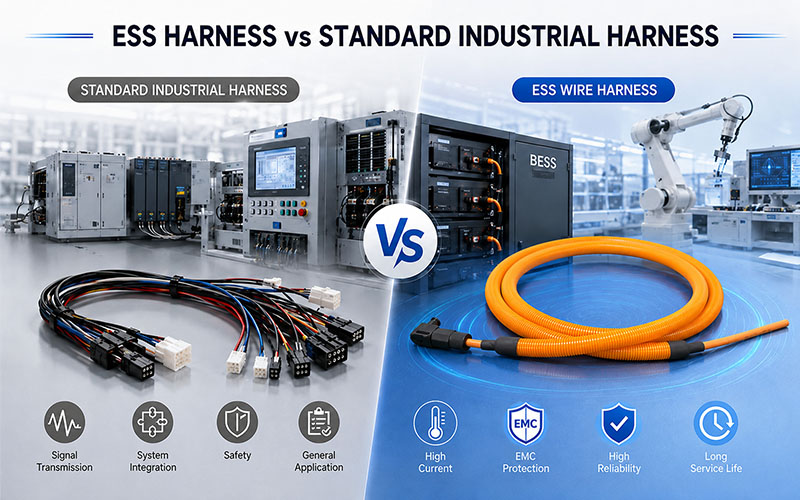
Different Applications Create Different Design Priorities
Traditional industrial wire harnesses are commonly used in:
- Industrial automation
- Packaging machinery
- Robotics
- CNC equipment
- Sensors and control cabinets
Most operate with moderate current and relatively predictable duty cycles.
ESS harnesses are designed for applications such as:
- Battery Energy Storage Systems (BESS)
- Containerized ESS
- Commercial energy storage
- Utility-scale battery storage
- Renewable energy integration
These systems continuously charge and discharge large amounts of electrical energy, placing much higher demands on cable assemblies.
Higher Continuous Current Requirements
One of the biggest differences is current carrying capacity.
Industrial harnesses often transmit:
- control signals
- sensor power
- low-current motor power
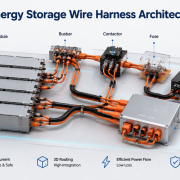
ESS harnesses routinely carry:
- hundreds of amperes
- continuous charge current
- continuous discharge current
- surge current during peak demand
High current increases:
- conductor heating
- contact resistance sensitivity
- voltage drop
- mechanical stress
Cable sizing therefore becomes much more critical.
Temperature Rise Becomes a Primary Design Concern
In many industrial applications, temperature is only one design parameter.
In ESS systems, temperature rise directly affects:
- battery efficiency
- connector lifespan
- insulation aging
- overall system safety
Engineers must evaluate:
- cable spacing
- airflow
- ambient temperature
- current derating
- enclosure ventilation
Thermal management is integrated into the harness design rather than treated as a secondary consideration.
More Complex Signal Integration
An industrial machine may contain a limited number of control signals.
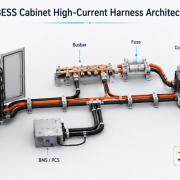
An ESS harness often integrates:
- CAN Bus communication
- Ethernet communication
- voltage sensing
- temperature sensing
- balancing signals
- auxiliary power
- grounding conductors
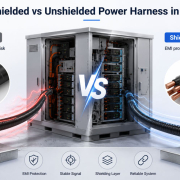
Signal integrity becomes increasingly important as battery capacity increases.
Noise suppression, shielding, and cable separation are essential.
Safety Requirements Are Much Higher
Energy storage systems contain significant stored electrical energy.
Harness failures can potentially lead to:
- overheating
- equipment shutdown
- battery damage
- arc faults
- fire hazards
For this reason, ESS harnesses are designed with additional safety considerations such as:
- insulation coordination
- creepage and clearance distances
- flame-retardant materials
- secure locking connectors
- high dielectric strength
- protective cable routing
Safety is considered throughout the entire design process.
Longer Expected Service Life
Industrial equipment is often upgraded or replaced every few years.
Many utility-scale energy storage projects are designed for:
- 10 years
- 15 years
- even 20 years of operation
The wire harness must therefore resist:
- thermal aging
- vibration
- oxidation
- UV exposure (outdoor systems)
- moisture
- repeated maintenance cycles
Long-term reliability is a key purchasing consideration.
Modular Design for Easier Maintenance
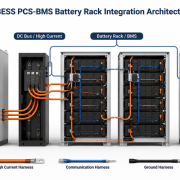
Large BESS installations contain multiple battery racks and numerous cable assemblies.
Modern ESS harnesses are typically designed with:
- modular sub-harnesses
- standardized connectors
- clear identification labels
- simplified replacement procedures
Reducing maintenance time directly improves system availability.
Validation Is More Comprehensive
Compared with conventional industrial harnesses, ESS products generally require more extensive validation.
Typical testing includes:
- Continuity testing
- Insulation resistance
- Hi-Pot testing
- Temperature rise testing
- Current cycling
- Thermal cycling
- Vibration testing
- Salt spray testing
- Pull force testing
- EMC verification
Testing the complete assembly under realistic operating conditions provides greater confidence in long-term performance.
Typical Comparison
| Design Factor | Standard Industrial Harness | ESS Wire Harness |
|---|---|---|
| Current Level | Low to Medium | High Continuous Current |
| Duty Cycle | Intermittent | Continuous Charge & Discharge |
| Thermal Design | Standard | Critical |
| Signal Integration | Basic Control | Power + Communication + Sensing |
| EMC Requirements | Moderate | High |
| Expected Service Life | 5–10 Years | 10–20 Years |
| Maintenance | Periodic | Modular & Serviceable |
| Safety Requirements | Standard Industrial | Enhanced Energy Storage Safety |
How FPIC Supports ESS Wire Harness Development
Energy storage systems require cable assemblies that combine high-current capability, reliable signal transmission, mechanical durability, and long-term environmental resistance.
FPIC develops custom ESS wire harnesses for battery racks, PCS, BMS, DC distribution systems, and containerized energy storage projects. Our engineering team works closely with customers to optimize conductor sizing, connector selection, routing, thermal management, and production validation, delivering reliable cable assemblies for demanding energy storage applications.
Final Thoughts
Although ESS wire harnesses may appear similar to conventional industrial cable assemblies, their design requirements are fundamentally different.
High continuous current, thermal management, communication integrity, safety, and long-term reliability all require specialized engineering.
As battery energy storage systems continue to expand worldwide, selecting a purpose-built ESS wire harness is essential for improving system efficiency, reducing maintenance, and ensuring safe operation throughout the equipment’s lifecycle.
FAQ
Why can’t standard industrial wire harnesses be used directly in ESS applications?
Standard industrial harnesses are generally not designed for the high continuous currents, thermal demands, and long service life required in battery energy storage systems.
What is the biggest difference between an ESS harness and an industrial harness?
The most significant differences are high-current capability, thermal management, enhanced safety requirements, and integrated communication wiring.
Why is thermal management so important in ESS harnesses?
High continuous current generates heat, and excessive temperature can reduce efficiency, accelerate insulation aging, and shorten connector life.
What communication signals are commonly included in ESS harnesses?
Typical ESS harnesses carry CAN Bus, Ethernet, voltage sensing, temperature sensing, grounding, and auxiliary power in addition to high-current power cables.
How long is an ESS wire harness expected to last?
Depending on the application, many ESS wire harnesses are designed for service lives of 10–20 years with proper installation and maintenance.
Looking for Custom ESS Wire Harness Solutions?
Energy storage systems require more than standard industrial wiring. FPIC provides custom ESS wire harnesses engineered for battery racks, BMS, PCS, and high-current power distribution, helping customers improve reliability, simplify installation, and support long-term system performance.
Contact FPIC today to discuss your energy storage wire harness project.
Resources
- IEC 62933 – Electrical Energy Storage (EES) Systems
https://webstore.iec.ch/
Provides international standards covering the safety, performance, and integration of electrical energy storage systems. - UL 9540 – Energy Storage Systems and Equipment
https://www.ul.com/
Defines safety requirements for integrated battery energy storage systems and associated electrical equipment. - UL 1973 – Batteries for Stationary Applications
https://www.ul.com/
Specifies safety requirements for stationary battery systems and their electrical interconnections. - TE Connectivity – Energy Storage Connectivity Solutions
https://www.te.com/
Provides technical information on high-current connectors and cable assemblies for ESS applications. - Phoenix Contact – Connection Technology for Battery Energy Storage Systems
https://www.phoenixcontact.com/
Discusses connection technologies, power distribution, and communication interfaces used in modern battery energy storage systems.