Shielded Power Harnesses in Energy Storage Systems: When Are They Necessary
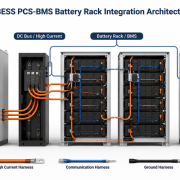
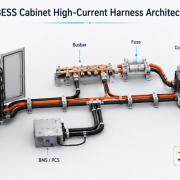
As Battery Energy Storage Systems (BESS) become more powerful and integrated, engineers are paying increasing attention to electromagnetic compatibility (EMC). High-current battery cables, power conversion systems (PCS), battery management systems (BMS), and communication networks operate within the same cabinet, making electromagnetic interference (EMI) a critical design challenge.
One common question during system design is:
Should the power harness be shielded?
The answer depends on the application. While shielding can significantly improve EMC performance in certain environments, it also increases cost, weight, and assembly complexity. Understanding when shielding is necessary—and when it is not—is essential for optimizing both performance and cost.
This article explains the role of shielded power harnesses in energy storage systems and provides practical guidance for selecting the appropriate solution.
What Is a Shielded Power Harness?
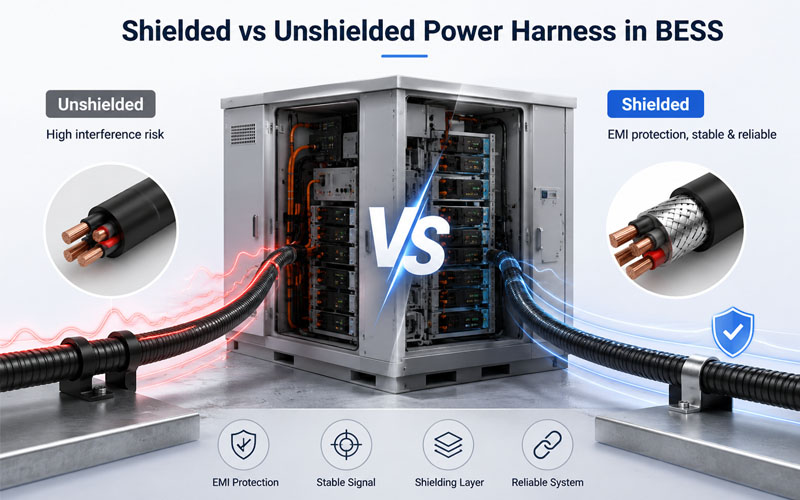
A shielded power harness is a cable assembly that incorporates a conductive shield surrounding one or more conductors.
Common shielding materials include:
- Tinned copper braid
- Aluminum foil
- Foil and braid combination
- Conductive tape
- Metal conduit (for specialized applications)
The shield helps control electromagnetic emissions and reduces the influence of external electrical noise.
Unlike insulation, which prevents electrical contact, the shield primarily manages electromagnetic energy.
Why EMI Is a Concern in Energy Storage Systems
Modern BESS cabinets contain multiple sources of electromagnetic interference.
Typical noise sources include:
- PCS inverters
- DC/DC converters
- High-frequency switching devices
- Contactors
- High-current DC cables
Sensitive circuits located nearby include:
- CAN Bus communication
- Ethernet
- Battery voltage sensing
- Temperature sensors
- Current sensors
- Control modules
Without proper EMC design, EMI may lead to:
- Communication errors
- Unstable sensor readings
- False alarms
- System resets
- Reduced reliability
When Is Shielding Necessary?
Shielded power harnesses are generally recommended under the following conditions.
High-Power PCS Installations
Power conversion systems switch large currents at high frequencies.
When power cables are routed close to communication wiring, shielding can reduce radiated emissions and improve signal stability.
Mixed Power and Signal Routing
In compact BESS cabinets, physical space is often limited.
If adequate separation between power and signal cables cannot be maintained, shielding provides an additional layer of EMC protection.
Long Cable Runs
Longer conductors act as larger antennas, increasing both emitted and received electromagnetic noise.
Shielded cables help reduce interference over extended distances.
High EMC Requirements
Some customers require compliance with stringent EMC standards or utility specifications.
In these applications, shielded harnesses may be necessary to satisfy conducted and radiated emission limits.
When Shielding May Not Be Required
Not every energy storage system requires shielded power cables.
Shielding may be unnecessary when:
- Power and signal wiring are well separated.
- Cable routing minimizes coupling.
- Switching frequencies are relatively low.
- EMC testing confirms acceptable performance.
- Cabinet layout provides sufficient isolation.
Using shielded cables where they are not needed can increase project cost without providing measurable benefits.
Shielding Alone Does Not Solve EMC Problems
One common misconception is that simply adding shielding eliminates electromagnetic interference.
In reality, shielding is only one part of an effective EMC strategy.
Successful EMC design also depends on:
- Proper cable routing
- Good grounding practices
- Shield termination quality
- Connector design
- Equipment layout
- Busbar placement
A poorly grounded shield may provide little protection—or even introduce additional interference.
Proper Shield Grounding
The effectiveness of shielding depends largely on how it is terminated.
Engineers should consider:
- 360° shield termination
- Low-impedance grounding paths
- Ground continuity
- Connector shielding performance
- Ground loop prevention
Incomplete or improperly terminated shields significantly reduce EMC effectiveness.
Connector Selection for Shielded Harnesses
Shielded cables require compatible connector systems.
Important connector features include:
- Metal shells
- Shield continuity
- Reliable grounding contacts
- High mating durability
- Environmental sealing (IP67/IP68 where required)
Connector selection should support both electrical performance and environmental protection.
Testing EMC Performance
Before production, shielded harnesses should be validated through EMC testing.
Typical evaluations include:
- Radiated emissions
- Conducted emissions
- Radiated immunity
- Conducted immunity
- Signal integrity verification
- Shield continuity testing
Testing complete cable assemblies under realistic operating conditions provides the most meaningful results.
Industry Standards
EMC design for energy storage systems commonly references:
- IEC 61000 Series — Electromagnetic Compatibility
- IEC 62933 — Electrical Energy Storage Systems
- UL 9540 — Energy Storage Systems and Equipment
- CISPR 11 — Industrial, Scientific and Medical Equipment
- CISPR 32 — Electromagnetic Emission Requirements
Project-specific customer requirements may impose additional EMC validation procedures.
How FPIC Supports Shielded Cable Assembly Projects
As energy storage systems become more integrated, EMC performance is increasingly important. FPIC develops custom shielded wire harnesses and cable assemblies for battery energy storage systems, supporting high-current power transmission while maintaining reliable communication between BMS, PCS, and auxiliary control systems.
Our engineering team assists customers with shield selection, grounding design, connector integration, cable routing optimization, and production validation to improve long-term system reliability and EMC performance.
Final Thoughts
Shielded power harnesses are not required in every energy storage application, but they become essential when electromagnetic interference threatens communication stability, sensing accuracy, or regulatory compliance.
Rather than treating shielding as a universal solution, engineers should evaluate the complete electrical architecture, cable routing, grounding strategy, and EMC requirements before selecting a cable assembly.
A well-designed shielded harness improves system reliability while avoiding unnecessary cost and complexity.
FAQ
What is the purpose of a shielded power harness?
A shielded power harness reduces electromagnetic interference by limiting radiated emissions and protecting nearby communication and sensing circuits.
Do all BESS power cables need shielding?
No. Shielding is typically recommended only when EMC requirements, cable routing, or high-frequency switching make interference likely.
Is shielding alone enough to solve EMC problems?
No. Effective EMC performance also depends on grounding, cable routing, connector design, and overall system layout.
How should a cable shield be grounded?
For best performance, shields should provide continuous, low-impedance grounding with proper 360° termination where applicable.
Which EMC tests are commonly performed?
Typical tests include radiated emissions, conducted emissions, immunity testing, shield continuity, and signal integrity verification.
Looking for Custom Shielded Wire Harness Solutions for Energy Storage?
Whether your project requires shielded or unshielded cable assemblies, FPIC provides custom wire harness solutions engineered for battery energy storage systems, PCS, BMS, and high-current power distribution. Our engineering team helps optimize EMC performance, reliability, and manufacturability for demanding ESS applications.
Contact FPIC today to discuss your custom energy storage wire harness requirements.
Resources
- IEC 61000 Series – Electromagnetic Compatibility (EMC)
https://webstore.iec.ch/
Provides international standards covering electromagnetic emission and immunity requirements for electrical and electronic equipment. - IEC 62933 – Electrical Energy Storage (EES) Systems
https://webstore.iec.ch/
Defines safety, performance, and integration requirements for electrical energy storage systems. - UL 9540 – Energy Storage Systems and Equipment
https://www.ul.com/
Specifies safety requirements for integrated battery energy storage systems and associated electrical equipment. - TE Connectivity – EMC Shielding and Connectivity Solutions
https://www.te.com/
Explains shielding technologies, connector grounding, and EMC solutions for industrial and energy storage applications. - Phoenix Contact – EMC Protection for Industrial and Energy Systems
https://www.phoenixcontact.com/
Provides technical guidance on cable shielding, grounding concepts, and EMC optimization for electrical installations.